
Made in Italy, from sofas to lamps, chemistry at the origin of design
An exhibition at the Adi Design Museum in Milan and at Palazzo Piacentini in Rome, organised by Federchimica and Adi tells the story of the link between the two sectors. Buzzella: "Chemistry is the enabling factor, the technical tool without which the idea would remain confined to paper"

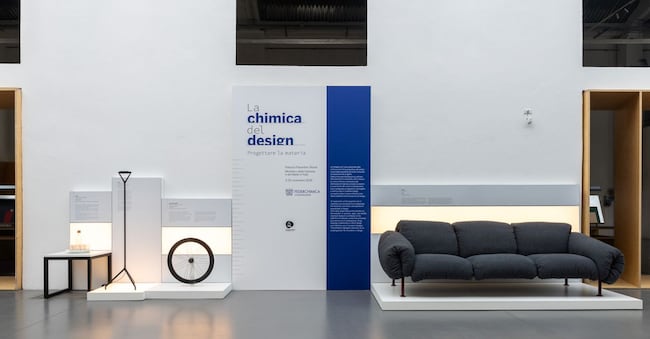
The Za:za sofa by Zanotta. The Bora Ultra WTO wheel by Campagnolo. The Lola lamp by Luceplan. The Sete glass set by Pandora design. These are objects that, in addition to having entered the design Olympus with the awards, in various capacities, of the Compasso d'Oro, have in common a genesis that begins long before the idea and the sketch. The starting point is where few think it is, matter. And therefore chemistry. From the first experiments on polymers to the evolution of ceramics, glass and textiles, chemical research contributes almost 100% to the definition of materials, production processes and new forms of contemporary living. Bringing the dialogue between chemistry and design to the fore is an exhibition entitled 'The Chemistry of Design. Designing matter', organised by Federchimica and Adi design museum in Milan. The capsule, which includes Za:za, Bora Ultra WTO, Lola and Sete, will be open until 25 May at the museum's premises in Piazza Compasso d'Oro in Milan, but it will be in November, at Palazzo Piacentini in Rome, from 3 to 20, that the actual exhibition will be hosted: the companies' desire to bring it to the Mimit headquarters sounds like a call for action to politics in favour of chemistry, which, recalls Federchimica president Francesco Buzzella, "is the industry of industries, it is a silent engine that constantly works behind the scenes of all production chains, given its essential and pervasive role: it is present in 95% of the manufactured goods we use every single day. It is essential to remember that beneath the elegant lines and efficiency of everyday objects beats the heart of Italy's fifth-largest industry and the third-largest producer in Europe, with a turnover of €65 billion by 2025 and a human capital of over 113,000 highly qualified employees'.
The itinerary to be presented at Palazzo Piacentini includes 50 design works, divided into four sections: generate, enhance, regenerate and rethink. It is made up of a selection of objects from the Historical Collection of the Compasso d'Oro and the ADI Design Index, alongside design experiences that explore the relationship between design and research into materials and processes. From furniture to lighting, from domestic utensils to sports equipment, and even building materials, the exhibition brings together objects in which chemistry plays a decisive role, demonstrating how it is a transversal language that unites apparently distant design fields. The aim of the exhibition "is to invite the public to look at the chemical industry from an unprecedented perspective," continues Buzzella. "If design represents the vision, the creative spark and the design ability to imagine the objects of our living, chemical research, by innovating, identifies the best solutions to meet the designer's needs. Chemistry is the enabling factor, the technical tool without which the idea would remain confined to paper'.
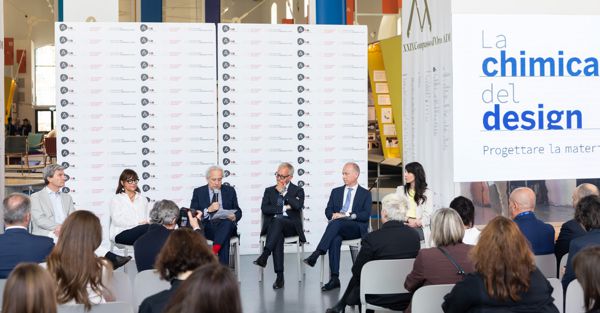
The presentation of the project in Milan was attended, among others, by the President of the ADI Foundation, Umberto Cabini, the President of ADI, Luciano Galimberti, Ottavia Bettucci, science and chemistry populariser, Marinella Ferrara, Professor at the Milan Polytechnic and advisor of the exhibition, and Andrea Rovatti, designer and artistic director of the project. Galimberti explained that the aim of the exhibition is also 'to make evident what often remains hidden: the fundamental role of chemistry as the enzymatic infrastructure of design. This exhibition tells how the transformation of matter is not just a technical support, but a generative component of contemporary design, capable of orienting its forms, functions and meanings". Designer Andrea Rovatti adds that the modular layout is designed to be adaptable to heterogeneous spaces and in view of the itinerant nature of the exhibition: "Since rigour does not mean rigidity, I thought of a light and elastic display system. The modules, independent but continuous, move in the three dimensions, adapting to the objects on display. A design approach that is therefore rigorous but fluid. It is precisely this movement in space that defines the innovation and coherence of the project" that tells the story of the link between chemistry and design. From the first experiments on polymers to the evolution of ceramics, glass and textiles, chemical research contributes to the definition of materials, production processes and new forms of contemporary living, to the point of configuring a relationship in which design and chemistry are in constant dialogue. The association between chemistry and design is perhaps not so obvious in the collective imagination, but if we analyse any design project, the first issue that is addressed is precisely the material. And therefore the chemistry that goes into making it.

