The feature article

Madonie: from co-working to digital nomads – a new model for inland areas

From a grassroots initiative to the first Nomad Residency: a project from Castelbuono that seeks to transform remote working, hospitality and community into a sustainable driver of development

5' min read

Translated by AI
Versione italiana

5' min read

Translated by AI
Versione italiana

The first result came almost unexpectedly, in the course of casual conversation. During the three days of the Madonie Nomad Residency, at least a couple of entrepreneurs present in Castelbuono enquired about properties for sale and expressed an interest in exploring potential investments. No deals have been finalised yet, but this is a clear indication of the question at the heart of the Madonie experiment: can a temporary presence turn into a lasting relationship with a local area?

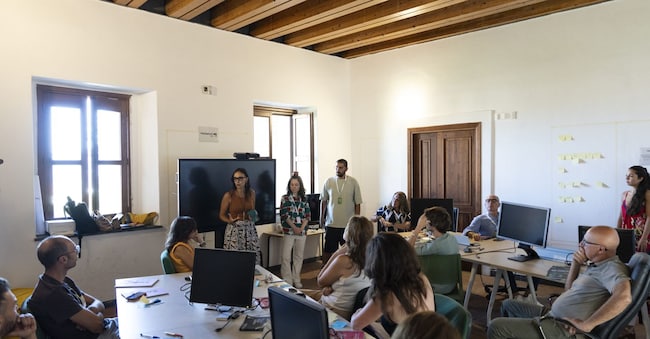
At the end of the three days, one is left with the feeling of having witnessed an attempt to build a more ambitious regional project around initiatives that are already proving successful. There are four key words: hospitality, distributed work, community, development. The Madonie Nomad Residency, promoted by So.Svi.Ma., with the municipality of Collesano as lead partner, and organised by Empeeria with the support of Destination Italia, brought together over 200 participants. Almost half took part for all three days: 22 municipalities from the Madonie area were represented, along with professionals and remote workers from 12 Italian regions and 12 countries.

Loading...

The workshop already exists in Castelbuono

Castelbuono isn’t starting from scratch. Here, distributed working is already a reality. South Working Castelbuono was founded in 2021 and is now run by Social Green Hub, an association that has grown out of a network of local professionals. The figures reflect a now well-established phenomenon: over 800 users in five years and more than 11,000 bookings at South Working Castelbuono’s spaces. Coworking, therefore, is not simply a service for those who occasionally work from the village. It has become a place for socialising, professional exchange and building new relationships, so much so that Social Green Hub defines its mission precisely through remote working and networking between professionals and the community: a small hub for contemporary work that continues to grow and attract professionals from further afield. ‘Castelbuono has always been an open laboratory of hospitality and culture,’ says Mayor Mario Cicero. Hosting the first edition of this Festival confirms our commitment to innovation, placing our community’s identity at the service of a far-reaching initiative.” This is the first building block: the Residency is now seeking to understand whether what has worked in one town can become a model for the entire Madonie area.

From reception to temporary citizenship

The first word is ‘welcome’, but not in the traditional sense of tourist hospitality. A professional who arrives, rents a house for a few weeks, visits restaurants and shops, and then leaves certainly boosts the local economy. But is that enough to talk of regeneration?

The aim is to shift the boundary from a visit to a longer stay, and ultimately towards a form of temporary citizenship.

“Digital nomadism represents a key frontier for promoting the wonders of Italia,” says Dina Ravera, president of Destination Italia. “Supporting the Madonie Nomad Residency means investing in high-impact, long-stay tourism, capable of fostering genuine connections with the local community.”

The leap towards development, however, occurs when that presence also generates investment, skills and returns. “As the lead local authority, we have believed wholeheartedly in this challenge,” emphasises Tiziana Cascio, mayor of Collesano. “We want to ensure that this event is not a one-off; we want to offer people the chance to return and stay, rather than simply promoting the area for its own sake.” For Cascio, the relational aspect must become “the real driving force for community growth in the Madonie”.

Work no longer forces everyone to leave

The second term is ‘distributed work’. For decades, finding a skilled job meant moving to areas where businesses and services were concentrated. Remote working breaks this link – at least for some professions – meaning you can work for a company in Milan, London or Berlin whilst living in the Madonie.

It means attracting professionals from outside the area, but also enabling those who have left to return, and ensuring that those who live here do not necessarily have to leave.

The co-working space in Castelbuono shows that there is a demand. However, scaling up requires connections, housing, transport, services and places where people can socialise. The international experiences shared in Castelbuono also highlight the limitations. Gonçalo Hall, a key figure behind the Ponta do Sol model in Madeira, estimates that only around 20 per cent of digital nomads are truly suited to living in a village setting. In Cape Verde, poor air links have hampered a promising project; in Pipa, Brazil, there was no physical space around which to build a community.

Loading...

In short, a pretty village and a fast internet connection aren’t enough.

The community is the most challenging infrastructure

The third word is ‘community’. The risk is creating a bubble of international professionals cut off from local residents. Value, on the other hand, is created when newcomers collaborate with a local business, share their skills, bring a house back into use, or build relationships that endure even after they have left.

“Rather than bringing a festival to a close, this marks the beginning of a new chapter,” says Tony Cirnigliaro, executive director of Empeeria, “moving from a few days’ hospitality to a way of life for the future of the Madonie.” The aim, he adds, is to build “a tangible opportunity that will endure and generate value for the local area”.

Development is measured after

The fourth word is ‘development’, and it is this that makes it necessary to measure results. Inland areas cover almost 59 per cent of the country’s territory and are home to around 13 million people; in Sicily, as in Basilicata, Molise and Sardinia, over 70 per cent of municipalities fall into this category.

An international survey cited by the Italian Digital Nomads Association indicates that 93 per cent of respondents would be willing to live temporarily in a small Italian municipality. In Pontremoli, there have been 94 new temporary residents since 2021, 23 of whom have settled there permanently.

But attracting people without proper governance can have the opposite effect: rising rents, gentrification, and divided communities. Digital nomadism is therefore not, in itself, a policy to combat depopulation. It can, however, become a driving force behind a development model that once again makes it possible to live, work and invest in inland areas. This is where territorial coordination comes in. “Madonie Nomad Residency is part of a broader strategy for the future of inland areas,” says Alessandro Ficile, sole director of So.Svi.Ma. “We are not talking about a one-off event, but the launch of an itinerant programme designed to foster networking between local councils, organise local resources and demonstrate that the Madonie have everything it takes to attract new talent and international visibility.” The guiding principle, he adds, must be “the economy of purpose and the desire to make a real social impact”.

At the close of the Residency, the Madonie 2026–2028 Manifesto was launched, based on six pillars, including connectivity, housing services, transport and the inclusion of the local community. The review process begins now.

Copyright reserved ©
Loading...

Brand connect

Loading...

Newsletter

Notizie e approfondimenti sugli avvenimenti politici, economici e finanziari.

Iscriviti