
Magritte returns to Antwerp: 1938 lecture 'relives' with AI at KMSKA
An immersive tour reconstructs the Belgian artist's famous lecture, transforming the museum into a mental map of surrealism

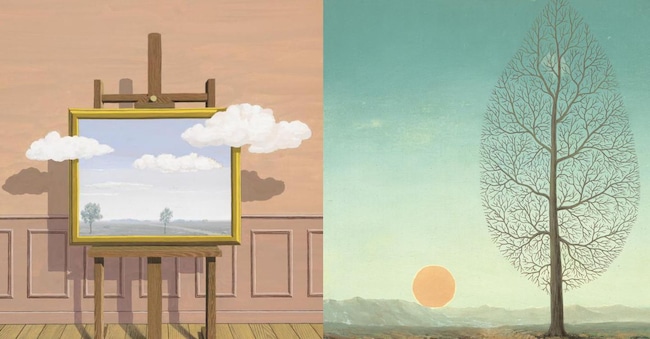
René Magritte returns to speak to the public. And he does so in Antwerp, where in 1938 he gave one of his very rare public lectures - the most dense and revealing of his poetics. The KMSKA, the Royal Museum of Fine Arts in the Flemish city, dedicates the exhibition 'Magritte. La ligne de vie' (until 22 February 2026), transforming those words into an immersive experience combining philology, curatorship and artificial intelligence technologies.
Only three times in his life did Magritte speak publicly about his art. The Antwerp conference, organised at the height of pre-war European tensions, is a key document: a surprisingly lucid reflection on the role of surrealism as a critical tool, capable of overturning the conventional meaning of images to show their reverse, the absurd, the logical fracture. It is from this theoretical core that the exhibition takes shape.
The project, curated by Xavier Canonne, an art historian and one of the leading experts on Belgian Surrealism, reconstructs the full text of the lecture and makes it the narrative guide for the tour. The artist's voice - recreated through AI modelling based on period recordings and sound testimonies - accompanies the visitor room by room, creating the impression of a tour guided by the artist himself.
The artist's reflection on language, image and paradox
The works on display include some emblematic paintings that Magritte himself quoted or mentioned in the lecture: for example 'The Taste of Tears' from a private collection, as well as, from the KMSKA's permanent collection, 'Sixteen September' or 'Ceci n'est pas une pomme', with references to the artist's reflections on language, image and paradox.
The works on display, most of which come from private collections and the 'Fondation René Magritte', follow the conceptual order traced by the artist: the 'problems' that run through his imagery, from the door to the window, from the enigma of the female figure to metamorphic objects - apples, clouds, bilboquets - that become tools to destabilise perception.

