
Maison Margiela, theatricality and roughness in Shanghai
Between containers in the Baoyang shipyard, the Autumn/Winter 2026 fashion show is staged, in which creative director Glenn Martens marks a reconnection with the maison's roots

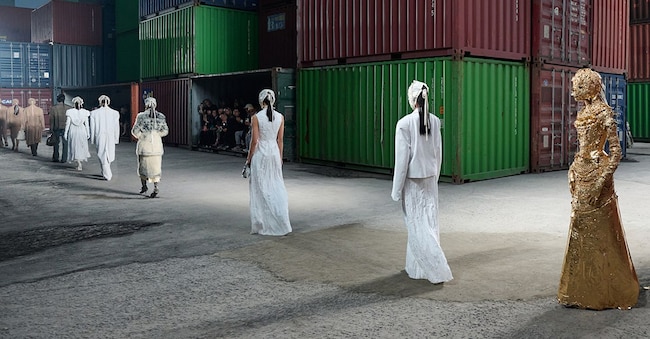
'Anyone who comes to Shanghai usually opts for the safe and familiar places on the Bund,' says a beaming Glenn Martens during a preview the day before the show, 'but Maison Margiela is unpredictable. Unpredictable and raw, that's what the Fall/Winter 2026 collection show looks like - the first event of such magnitude for Margiela in China, complete with four satellite shows in Shanghai, Beijing, Chengdu and Shenzhen: a catwalk that winds its way through containers stacked in the Baoyang shipyard.
The visual impact is glorious in its industrial brutality, the roughness an obvious reference to Martin's stage gimmicks and his predilection for abandoned places, devoid of glamour but teeming with life. Since the arrival of CEO Gaetano Sciuto and the appointment of Martens as creative director, Maison Margiela has embarked on a path of reconnection with its roots. In this sense, Martens is the perfect candidate, not only for his obvious Belgian origins but also, and above all, for his architectural approach to deconstruction, taste for the imperfect and black humour.
The show mixes prêt-à-porter and Artisanal (their couture), highlighting the perfect synchrony between Martens and the brand, while recapitulating the codes and tropes of the maison - from the reuse of historical pieces to the idea of the nude becoming a dress, from off-register tailoring to veiled faces - in a manner so much Margiela as to be at once too orthodox, formulaic and paradoxical.
The use of the mask, in this sense, is indicative: Martens transforms it from an instrument of anonymity into a macabre, hyper-theatrical element. The tension between over-the-top theatricality and brutal dryness is precisely the energy that pervades the show, but Martens only really convinces when he combines experimental urgency and a sense of reality.
That said, Artisanal is a marvellous registry of material treatments - from shattered porcelain reconfigured into clothes to candle wax fused onto lace - employed on forms worthy of an opera. Overall, the effect is opulent but heavy, and the solemn slowness of the presentation adds to the dose. Martens seems to have already found his comfort zone, a place it is perhaps still too early to occupy. Grandiose and sketchy but costumed couture; straightforward and elegant ready-to-wear: that, in a nutshell, is the formula. Martens, however, has the talent and creative means to say something truly personal and more incisive, somewhere between these extremes and beyond the gimmicks and homages to the archive.

