
Making ends meet with a racket
Conor Niland, captain of the Irish Davis team, offers significant testimony on what it means to be a professional tennis player and tournaments on the circuit: struggle with money, loneliness, fatigue

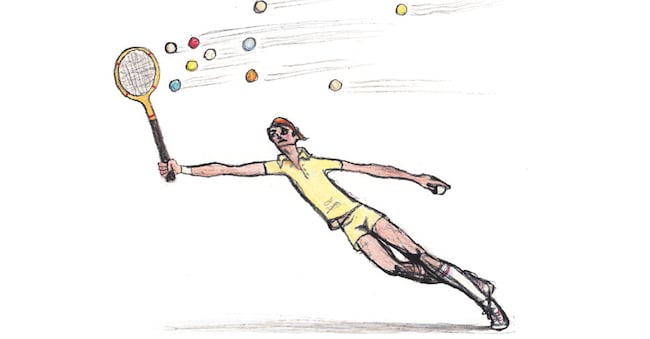
There are the predestined, like Jannik Sinner or Carlos Alcaraz, then the top ten champions, the excellent players in the top 100 of the Atp ranking... and from there on down everyone else, all the way to the base of the pyramid. In tennis, an army of professionals is on the court every day to advance, to win points, to improve their position in the rankings and, therefore, their everyday life. Nobody thinks about these dozens and dozens of athletes, about how they live, about the fatigue they face. An indistinct area, until someone emerges from the grey because, having emerged from the qualifiers, he or she lands in the main draw of a tournament or because he or she beats a fellow player with a reputation. A flash of sudden notoriety that one tries to confirm in the next round, bringing home more points and hoping not to plummet again among the myriad difficulties of someone who is an excellent professional but not yet a star. Here, Conor Niland's book recounts the trajectory of them all: the days, the expectations (between victories and disappointments), the economic precariousness, the loneliness, the physical and mental fatigue. Current captain of the Irish Davis team, Niland was Ireland's junior number one, a promise that reached the first round of Wimbledon and the Us Open but did not take off. As a young boy, he won with Federer, dribbled with Serena Williams in Nick Bollettieri's academy, went to college at Berkeley, grinding out successes only to find himself in the boundless ocean of futures - as the Itf (International tennis federation) tournaments were then called, the lowest level of the professional circuit - dreaming of soon moving up to Challengers, the next level where the prize money starts to be interesting. And they give a glimpse of the possibility of getting out of that state of uncertainty that not only weighs you down emotionally but also makes you live uphill and amid continuous acrobatics. Like those who give up doubles (where you often sign up to bring home some money) if they lose in the first round in singles and already have a plane ticket the next day. Or like those of those who wade through the infernal bureaucracy of countries where a visa is required: an obstacle course to which one submits oneself because the scoreboards are less prohibitive and therefore the chances of advancement are perhaps greater.
Niland, born in 1981, is the son of parents who wanted at all costs to make him a tennis player (the same fate destined for his sister and brother) and planned every step to achieve this goal, investing not a few resources. Conor has worked hard to live up to it, measuring himself against a type of life that involves - once past adolescence - many unknowns and surprises that are not always pleasant. The first is that friendships do not form between tennis players. Everyone thinks for himself, is focused on his own path, does not share hopes and goals: loneliness is in the nature of a tennis player's life. Even those who are kind at first, if they go on in their careers, end up not even granting a greeting any more. Conor quickly realises that one cannot think of being a professional without having a coach and without being able to count on a sponsor: with the prizes - between travel, hotels, food, stringing of rackets - one does not make a living. Futures offer no cover, Challengers do not reimburse the coach's expenses, so you have to decide whether to share a room or rent one for him too. The intervention of the Federations to support tennis players is of great help (in Italia it has happened with many players who have now passed the most complicated stage), not in Niland's Ireland. He also describes extreme situations, such as that of the American John Valenti: more than a decade on the professional circuit without ever earning a point in singles, always defeated, his shirt marked grinder (meat grinder), the days and nights spent in a kind of camper van.
In this painful, ironic and enjoyable memoir, the author explains how the scourge of betting creeps in. "Once, the night before a Challenger match, the phone in my hotel room started ringing. It was strange... "Hello?" I said diffidently. "Neeland?", "Yes, who is this?". I got no answer. "Tomorrow's match, can you miss it?" The financial pressures of professional tennis can drive a low-level player to desperation, and desperation can make the line between right and wrong blurry, but instinct drove me to hang up in a hurry."
© REPRODUCTION RESERVED
Conor Niland


