Public Art in the Emirate

Manar Abu Dhabi, the compass light in the Gulf

The Light Compass transforms islands, beaches and waterfronts into a light atlas of site-specific works: $35 million spent, large turnout of residents and visitors

by Maria Adelaide Marchesoni

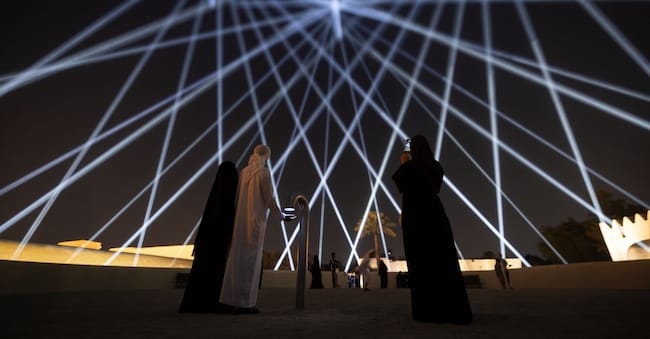
«Pulse Canopy», 2025 di Rafael Lozano-Hemmer, Manar Abu Dhabi 2025

5' min read

Translated by AI
Versione italiana

5' min read

Translated by AI
Versione italiana

When the light art exhibition 'Manar Abu Dhabi' opened in 2023, it opened up a new way of narrating and bringing the capital to life for its citizens. Far from the clamour of museums and trade fair circuits, the project chooses night as its exhibition space and light as its shared language. Not an ephemeral event, but an urban laboratory in which art and territory illuminate each other. The new edition of Manar Abu Dhabi (15 November to 4 January) entitled "The Light Compass" under the curatorial direction of Khai Hori, brings together 15 Emirati and international artists and collectives from 10 countries and presents 22 site-specific light sculptures, projections and immersive installations that stimulate creativity while celebrating Abu Dhabi's diverse natural and urban landscapes.
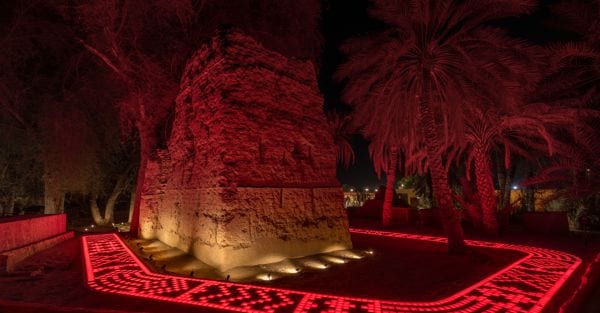
«Sadu Red Carpet», 2025 di Khalid Shafar, Manar Abu Dhabi 2025

'It is a project designed for everyone,' says Reem Fadda, director of the Cultural Foundation and Abu Dhabi Cultural Sites at the Department of Culture and Tourism - Abu Dhabi, 'which offers anyone the chance to freely explore art installations spread throughout the territory, transforming the city into an open-air museum accessible free of charge. A choice that reinforces the idea of a shared, open and inclusive culture, capable of involving the everyday life of Emiratis and others, of bringing them closer to an innovative vision of their own urban landscape'.
Loading...

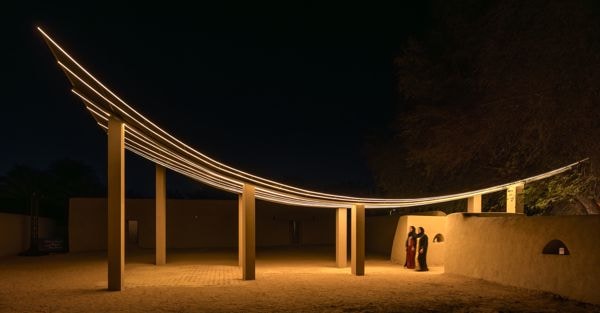
«Guiding Drapes», 2025 di Abdalla Almulla, Manar Abu Dhabi 2025

The first edition of Manar Abu Dhabi attracted some 668,000 visitors, a number that surprised even the organisers, consisting mostly of families, who took advantage of the 'cool' autumn evenings to visit the exhibition. "This year," says Fadda, "the aim is to improve the visitor experience and make everything as smooth as possible.
If the first edition brought the works to the islands Lulu Island, Samaliyah Island and Eastern Mangroves, many of them accessible only by boat. "Islands that are not usually open to the public were favoured in order to make the exhibition not only an artistic event, but also an opportunity to experience the emirate's environment in a new way," says Fadda. For this second exhibition, accessibility was at the centre of attention: 'the boat trips were great, but we wanted more people to be able to participate easily, which is why this time, in agreement with the property developers who are partners in the initiative, we focused on an island surrounded by mangroves near the Jubail Mangrove Park, one of the largest mangrove forests in the region. With locations spread between Abu Dhabi and Al Ain, most of them easily accessible by car, accessibility and fluidity were therefore put first.

The budget for public art

In Abu Dhabi, public art is experiencing a season of great expansion. With Public Art Abu Dhabi (PAAD), the emirate has decided to invest USD 35 million a year to transform the city into a diffuse stage where art installations and interventions become part of everyday life. It is a strategy that aims to give new impetus to the local creative industries and, at the same time, to consolidate Abu Dhabi's image as a leading cultural destination on the international scene.
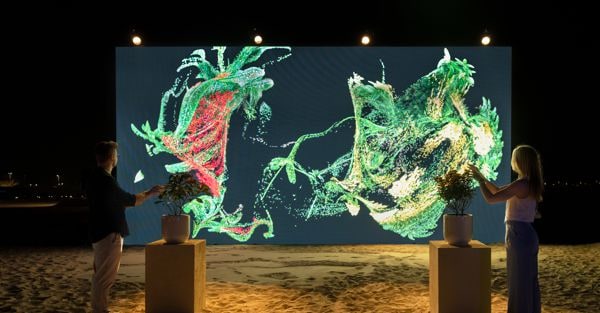
«Floral Resonance», 2024-ongoing di Christian Brinkmann, Manar Abu Dhabi 2025

The vision is divided into several projects

The Public Art Abu Dhabi Biennial, which opened in November 2024, brought interactive works and installations to numerous locations around the city, accompanied by a busy calendar of events. Alongside this, 'Manar Abu Dhabi' illuminates the islands and mangroves with sculptures and light art installations that reshape the nocturnal landscape. Completing the picture is a cultural programme that invites the public to participate: workshops, conversations with artists, guided tours and performances designed to create an ongoing dialogue with the city. Thus, step by step, Abu Dhabi weaves art into its urban fabric, building a new way of experiencing public space.
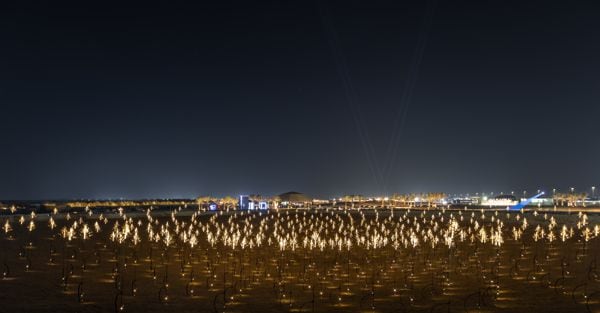
«Whispers», 2025 di DRIFT, Manar Abu Dhabi 2025

The new commissions stay in town

But what happens when these events end? Do the works return to their owners? Part of the artistic heritage on display, especially the commissioned works, remains in the city and the final destination is the Abu Dhabi Municipality. Since the first edition of the Public Art Abu Dhabi Biennial concluded last April, which involved some 70 artists from the region and abroad, with 40 new site-specific commissions, 11 works will remain in the city. These include the installation "Where Lies My Carpet Is Thy Home" by Christopher Joshua Benton created in the bustling carpet souk involving the market community. The giant carpet made fuses designs of Afghan war carpets with 8-bit pixelated images, weaving together stories of migrant traders from Afghanistan, Pakistan and India. Visitors were invited to walk on it, interact and reflect, thus reinforcing the biennial's goal of making art accessible. Another work is 'Homesickness' by Farah Al Qasimi, an installation inspired by the history of pearl fishing. Located on the Corniche, it features five giant oysters, each with a glowing pearl and a built-in loudspeaker playing excerpts of the song 'Tob, Tob Ya Bahar', traditionally sung by the wives of pearl fishermen praying for the safe return of their husbands.

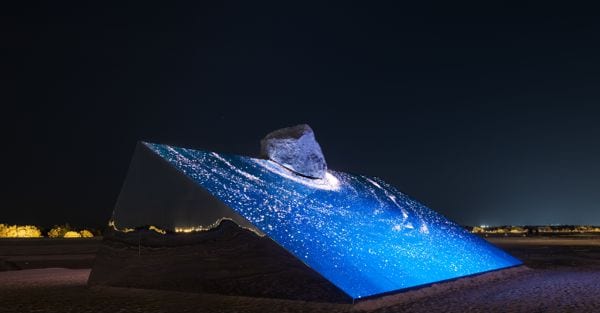
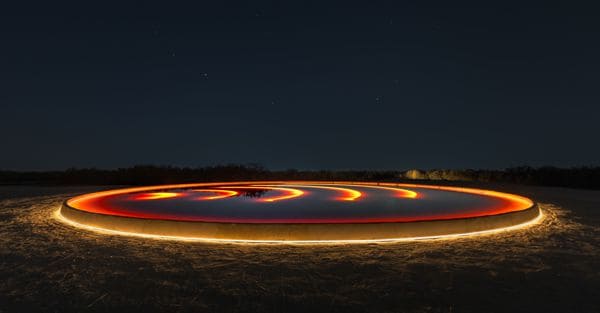
«Contingent Object», 2025 di Shaikha Al Mazrou, Manar Abu Dhabi 2025

The works commissioned for Manar Abu Dhabi

The 15 works commissioned by the Department of Culture and Tourism - Abu Dhabi for the second edition of 'Manar Abu Dhabi' bear both Emirati and international signatures. Prominent among them is "Contingent Object" by Shaikha Al Mazrou (Sharjah, 1988), a 30-metre circle that slowly changes its appearance as salt crystallises, turning into an ephemeral sign immersed in the natural landscape. Considered to be one of the most incisive artists of her generation, Al Mazrou investigates material tensions, abstract forms and colours that dialogue with contemporary art movements, giving life to sculptures that narrate a profound relationship with matter and its transformations (at Lawrie Shabibi, her works start at $40,000). Three installations have been commissioned to the Dutch studio Drift, which enriches the itinerary with interactive works: "Unfold", capable of translating the biometric data of visitors into luminous flowers and soundscapes, and "Whispers", a field of lights that vibrates as the air passes through. Works such as 'Floral Resonance' by Christian Brinkmann, an interactive audio-video installation that relates the visitor to an ornamental plant and each contact is recorded as an electrical variation and mapped in real time on light images and sounds, complete the panorama.

For the first time, 'Manar Abu Dhabi' also extends to Al Ain, in the oases of Al Qattara and Al Jimi, both protected by Unesco. Here, light becomes a bridge between history and nature, merging with places that have always been linked to water and land. At Al Qattara, Rafael Lozano-Hemmer presents "Translation Stream", which interweaves Emirati poetry and technology, and "Pulse Canopy", a suspended grid of lights that follow the heartbeat of visitors (represented by Pace Gallery, his works range from 8 thousand to 500 thousand dollars). Designer Khalid Shafar, on the other hand, reinterprets Bedouin weaving in a luminous key with 'Sadu Red Carpet'. In the oasis of Al Jimi, Ammar Al Attar's "Cycle of Circles" investigates the meditative value of repetition through photography, while Maitha Hamdan's "Breath of the Same Place" uses light and sound to evoke the dialogue between body and ecosystem.

«Skyward», 2025 di Ezequiel Pini (a.k.a. Six N. Five), Manar Abu Dhabi 2025

Focus on light art in the Gulf

"Manar Abu Dhabi" is part of a regional trend that sees light art conquering the big cities of the Gulf, from Dubai to Riyadh, where the fifth edition of "Noor Riyadh" has just started. Festivals such as Manar, Noor and Dhai - all etymologically linked to light - respond to the cultural ambition of the area: to create urban spectacles with a high visual impact and to strengthen soft power through night-time events capable of attracting thousands of people. The model seems to work: attendance is very high, with thousands of visitors every night.

Copyright reserved ©
Loading...

Brand connect

Loading...

Newsletter

Notizie e approfondimenti sugli avvenimenti politici, economici e finanziari.

Iscriviti