
From 1 September, manicure changes face: EU ban on unsafe ingredients in gels and semi-permanents
The European Union's CLP Regulation has decided to ban two ingredients in cosmetic products, including nail products such as gels and semi-permanent nails, which are considered to be a health risk
3' min read
3' min read
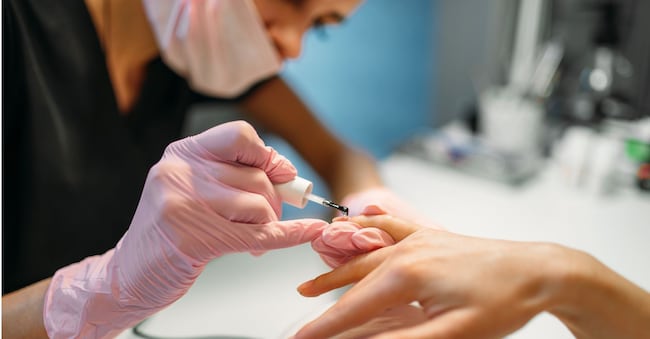
Flawless shine, extreme durability, perfect colours: semi-permanent nail polish has conquered millions of hands. But from 1 September, manicuring will no longer be the same. The European Union's CLP (Classification, Labelling and Packaging 1272/2008) Regulation has decided to ban two ingredients found in cosmetic products, including nail products such as gels and semi-permanent nail polishes, which are considered to be a health risk. The two banned ingredients are: TPO (Trimethylbenzoyl Diphenylphosphine Oxide) and DMTA (Dimethyltolylamine). The decision comes after the classification of these substances as toxic for reproduction, marking an important step towards greater health protection for consumers and professionals. A decision that changes the rules of the game for salons, beauticians and consumers, paving the way for safer and more transparent formulas.
Why they are banned
TPO is a photoinitiator, indispensable in gels to allow polymerisation under a UV/LED lamp; DMTA, on the other hand, is a conditioner that improves adhesion and resistance of primers, bases and top coats. Two key components, therefore, that have made products better performers for years, but the European Union has placed them on the list of substances that are carcinogenic, mutagenic or toxic to reproduction. TPO has been associated with possible DNA alterations and negative effects on fertility, while DMTA, belonging to the aromatic amine family, can act on the endocrine system and disturb the hormonal balance, with consequences on the male and female reproductive cycle. The most exposed groups are female workers who handle these products on a daily basis, with risks related to inhalation and direct contact. For customers, exposure remains more limited, but not without care: it is essential that curing takes place with safe lamps and correct timing.
The new scenario for salons and consumers
"The regulation leaves no room for exceptions: products containing TPO and DMTA can no longer be sold or used, even if they are already on the shelves or open in salons," says Daniela Pianese, nail technician and owner of the salon 'A Casa della Dani'. "A squeeze that forces the sector to reformulate its lines, focusing on safer and more transparent alternatives. For the consumer, it becomes fundamental to read the INCI, the list of ingredients, and make sure that the acronym TPO does not appear, thus moving towards nail polishes indicated as TPO-free. Performance remains excellent with the use of alternative photoinitiators, provided the products are carefully formulated and cured correctly. I have already been using TPO-free products in my salon for years. It is important for salon owners to request certification from the manufacturers. Already today, many companies state 'TPO-free' formulas or the words '5-free', '7-free' or '10-free' on the label, indicating the absence of controversial ingredients such as formaldehyde, toluene or phthalates.
How to choose
Orienting oneself in the choice of manicure products today requires greater awareness. Experts suggest paying attention first of all to the INCI, the list of ingredients: consulting it becomes essential especially for online purchases, where direct contact with the product is not possible. However, it is not enough to read the names: it is important to know that labels such as '5-free' or '10-free' indicate the absence of potentially harmful ingredients, but they are not uniformly regulated and can give rise to false reassurances. Even more useful is to turn to brands that have caught the spirit of the European regulation early, investing in line reformulation even before the ban. Several companies started some time ago to replace TPO with safe alternatives such as octylphosphine ethyltrimethylbenzoyl or bistrimethylbenzoyl phenylphosphinate, guaranteeing similar performance to the previous ones. This is not a passing fad, but the essential step towards truly evolved professional cosmetics. Finally, on the consumer side, it is crucial to ask openly in the salon what products are used: not only to check compliance with the new regulatory framework, but also to understand the level of transparency and sensitivity of the staff.

