
Many of the objections raised by Trump are those of Italian companies
The trade barriers faced by US exporters are the same as those denounced by European companies for years as excessive, invasive and burdensome

3' min read
3' min read
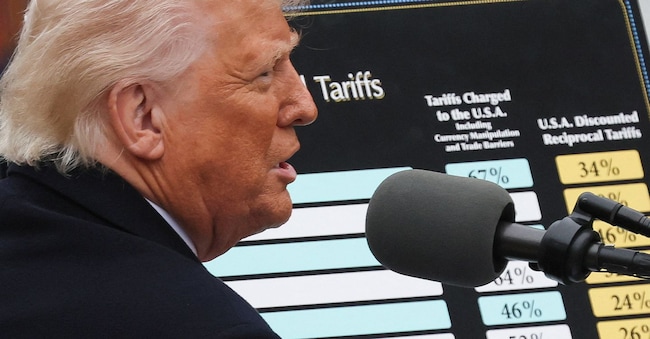
What if Trump's 'Liberation Day' eventually turned into a liberation for Europe? It may sound like a provocation, but a careful reading of the 397 pages of the 2025 National trade estimate report on foreign trade barriers, the annual US report on the main trade barriers faced by US exporters (quoted by the US President on 2 April), in particular the chapter devoted to the European Union, raises an interesting thought: many of the challenges are the same as those denounced by European companies for years as excessive, invasive and burdensome. The critical issues highlighted in the report concern many areas. Here are the most significant ones.
The first is the environment. The US judgement on EU regulations such as the Reach regulation (to improve human and environmental protection from chemicals) or the packaging regulation is shared by many European companies. The second is food safety. Just read the parts on the wine labelling regulation, the Farm to Fork strategy (sustainability of food systems) or the use of Genetically Modified Organisms (GMOs), to name a few. The third, crucial for transatlantic relations, is digital. The report points the finger at regulations such as the Digital Services Act (on digital services), the Digital Markets Act (on digital markets where large platforms dominate) and above all the Gdpr (privacy). American companies - but also European ones - complain about high compliance costs, complex procedures and disproportionate penalties. Perhaps also because of these rigidities, it is no coincidence that Europe is still struggling to give birth to technological giants capable of competing on a global level.
The report does not lack explicit references to Italy. There are two critical points: on the one hand, the slow and complex procedures for obtaining permits in strategic sectors such as energy and infrastructure; on the other hand, the uncertainty and, above all, the unpredictability in which the health industry (pharmaceuticals and medical devices) operates, amidst discontinuous pricing policies and delays in reimbursements and payments. The average times with which public hospitals pay their suppliers - the US report points out - still exceed the limits set by European regulations. Criticisms that could very well have been raised by Italian companies.
That the regulatory burden is a problem was also emphasised by Mario Draghi in his report on competitiveness: between 2019 and 2024, the EU adopted around 13,000 pieces of legislation, compared to around 3,500 acts and 2,000 resolutions passed at federal level in the United States. It must be said that regulation is most pervasive where institutional fragmentation is greatest and corresponds to the weakness of the powers granted to European institutions compared to national governments. To open up the topic of governance and competences of the Union here would be vague, but this is certainly at the heart of the problem. The Commission, however, seems to have acquired a different awareness today than in the past. Proof of this is the 'Omnibus Package', presented on 26 February, which aims to exempt 80% of companies from sustainability and investment obligations and raises an uncomfortable question: were these rules really necessary?
In this context, the temptation to respond to protectionism with new tariffs risks triggering a dangerous spiral. There is an alternative: sit down at the negotiating table starting precisely with non-tariff barriers. Rethinking our own regulatory policies in a strategic key, revising those measures that penalise European companies even more than foreign ones, would lay the foundations for negotiations with the United States, but above all would be good for our continent's competitiveness.

