
Maradona, all that remains five years after the death of D10S
On 25 November 2020 the only footballer who made himself a god departed. In Buenos Aires and Naples a cult that moves tourism (and millions) survives him

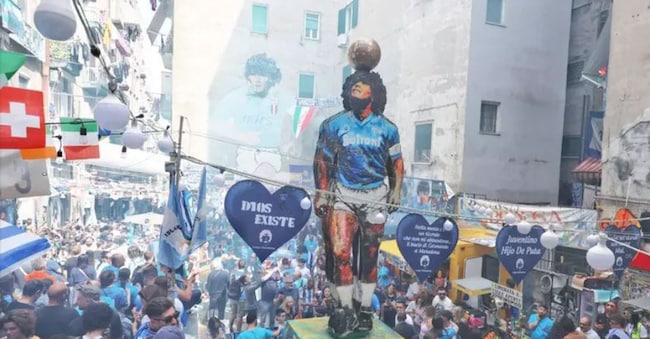
The magic number, according to Pythagorean doctrine, was not 3 but 10, the sum of the first four numbers and all that they represented: 1 (unity), 2 (polarity), 3 (harmony), 4 (space). Not 'man's number', but divine. Pythagoras believed in reincarnation and, if he was right, who knows, he might not have found confirmation of this theory 25 centuries later, when a 10 appeared on the (green) earth, able to unite and polarise, harmonise seemingly irreconcilable elements (Giordano and Bruscolotti, Burruchaga and Pasculli) and throw himself into space like no one else. With the ball at his feet, of course: we are talking about Diego Armando Maradona, the only footballer who made himself a god.
More than god: D10s, as if to certify his superb numerological entity. Thanks to a Holy Hand (the one with the first goal against England in Mexico '86) but, above all, to an exemplary life parable that from a hut (the favela of Villa Fiorito) took him to the roof of the world (the 1986 Mundial, the league titles and the UEFA Cup with Napoli), falls (drugs and excesses), deaths (the overdose in 2000, the heart attack in 2004) and resurrections that were never definitive (USA '94, the unfortunate parable as Argentina's captain).
Until his actual death, dated 25 November 2020, exactly five years ago. In controversial circumstances, consistent with the character's life: in Buenos Aires the trial on the responsibility for the death was in fact cancelled, due to a judge's participation in an unauthorised documentary that would damage both the plaintiff (the family) and the doctors' defence. Yet, as only happens to the founders of great religions, Maradona is more present in death than in life, and all the cult followers can easily testify to this. But not only.
The faithful are accustomed to believing in signs, and so here are the signs: Argentina has not won a World Cup for more than thirty years, then Maradona dies and here is the World Cup won by Argentina (Qatar 2022); the Napoli has not won a championship for more than thirty years, then Maradona dies and here are even two championships in three years (2023 and 2025) won by Napoli. Religions are born from below, as genuinely popular phenomena, and nothing different can be said for the cult of Maradona. In Buenos Aires, an estimated one million tourists visit Maradonian sites every year: the Casa Natal de Diego Armando Maradona, recognised as a national heritage site, the Bombonera, stadium of his Boca Juniors, the tomb at the Jardin Bella Vista. The most fundamentalist devotees even get themselves baptised by the so-called Iglesia Maradoniana, swearing on a copy of the autobiography Yo soy el Diego: "I believe in Diego, almighty footballer, creator of magic and passion..."
To systemise all this love, the Diez's five heirs (Dalma, Gianinna, Diego Jr., Diego Fernando and Jana), united in the Fundacion Maradona, are collecting donations for the realisation of the M10 Memorial, a 1,000 square metre mausoleum dedicated to the Pibe a few steps away from the Casa Rosada. Complete with a ledwall pixelating the photos of all the donors. It should have been inaugurated back in May, but at the moment it is still a building site. Because the step from the divine (which is infinite) to the human (which can be indefinite) can be rather short.


