
Maratona dles Dolomites, tradition and innovation for the queen of Alpine passes

9' min read
9' min read
Marathon wet, Marathon still beautiful and lucky. It almost seems like a twist of fate, but in the year in which the theme chosen was Mutatio and, therefore, also climate change, the 8,050 starters were not frightened off by rain and cold, which had spared the participants for at least seven editions now. However, not even to the best of intentions, the newly-announced theme of 2025 seems to be quite auspicious: Lüm, meaning 'light' in Ladin, hints at a return to the 'tradition' of meeting in La Villa in Badia in a year's time with the sun kissing the cyclists all day long.
Regardless of the weather, this year's Maratona was again able to pamper its guests with side events and, during the ride, even the newcomers verified the proverbial 'beauty of going slow' for the majority of the group. For many years, in fact, the agonistic soul, which makes it a coveted event among those who have raced as professionals and have exceeded age limits or have been excluded, has continued to coexist without conflict with the more 'quiet' soul of those who want to test their training and try at least once a year a timed challenge with themselves or friends in complete safety. But there is an increasing proportion of those who, while loving the effort and pleasure of 'gaining' an Alpine pass with their bike, decide to share the experience really unhurriedly, to enjoy the landscape and, as happens to many, make new friends. So many events and expectations in the same event, with the eye on the stopwatch largely only dedicated to the 'gates' that prevent the continuation of the longest routes only in the event of a major delay, for the mutual protection of organisers and participants, who would like to avoid finding themselves in the middle of traffic reopened outside the maximum time allowed in the various sections. Nevertheless, this event always delivers surprises, highlighting people's passion and energy in unexpected ways: suffice it to say that this year's oldest participant, Domenico Richici of Reggio Calabria, 85 years old, completed the 'classic' 55-kilometre route in 4 hours, 45 minutes and 32 seconds, in 180th place in the highest age group (over 65) out of 206 finishers, beating even a couple of dozen years younger than him by 40 minutes. While not everyone had a brand new bike: this was the case of Paolo Rinaldi, a Tuscan transplanted to Concorrezzo, who took part with a bike so classic that it was almost twice as old (the construction dates back to 1920), but despite this he completed the Sellaronda in 4 hours and 20 minutes, leaving behind a hundred or so. And for the largest gaps between first and second, it is no coincidence that they are among the most mature categories: the ones where with experience most decide to risk less. But where it is equally true that experience also teaches one how to manage oneself well, and so many 'mature' riders are able to do better than the young ones because they know how to manage themselves and have fun like kids.
In the over 60s women, the biggest gap was in the middle distance, with Olga Cappiello ahead of the category runner-up by one hour and thirty-six minutes. An equally remarkable gap for veteran Rocco Cattaneo, who excelled among the over-65 men with a 55-minute and 37-second margin over his first pursuer. And the young men? Many arrived calmly, because many spent time taking photos with friends in the many hotspots in the midst of nature and in the presence of the famous peaks: a sign of changing times because, usually, adventures of this kind are more and more fashionable to recount them (almost) metre by metre.
Always evolving but equally tied to tradition
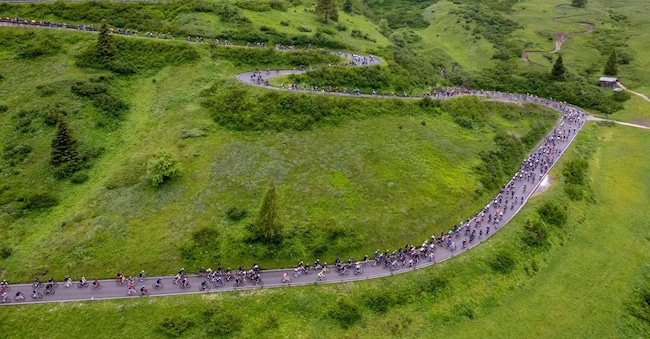
The most important mutation undergone by the Marathon is that it has increasingly become a global event and a fixture for more than thirty years. A gathering first only for a few 'heroes' capable of pedalling feats in the order of 200 kilometres, then for amateurs increasingly staggered according to training and distributed internationally. Comparisons abound: on the one hand it is the catwalk for perhaps the most beautiful and expensive bikes in the world. On the other it is the celebration of many amateurs who, regardless of their technical equipment, come from all corners of the globe to pedal in the sound peace of a car-free day in front of the Unesco Dolomites, for the longest traffic closure ever seen in the mountains. Participation has for many years now given equal space to Italians (102 out of 107 provinces represented) and foreigners (79 nations represented, of which 39 non-European): more generous with foreigners, in short, even than the New York Marathon running event, which favours compatriots for more than 60% of those registered. In this evolution, however, the format will not be touched: three courses and complete timing are a must. Since, thanks to the help of no less than 1,500 Ladin volunteers, an absolute record even in proportion to the population, the roads are kept free of vehicular traffic in complete safety and without hostility from the inhabitants and local authorities.
Good practice of cooperation in road closures
.Just a few weeks and a few kilometres from where in a similar event, in the Veneto region, there was almost a fatality due to a motorist breaking a roadblock during an amateur cycling competition, it is only right to reiterate the good example and the envy that the Marathon creates in other areas. The thirty-seventh edition of the Maratona dles Dolomites - Enel concluded its 37th edition by committing and closing seven Alpine passes to vehicular traffic for the entire day with the full cooperation of three provinces (Bolzano, Trento and Belluno), the joy of 1,500 volunteers and a participation of over 8,000 registered participants against 31,000 requests. An untouchable success, resilient to the serious crisis that the road bike events sector is facing, primarily due to the difficulty of obtaining permits to close roads during competitions or 'car free' events, often due to the individual municipality or prefecture even in routes that, with hundreds of kilometres, involve several territories. But if the political will is unfortunately influenced by those in charge, events such as these that promote the territory in the mountainous area (among the most important and participated ones, some roads in the Stelvio National Park, on Montegrappa and Gran Sasso are also 'closed') do not always receive the same adhesion from the authorities, the population and the economy of the territories. But events such as this one must serve to demonstrate and inspire because it is clear that, if well organised and perceived, the 'sacrifice' of a day in giving up motor vehicles not only brings a good experience to participants, but also helps to convey the image of environmentally aware and sustainable localities through concrete actions, at least for (a few) days a year.


