
Campiello: Marcello Fois wins the 2026 edition, with tributes to Murgia and Deledda
The announcement took place this evening, for the first time in the history of the Award, at the Palazzo della Mostra del Cinema on the Lido of Venice

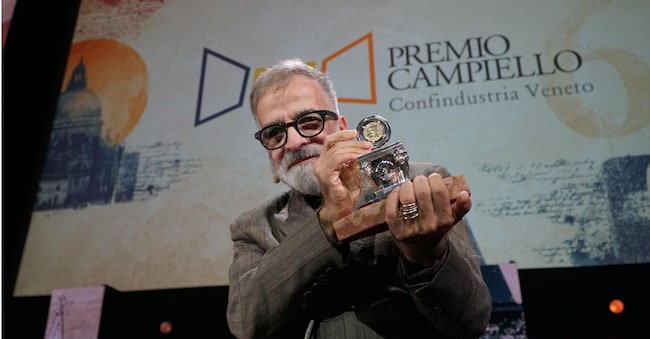
The writer Marcello Fois has won the 64th edition of the Campiello Prize with *L’immensa distrazione* (Einaudi), the competition for contemporary Italian fiction organised and run by the Fondazione Il Campiello – Confindustria Veneto.
The announcement took place this evening, for the first time in the history of the Award, at the Palazzo della Mostra del Cinema on the Lido of Venice. The winner of the ‘vera da pozzo’ – the symbol of the Prize – was chosen by the Jury of Three Hundred Anonymous Readers, comprising people of different ages, professions and geographical backgrounds, whose names are kept secret to safeguard the independence and transparency of the judging process. Out of 282 voters who cast valid votes, Fois received 83 votes, winning by a narrow margin over Alcide Pierantozzi, with *Lo sbilico* (Einaudi), who received 80 votes. Third place went to Elena Varvello with *La vita sempre* (Guanda) with 54 votes; fourth place went to Valeria Parrella with *La ragazzina* (Feltrinelli) with 33 votes; and Ermanno Cavazzoni with *Storia di un’amicizia* (Quodlibet) received 32 votes.
“Writing this novel was like taking stock of everything, figuring out where I stand, where I’m at, realising that writing is an incredibly difficult craft, that there’s a difference between writers and those who publish, and that there’s so much to say, so much gratitude for this world,” said Fois in the heat of the moment, immediately after the winner was announced. “First of all, I want to thank someone who is no longer with us, but who is still with me; she was a beautiful woman, anything but bitter, and very resilient: her name was Michela Murgia,” added Fois, dedicating the prize to his friend, the writer Michela Murgia, a fellow Sardinian like himself, who passed away three years ago.
In Fois’s remarks, there was mention of the great Sardinian writer Grazia Deledda: “I was born two hundred metres from Grazia Deledda’s house; she remains the only Italian woman to have won the Nobel Prize for Literature, one hundred years ago, in 1926,” he said – Deledda was the first woman to agree to stand for election in 1919, at a time when it was impossible for women to stand as candidates; by ‘exploiting a loophole’ in a law that did not prevent candidacy but did prevent voting, she stood for election. Deledda was a wonderful woman, the sort we need today, and one who perhaps ought to be remembered in schools – at the very least in the topics for the school-leaving exam – something which, however, did not happen this year, on the centenary.”
The plot
In *L’immensa distrazione*, Marcello Fois recounts the saga of the Manfredini family, an Emilian dynasty which, starting with a modest abattoir, built a veritable industrial empire over the course of the 20th century. At the heart of the novel is Ettore Manfredini who, on the morning of 21 February 2017, having just died, embarks on a long journey through his memories, retracing his own life and that of his family: from the poverty of his childhood to his economic rise, from the consequences of the racial laws to the wounds of the war and the Holocaust, right through to the conflicts, secrets and ambitions that span the subsequent generations.

