
Railways, Tgv Milan-Paris restarts in March
The reopening of the Frejus tunnel is expected between 15 and 30 March 2025. Meanwhile, SNCF is launching a recruitment campaign in Italy with a view to entering the high-speed market from 2027: the French will compete with Trenitalia (FS) and Italo
by Marco Morino
3' min read
3' min read
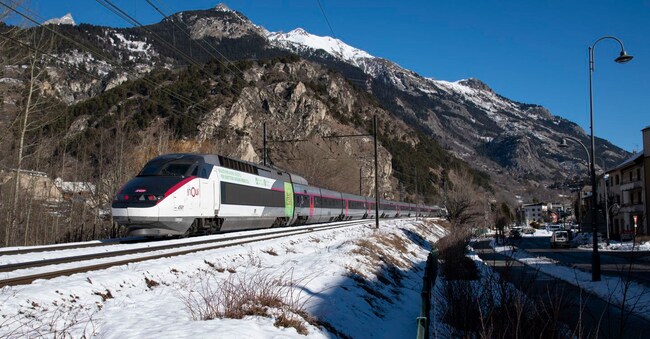
The reactivation of the rail link between Milan and Paris (via Turin) operated by the Tgv of Sncf (Société Nationale des Chemins de fer Français), the flagship train of the French state railways, is approaching. The cross-border line has been interrupted since 27 August 2023 following a landslide in Haute Savoie that blocked the Fréjus railway tunnel between Piedmont and France. The tunnel should become accessible again between 15 and 30 March 2025, thus enabling the French railways to resume daily connections between Milan and Paris. With a novelty: the service will be upgraded. That is, from the previous 2/3 trips per day to 5/6 trips per day.
A high-speed challenge
.A further sign of Sncf's increasing focus on the Italian market. The appointment of Caroline Chabrol at the head of Sncf Voyages Italia, a subsidiary of the transalpine rail group, has just been announced. Her role will be to lead the resumption of rail services between Milan and Paris and, above all, to contribute to the development of the high-speed offer with the new latest-generation Tgv M trains, promoting rail as an alternative to air and road transport. Sncf's strategic objective is to enter the Italian high-speed market and challenge, starting in 2027 (the debut date has not yet been announced), the two present operators: Trenitalia (Ferrovie dello Stato) with its Frecciarossa and the private company Italo (formerly Ntv) with its amaranth convoys. Sncf could end up serving around 10 million Italian passengers a year.
The recruitment campaign
.In this context, Sncf Voyages Italia is preparing to launch a recruitment campaign (recruiting), aimed at all professional figures, to strengthen its team, currently comprising some sixty employees. To support this initiative, the new corporate website www.sv-italia.com has just been launched, with the main objective of attracting new talent and making the company and its values known to the public. The transalpine railway company is looking not only for drivers, train conductors and controllers, but also for staff for the administrative offices (the head office is in Milan).
Why Italy?
.Company sources explain: 'Italy represents a fundamental and strategic market, with over 56 million passengers carried by high-speed trains each year. It is a dynamic market, with a network that continues to grow and offers prospects for expansion. Moreover, 80% of Italian passengers who do not currently use the train are interested in this mode of transport'.
As anticipated, Sncf Voyageurs will commence operations during 2027, making up to 13 daily round trips on the Italian domestic market, split between two routes:


