
Roadmap in March: how EU leaders accelerate to complete the single market
The Twenty-Seven, meeting with former Italian Prime Ministers Draghi and Letta, list simplification, merging capital markets, and defending strategic sectors among their priorities. Costa announces review of competition rules: countries want to promote EU champions
by our correspondent Beda Romano
 Aggiungi Il Sole 24 Ore
ai preferiti su Google
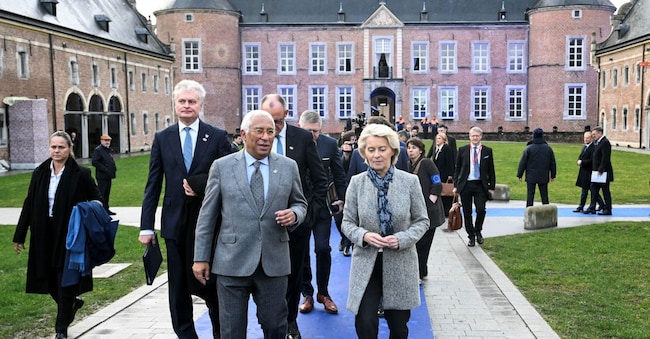
BILZEN (Limburg) - Meeting for an informal brainstorming in Belgian Flanders, the Twenty-Seven committed themselves yesterday to the rapid completion of the single market. Regulatory simplification, merging capital markets, consolidation in the telecommunications market, lower energy prices and protection of the most strategic sectors are the priorities the heads of state and government set themselves. A roadmap will be decided in March.
'Today's meeting was a turning point,' European Council President António Costa told a press conference in Bilzen, a town in Belgian Flanders. 'Until 1992 we had a common market. Since 1992 we have been committed to creating a single market (single market, in English). Now we want to create between 2026 and 2027 the foundations of a single European market (one market, in English)'. This is about breaking down barriers and Europeanising sectors that have so far remained national.
Yesterday's meeting was divided into two parts. The first was attended by Mario Draghi, author of a well-known report on the future of the European economy. According to information leaked on the sidelines of the meeting, the former Italian Prime Minister stressed the urgency to act, without delay. He explained that there is no more time for procrastination and suggested that leaders give themselves a year to get to grips with the most pressing issues: market fragmentation, underinvestment, high energy prices.
The second part featured Enrico Letta, also author of a report, this time on the future of the single market. According to information gathered on the sidelines of the meeting, Italy's former Prime Minister emphasised the need to make the telecommunications, finance and energy markets, which until now have remained in national hands, European. Mr Costa himself pointed out that governments are ready to promote mergers between telecom groups.
'Countries want to promote European champions,' added the former Portuguese premier, heralding a review of competition rules. The topic has always been very sensitive, not least because of obvious national jealousies. In this regard, speaking to the leaders, former Prime Minister Letta proposed to go beyond the example of Airbus, a joint venture between governments, and give the European Commission a capital instrument allowing it to invest in European companies.


