Companies

Marche, the land of well-being and quality of life focuses on truffle production

This is one of the actions of the latest update of the 2024-2026 Three-Year Programme of the Regional Law of December 2023 No. 23

by Daniela Casciola

4' min read

Translated by AI
Versione italiana

4' min read

Translated by AI
Versione italiana

The 2025 update of the 2024/2026 Three-Year Programme of Marche Regional Law no. 23 of December 2023, dedicated to initiatives for the enhancement of the Region as a land of wellbeing and quality of life, approved by resolution no. 1025 of 30 June last, at point e9 provides for actions to support the promotion of truffle production in the Marche, which the offices are preparing to implement.

With Law No. 23 of December 2023, the Marche Region has aimed at enhancing its territory as a land of wellbeing and quality of life, also with a view to orienting the tourist-accommodation offer in a sustainable key by capturing its specific features, natural beauty and commitment to environmental conservation. The aims of this law, also in implementation of Articles 9 and 41 of the Constitution, are achieved through an integrated and interdisciplinary approach, involving transversal areas such as food, agri-food chains, quality and safety of agricultural products, health and welfare, industry and craftsmanship, environment and territory, tourism, culture, sport and leisure, education and training. Truffle-growing plays a strategic role for the economy of the inland areas of the Marche region and could not be missing among the strong points of the entire operation codified in law no. 23.

Loading...

In the Marche region, there is the 'all-year truffle'. All commercial truffle species in Italy are present in the wild and in artificial truffle grounds (in the case of cultivable species). It is estimated that in the Marche region there are over 12,000 truffle hunters, equal to 0.8 % of the resident population, one of the highest figures in Italy. The companies are mainly located in thetwo large production poles of the Region, one in the South, including the inland areas of Piceno and Alto Fermo, and the other in the North, in the province of Pesaro Urbino, between Valmetauro and Montefeltro.

It is not easy to quantify the number of areas where truffles are currently cultivated, as many of them are cultivated independently by truffle growers and are therefore difficult to trace. However, it is estimated that there are no less than 1,600 hectares of cultivated areas, plus natural and controlled truffle beds, for a marketed production of around 50 tonnes per year, almost half of which is made up of prized white truffles. The resulting commercial value is over 6 billion euro.

Modern truffle-growing originated in the Marche region, both because the first 'cultivated' truffle ground was planted here in 1932, but above all because in the 1950s and 1960s, numerous cultivated truffle grounds were created by Mannozzi Torini, regional inspector of the State Forestry Corps, mainly with black truffles, demonstrating the vocation of the Marche region for cultivation, as well as spontaneous production thanks to favourable climatic and soil conditions.

The Marche Region, through its AMAP Agency plays a decisive role, managing the Truffle Cultivation Centres of the Marche Region, which since the 1980s have been studying the region's truffle fields and forests in order to characterise them from a botanical, pedological and silvicultural point of view. The centres, located in Amandola (FM) and Sant'Angelo in Vado (PU), collaborate with universities and research institutes to study the main truffle species, experiment effective cultivation techniques and monitor growth dynamics. The centres also monitor seasonal climatic trends to adjust the harvest calendars of the different species.

The regional agency AMAP also manages two nursery facilities attached to truffle centres, specialising in the production of mycorrhized plants for planting cultivated truffle beds. This is a cultivation technique that consists of having the plant's root system attacked by non-pathogenic fungi that create a situation of symbiosis and mutual exchange with it. The peculiarity of truffle production in the Marche lies in the use of propagation material, both plant and fungal, of autochthonous origin, taken from regional sites with a high truffle vocation. Greenhouse production exceeds 10,000 plants per year.

-----------------SCHEDGE: Truffles in Le Marche----------------

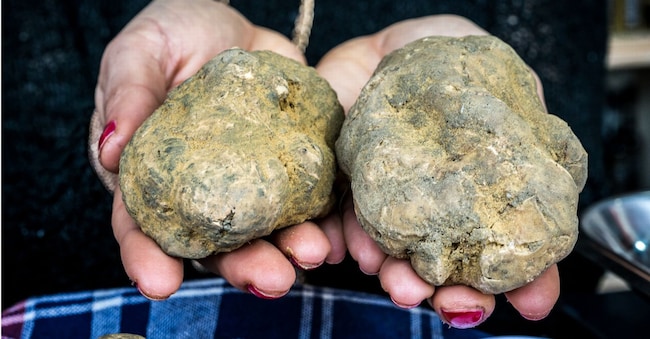
The truffle is a resource for the entire Marche region, recognised as one of the world's largest producers and exporters: from north to south, from the province of Pesaro and Urbino to that of Ascoli, all types of the precious hypogean fungus can be found: the white truffle, the black prized, the bianchetto, and the black summer truffle.

The Precious White Truffle (Tuber magnatum pico) harvested in the area north of Pesaro and Urbino. The Pesaro area, where the white truffle is harvested, is considered nationally one of the best places for the collection of this tuber. In this province, there are truffle markets and also important exhibitions and events such as the Mostra del tartufo di Bianco pregiato delle Marche di Sant'Angelo in Vado, the National Truffle Fair of Acqualagna or that of Pergola, places that are also truly spectacular from a natural and cultural point of view. Its production can also be found in the South of the Region in Amandola, for example, which hosts an important event in the autumn "Diamanti a Tavola" - Fiera del Tartufo Bianco Pregiato dei Sibillini.

The Precious Black Truffle (Tuber melanosporum) is mainly found in the southernmost area in the province of Ascoli Piceno. The main towns for the black truffle harvest are Acquasanta, Roccafluvione, Montefortino and Comunanza. The importance of the prized black truffle for the mountainous territory in the Ascoli Piceno area has been recognised by the important European Collective Mark Quality Certification with geographical reference. Also the Tartufo Lands, of the Unione Montana Marca di Camerino, promote an important event every year in Pievetorina to valorise the product.

The black summer truffle also called Tuberestivus scorzone (Tuber aestivus vitt) is present throughout the region.

Finally, we also have the Tartufo bianchettoalso known as Marzuolo because of the harvest period from January to March (Tuber borchii) celebrated with the Tartufo Bianchetto Festival held every year in Fossombrone.

Copyright reserved ©
Loading...

Brand connect

Loading...

Newsletter

Notizie e approfondimenti sugli avvenimenti politici, economici e finanziari.

Iscriviti