
Mareterra, the Principality's eco-district wrested from the sea with villas at 120,000 euro per square metre
Prince Albert cut the ribbon on the two-billion-euro development on six hectares that includes super-apartments, villas, swimming pools and shops. signed by top archistars (from Renzo Piano to Norman Foster, from Tadao Ando to Stefano Boeri)

3' min read
Key points
3' min read
The name says it all: Mareterra is a new 'eco-district' in Monaco, built on six hectares taken from the sea. The pedestrian district, created from nothing between land and water, gives Monte Carlo new residential complexes, restaurants and shops, a park and a promenade along the coast leading to the famous Larvotto beach.
The project
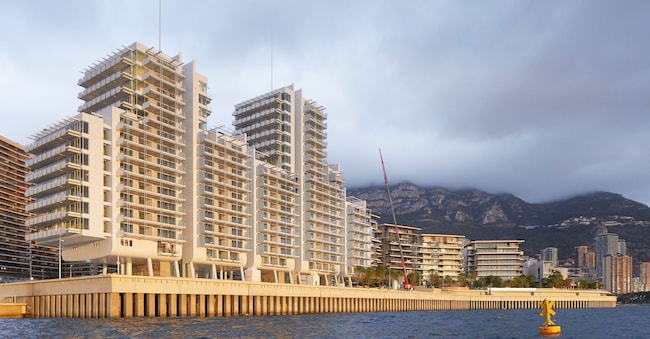
.'This is a project that transforms Monaco, our first eco-district,' Prince Albert declared at the official opening. 'Mareterra integrates perfectly with our coastline and will be considered a natural extension of our territory. For the two billion euro project, realised by Sam L'Anse du Portier, the big names of contemporary architecture were recruited: Renzo Piano, at the express request of the prince, and Norman Foster, Tadao Ando and Stefano Boeri. Piano, who was present at the inauguration, has created "Le Renzo", a majestic 17-storey residential complex 125 metres long that resembles a cruise ship and seems to be suspended five metres above the ground, supported by delicate supporting columns. Below the flats are shops and restaurants. There are only 50 flats, all from 400 square metres upwards, with a super-attic on four floors. The residents' swimming pool is at the prow and, just two metres above sea level, seems to dive into the Mediterranean.
A further four smaller residential complexes were created by Valode & Pistre Architectes, who were also responsible for the entire masterplan. Foster, Ando and Boeri designed the villas on the hill. Mareterra forms a curve that follows the natural course of the coastline, extending the space between the Grimaldi Forum convention centre and the Grand Prix tunnel, made famous by Formula One, towards the sea.
In a place where space is scarce and real estate is among the most expensive in Europe, Mareterra offers larger flats, which are the most sought after on the market. Foreigners who want to obtain residence in Monaco for tax reasons can only do so if they can prove that they own at least one room for each family member.
The real estate market in Monaco is still considered an excellent investment, as evidenced by the fact that all available properties in Mareterra, both the 110 flats and the 14 villas, have already been sold before completion. Prices have also reached record levels for Monaco, reaching, according to unofficial sources, 120,000 euro per square metre.
Brand connect


Newsletter RealEstate+
La newsletter premium dedicata al mondo del mercato immobiliare con inchieste esclusive, notizie, analisi ed approfondimenti
Abbonati