
Maria Lai crosses the ocean with a thread
At the 'Warehouse' in Cold Spring a summary of the history of the loom artist, of sewn books, of relational art. An emotion, based on a journey made in 1968
5' min read
5' min read
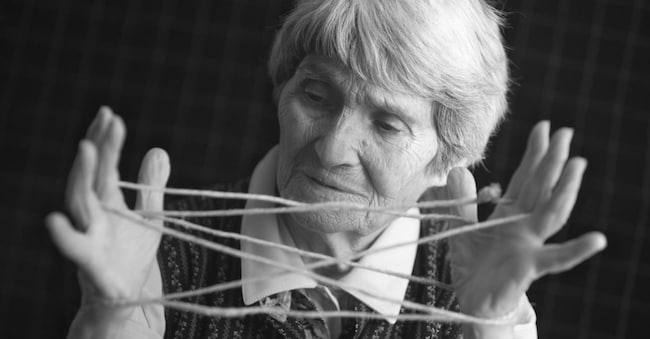
All her life unravelling skeins, unravelling and creating knots, tangles, tangles, labyrinths and doodles of scattered threads, warps and wefts, 'weaving' and 'being', and then, here she is, Maria Lai, old and (humbly) aware of her artistic greatness - of which no one now doubts any longer and which, indeed, is only destined to increase from now on -: The photographer Daniela Zedda places in her hand the threads of the game of "ripiglino", which children have always played and known how to play: and she, on the other hand, who has been tinkering with threads for decades, not only has never done so, but now cannot help but look, for the umpteenth time, amazed and scrupulous, at the effect they (the threads) have, those threads that twist in her wrinkled yet smooth hands, fingers like fuses, tangles that delineate geometric destinies, metaphors of our condition. Maria Lai (1919-2013) welcomes us with this extraordinary, intense presence in an iconic photograph placed just before we set foot in the exhibition: a sapiential warning that smacks of the archaic and, at the same time, of the future. They are, his gazes, his works, profound meditations around an unbroken thread that, not by chance, already in Greek myth - the Moire and Arachne and Penelope - was a symbol of life, of stories, of bonds, of plots that become fate, connection, continuity. Union and communion.
The great exhibition at the Magazzino Italian Art in Cold Spring (one hour from New York, an architectural and cultural marvel, a true embassy of 20th century Italian art, the merit, and incredible work, of two generous and precious collectors like Giorgio Spanu and Nancy Olnick) is entitled 'Maria Lai. A Journey to America' (until 28 July 2025). This is not, however, only the artist's first retrospective in the United States, which would already be a great deal: in more than one hundred and more works, a particularly successful exhibition traces a career that straddles the tradition of her native Sardinia (and the first canvases, some of which have never been seen in the exhibition, merge sheep and stones in a landscape clarity whose beauty and strength she never tires of singing), the dialogue with Arte Povera and the influence of American culture. There is, moreover, the heartfelt homage and - indeed - the reknitting of a thread that has to do with Lai's biographical story: almost a destiny, which is fulfilled years later. Maria Lai, in fact, had already been to America: in love with the poetry of Walt Whitman, an expert on the painting of Pollock and Rauschenberg, she visited the United States (and Canada) in the spring of 1968. Not only that: she took some of her most significant works with her in the hope of exhibiting them. And here, for the first time on display, are seven of these works, including Notturno n.2 and Pietre (1968), from an American private collection. On his return to Italy, the artist found the courage to present the results of his experiments in Bolzano and Rome, where, in 1971, he already exhibited some of his 'Telai' (looms), certainly his best-known creations (together with the sublime stitched books), which characterise his artistic and moral 'doing'. Tools, the looms, inspired by the common ones historically used by the women of the island to create everyday objects, carpets, dowry cloths, often of high aesthetic value but above all central, in her inspired vision, in describing the condition (and rebellion against the state of things) of women.
The exhibition, curated by Paola Mura (Magazzino's new Artistic Director) offers, on two levels, works coming from various institutions (including Fondazione Maria Lai, Fondazione di Sardegna, MAN Nuoro, Regione Autonoma della Sardegna) as well as from private individuals, and from the Olnick-Spanu collection itself. The sensation that must be emphasised, going through the rooms of the Magazzino, is that of a 'new' - and truly contemporary - look at Maria Lai's work: a refined anthology without too much clutter but with admirable examples of her decades of work. And if the final room closes with the moving "tapestry-sheet-book-letter" of the last collective action promoted by the almost 90-year-old Lai, "Being is weaving" (realised in 2008 in Aggius, a town known for its sewing tradition) with textile works accompanied by readings by Whitman, before that, we had gone back to that phenomenal experiment in relational art (the first in Italy) in 1981, when the artist convinced the inhabitants of her native town, Ulassai, to "Bind themselves to the mountain". Connecting people and houses to each other and 'anchoring' them all to an archaic stone, the majestic overhang of Monte Gedili, with 26 km of a blue ribbon of denim cloth: each family, mapping their connections with the neighbouring one, testified what bond held them together, and how feeble, but vital, the relationship was, for better or for worse: from one house to the next a bread and a bow to indicate the members of the same family and the harmony, the knots with friends, and no sign for those who had a grudge relationship: a documentation with Tonino Casula's video and Pietro Berengo Gardin's photographs with interventions by Lai already presented at the Venice Biennale and Documenta.
Maria Pietra, this is the name of Maria's poetic and fictional alter ego, is the theme-figure that recurs in the tenuous threads that are knotted between the pages of book-objects (in a breathtaking display in cases that enhance the essence of these works): since her return to Sardinia in the 1990s, the figure of a woman-artist who moves in perpetual search: polymateric works, large sewn sheets, books, looms: in those threads of 'Vela spaziale' there is life stretching towards new experiences, new conquests and memories. In Maria Lai's art, everything is a web of memories, transformations and tensions towards the unknown: these are universal stories, narrated with sweet stubbornness, by a kind of little jana, a great artist and powerful fairy despite her soft, calm voice. Emotions and reflections that touch the heart and mind of anyone who observes them, regardless of their historical or geographical context: a lump that twists and does not leave you. The same that Maria has as she observes, captured, the threads in the photo to which she returns at the end of the exhibition. Those soft, taut threads, waiting for someone else - all of us - to pick them up from her skilful fingers, in the miracle that art renews, allowing us to hold hands with the sun, words and other stars.

