Art

Marina Abramović: a life of sensuality, death and the will to live

In Berlin, the Serbian artist’s exhibition explores themes ranging from melancholy over the break-up of Yugoslavia to sensuality and Balkan traditions

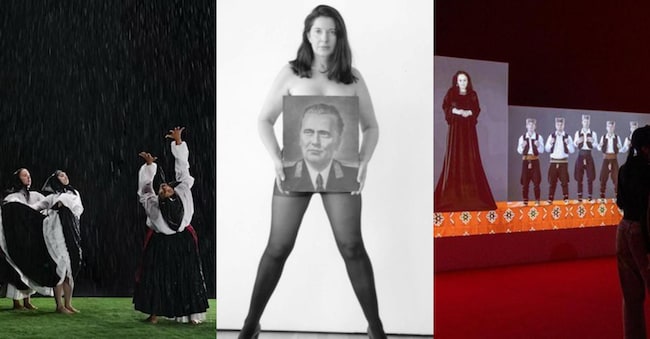
Da sinistra: Marina Abramović, Scaring the Gods from the series Balkan Erotic Epic © Marina Abramović, Courtesy of the Marina Abramović Archives / VG Bild-Kunst, Bonn 2026, photo: Marco Anelli; centro: Marina Abramović, Portrait with Tito, 2004 © Marina Abramović, Courtesy of the Marina Abramović Archives / VG Bild-Kunst, Bonn 2026, photo: Paolo Canevari; destra: Marina Abramović: Balkan Erotic Epic. The Exhibition, installation view, Gropius Bau, 2026 © Gropius Bau, photo: Rosa Merk

4' min read

Translated by AI
Versione italiana

4' min read

Translated by AI
Versione italiana

You either love it or hate it. But you go through it anyway, experiencing it. And love for Marina Abramović wins out: Balkan Erotic Epic. The Exhibition — the artist’s first solo exhibition in Berlin since 1990 — has been extended until 30 August due to huge public demand. In October 2026, a four-hour stage adaptation will also be staged at the Haus der Berliner Festspiele.

Abramović gets it spot on, both in terms of timing and approach: a perfectly packaged product, capable of making an impact and dividing opinion. A success, however you look at it. This time, however, there is one detail that invites an almost inevitable comparison: Gabriele Stötzer, a leading figure in the women’s resistance movement in East Berlin — who has herself been the subject of a major retrospective at the Gropius Bau in recent months — also lives in the same building in Berlin where the Serbian artist resides. A proximity which, almost instinctively, sheds new light on Abramović’s exhibition, accentuating its magnificence and theatrical presence.

Loading...

Tito’s Funeral: the body as collective mourning

The exhibition opens with an immediate impact: the video installation Tito’s Funeral occupies the entire central courtyard with images, moving slowly and imperceptibly, of the ‘Narikače’ — the traditional Balkan mourners, historically charged with giving voice to collective grief — as they beat their chests, weeping over the death of Tito, the marshal who led socialist Yugoslavia from the post-war period until his death in 1980, an event that foreshadowed the country’s dissolution a decade later amidst the conflicts of the 1990s. The muffled rhythm of that collective beating creates an almost hypnotic state, in which the tension becomes charged with an ambiguous sexual energy. The body becomes a site of social and political ecstasy, and erotic energy a means of coming to terms with a historical loss.

The installation highlights the extent to which the trauma of the break-up of Yugoslavia, the figure of Tito and the memory of the Balkans continue to permeate the artist’s work, as he returns to his roots through the customs, myths and pagan beliefs of various countries in the region. Here, eroticism becomes a tool with which…

Marina Abramović in una grande mostra a Berlino

Photogallery9 foto

Through these practices, communities come to terms with death, ensure fertility and restore balance to the natural world.

Three thematic chapters

The exhibition is divided into three sections. It opens with a clear statement on female power, transcending the roles assigned over the centuries: a ceramic figure discovered in 2001 in the Macedonian village of Macevo, whose silhouette resembles the shape of a vulva. Abramović subverts its traditional meaning — a symbol of fertility and good fortune — transforming it into an emblem of strength and resilience.

In the following rooms, a grotesque and deliberately didactic style — conveyed through an animated film — presents sexual expression as an almost ecological act, in which the earth, a living being, is nourished and reawakened through erotic rituals. Penises and vulvas become symbols of cosmic energy and protective elements of the earth; the video ends with a desolate image, a sort of graveyard — or forest — of phalluses.

The theme of the body between life and death recurs in Nude with Skeleton, a 2002 performance in which the artist lies beneath a skeleton, evoking the Tibetan ritual of monks who sleep alongside the deceased to train the mind to accept its own end.

Fifty years of history

The exhibition places her most recent work on the body in dialogue with three historical works that mark three fundamental stages in Abramović’s artistic exploration. Rhythm 5 (1974) was one of the first performances in which the artist put her own body at real risk, losing consciousness whilst inside a burning five-pointed star — an episode that cemented her interest in physical limits and the threshold between control and surrender. Lips of Thomas (1975, later restaged in 2005) remains one of her most radical performances, centred on acts of ritual self-harm and physical endurance, often cited as a manifesto for the use of pain as an artistic language. Spirit Cooking (1996), one of the most controversial and debated works of her career, takes the form of a series of conceptual ‘recipes’ written on the wall, halfway between a magical ritual and linguistic provocation.

Loading...

Comparing these three works allows us to view Abramović’s most recent work within a long-term perspective, highlighting the evolution of certain recurring themes throughout her career.

The exhibition is accompanied by the publication *i* *On the Erotic* , which features an interview with the artist alongside texts by the curator Agnes Gryczkowska and by Audre Lorde, Svetlana Racanović, Silvia Federici, Mithu M. Sanyal, Elizabeth M. Stephens and Annie M. Sprinkle — a critical framework that places Abramović’s work in dialogue with contemporary feminist and postcolonial thought.


Marina Abramović, Balkan Erotic Epic. The Exhibition, Berlin, Gropius Bau, f30 August 2026.

Copyright reserved ©
Loading...

Brand connect

Loading...

Newsletter

Notizie e approfondimenti sugli avvenimenti politici, economici e finanziari.

Iscriviti