
Mario Draghi: 'Europe risks stagnation if it does not focus on artificial intelligence'

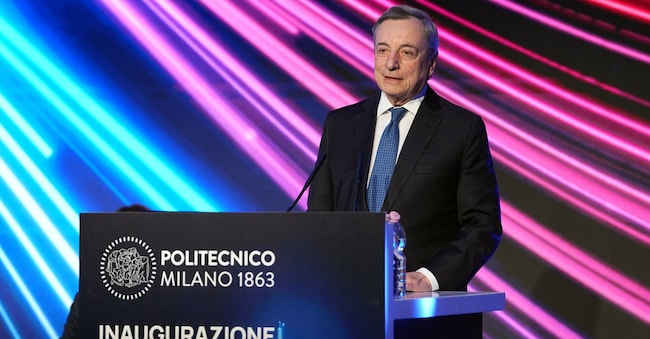
"For more than two centuries the improvement in living standards has been fuelled by progressive waves of technological progress, today technologies remain the main driver of prosperity". Mario Draghi yesterday chose the opening of the academic year at the Politecnico di Milano to issue a new warning to Europe by putting artificial intelligence at the centre of growth. "Advanced economies cannot rely solely on labour and capital for prosperity," warned the former Prime Minister, "making technologies even more central.
The economist's words on this occasion again do not leave much room for interpretation and nail Europe to a turning point in rethinking its production processes and the very idea of productivity. "Our populations are ageing and much of our physical infrastructure dates back decades. As Nobel Prize-winning economist Robert Solow showed in the mid-1950s, once this stage of development is reached, growth depends overwhelmingly on productivity, which in practice means new technologies and the dissemination of new ideas'.
In this respect, Draghi's analysis is merciless. "Over the last twenty years," he recalls, "we have gone from being a continent that embraced new technologies, narrowing the gap with the United States, to one that has progressively erected barriers to innovation and its adoption. We saw this in the first phase of the digital revolution, when European productivity growth dropped to about half the US pace and almost all the divergence emerged from the technology sector. Now this pattern is repeated with the artificial intelligence revolution'. "Last year," the former prime minister continues, "the United States produced 40 major fundamental models, China 15, the European Union only 3; the same pattern can be observed in many other frontier technologies, from biotechnology to advanced materials to nuclear fusion, where many significant innovations and private investments take place outside Europe. If we do not close this gap and adopt these technologies on a large scale,' Draghi warns, 'Europe risks a future of stagnation with all its consequences.
In recent weeks, two more studies confirm the concerns of the former Prime Minister. According to Atomico's 11th State of European Tech, a report that photographs the state of the art of technology in Europe, the old continent finds itself in the paradox of a talented athlete who runs fast but never accelerates enough. The numbers tell of an ecosystem that continues to expand with almost forty thousand technology companies financed, compared to thirteen thousand in 2016, and a total industry value estimated at four trillion dollars, fifteen per cent of Europe's GDP. Active investors are also growing, now numbering two thousand eight hundred and fifty, more than twice as many as eight years ago, while on the public-private collaboration front, the continent continues to move at a slow pace, given that only one in five European companies works with innovative start-ups and just nine per cent of public contracts are oriented towards digital technologies, percentages much lower than in the United States.
The central theme of the report remains that of digital sovereignty, which Tom Wehmeier of Atomico defines as Europe's ability to govern its own destiny in an era when technology and algorithms are reshaping administrations, defence, finance and healthcare. The founders, however, do not seem convinced of the current direction: almost seventy per cent find the regulatory environment too restrictive and just eighteen per cent find it favourable. The demand is clear: a truly single regulatory framework that allows companies to operate and raise capital across borders in forty-eight hours, overcoming the fragmentation that currently slows down growth and investment.


