
Mario Draghi's speech in Aachen
The former Prime Minister's speech at the ceremony to award the International Charlemagne Prize of the City of Aachen

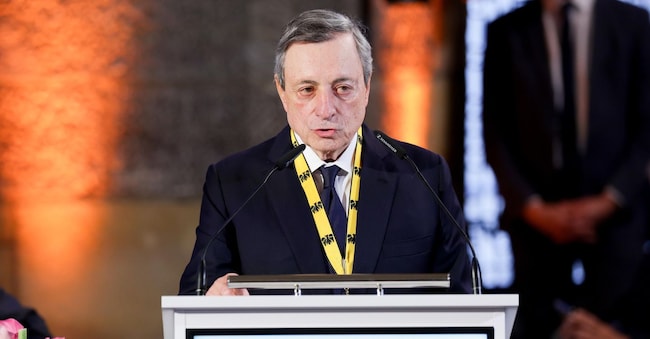
We publish the speech by Mario Draghi, delivered at the ceremony for the International Charlemagne Prize of the city of Aachen.
Mayor Dr. Ziemons, Chancellor Merz, Prime Minister Mitsotakis, President Laschet, President Lagarde, Distinguished Laureates from previous years, Eminences and Excellencies, Dear Guests, Ladies and Gentlemen,
I will not pretend that what awaits Europe is easy. The tension our continent is under is deep and getting heavier by the month.
But this is not only a moment of danger. It is also a moment of revelation.
Because the forces challenging Europe today are accomplishing something that decades of peace and prosperity have failed to do: they are pushing Europeans to recognise, once again, what they have in common and what they are willing to build together.
This should give us confidence. It should also make us clear about the magnitude of the task ahead of us.
Since 2020, external shocks have followed one after the other, each aggravating the previous one and further narrowing the space for hesitation. We are still absorbing tariffs from our largest trading partner, at levels unprecedented in a century. Most recently, the war in the Middle East has brought inflation back into our economies and anxiety back into our households. Even when the Strait of Hormuz reopens, the rifts in supply chains could extend for months or years.
These shocks would be difficult under any circumstances. But they come at a time when Europe's need for investment has become enormous. The previous estimate of around EUR 800 billion a year in additional strategic spending has risen with the defence commitments of recent years to almost EUR 1.2 trillion a year on average.
Growth is therefore the precondition for everything Europe says it must do today: financing the energy transition, defending its continent, building the industries of the digital age and supporting ageing societies.
And the world that once helped Europe generate prosperity no longer exists. It has become harder, more fragmented and more mercantilist.
Across the Atlantic, we can no longer take it for granted that the guardians of the post-war order remain committed to preserving it. Decisions with far-reaching consequences for European economies are increasingly being taken unilaterally, ignoring the rules that the United States once championed. And for the first time since 1949, Europeans are facing the possibility that the United States will no longer guarantee our security on the terms we once took for granted.
On the other hand, China does not offer an alternative anchor either. It is generating industrial surpluses on a scale that the world cannot absorb except by hollowing out our own manufacturing base. And it is directly supporting our adversary, Russia.
In a world of evolving partnerships, every strategic dependency must now be re-examined. For the first time in living memory, we are truly alone together. Europe is responding to this new reality. But it is responding within a system that was not designed for challenges of this magnitude.
The European project was built, deliberately and wisely, to prevent the concentration of power. After the catastrophes of the first half of the 20th century, Europeans determined that no one member state would dominate over the others.
Instead, they created a different, shared and diffuse model of governance. They relied on independent agencies, rule-based processes and financial markets to do a job that, elsewhere, would have required open political choice. Where agreements had to be reached between governments, European governance wrapped them in layers of procedure that deprived them of their political charge. Decisions that in another context would have been divisive ended up appearing administrative.
The results of that system have been extraordinary. Peace on a continent once defined by war. The return of nations that had spent generations behind the Iron Curtain to a community of free peoples. The single market. The euro. The freedom to move across borders that had divided Europeans from one another for centuries.
For seventy years, this architecture has carried Europe forward. It allowed us to achieve something historically rare: integration without subordination. But it was based on two fundamental assumptions.
The first was that Europe had built a truly open economy in which the state did not need to direct growth: free trade internally through the single market, and free trade externally through a rules-based international order.
The second was that Europe would never again have to deal with the most difficult questions of power and security, because they would be solved for us.
Both assumptions have now proven to be fallacious. And as they fade away, the political issues that Europe had sought to mitigate are returning to the heart of the European project.
Nothing makes this more visible than the contradictions of the European economic model.
Externally, we dismantled trade barriers, embraced global supply chains and built the most open of the world's great economies. Internally, however, we have never fully practised the openness we preached: we have left the single market unfinished, capital markets fragmented, energy systems insufficiently connected, and large parts of our economy entangled in layers of regulation.
There is irony in all this. Europe relied on the markets to do a job that the common political authority was not in a position to do. We denied those markets the continental scale they needed to succeed. The result was not a true market economy, but an asymmetric economy. And from this asymmetry stem many of the vulnerabilities that Europe faces today.
The first vulnerability is our exposure to external demand. European companies have been pushed outwards in search of the growth that Europe itself could not provide. Since 1999, trade as a percentage of GDP has risen from 31% to 55% in the euro area. In the US and China, by contrast, it has barely moved. Both remain much less exposed to trade.
Our sensitivity to changes in American and Chinese policies is therefore not simply an externally imposed misfortune. It is a reflection of our own failure to build a sufficiently deep internal market.
The second vulnerability is our growing strategic dependence. No advanced economy can eliminate it completely. Even the United States has its exposures, including in critical minerals. But Europe's position is of a different order.
If we had taken the necessary measures to integrate our economy, the capital markets would have channelled more of Europe's savings into domestic productive risk. Energy would move more freely across borders, supported by networks, interconnectors and storage. Decarbonisation would be more within our reach, and our economies less sensitive to fossil fuel shocks: since the beginning of the conflict in Iran, citizens of countries with higher shares of clean energy have paid, on average, about half as much in wholesale electricity prices as those with lower shares.
But Europe chose a more defensive path. We tried to keep disruptions at bay. We limited consolidation, constrained risk and postponed cross-border investments. But the result has not been more control. It was dependence.
Today, half of the capital invested through European funds flows back to the US, where both risks and returns are higher. We depend on America for 60% of our LNG imports. Even in clean technologies, Europe is still unable to deploy its green transition on a large scale without increasing dependence on Chinese supply chains.
The third weakness, and perhaps the most important, is Europe's deteriorating position in the technologies that will define the next decade.
Since 2019, the hourly productivity gap between Europe and the US has widened by 9 percentage points, at purchasing power parity and constant prices. This does not, in itself, measure differences in living standards. But it does indicate a widening divergence in productive capacity, reflecting not only the larger size of the US technology sector, but the deeper digitisation of businesses and workflows in the US.
Artificial intelligence now adds to that gap.
OECD scenarios suggest that about half of the productivity growth in the next decade could come from AI and its deployment in the economy. At no time in recent memory has such a large part of our economic future depended on a single technological transformation.
But AI is not simply yet another digital tool to be adopted. It requires industrial mobilisation on a scale not seen in generations: huge investments in energy, semiconductors, computing infrastructure and capital. And here Europe is lagging behind.
The US is on track to spend about five times more than Europe on building data centres by 2030. China is mobilising on a similar scale. If Europe were to match that ambition, energy demand could increase by 20-30% compared to today.
Europe has the savings, talents and latent energy potential to compete in this transformation. But the same barriers and constraints that have produced our exposure and dependencies now prevent us from mobilising on the scale that the moment demands.
This is not a gap we can afford to let widen. Unlike electricity or the internet, AI improves with use. Each cycle of implementation generates the data and capabilities that make the next cycle even more powerful. The economies that combine these advantages first will move ahead permanently.
All three consequences point back to the same source. Europe has opened up to the world without completing the market internally. It has become too dependent on foreign demand, too dependent on capacities controlled elsewhere and too fragmented to mobilise its own scale.
The question now is how to correct this imbalance. Across Europe, different answers are emerging.
For some, the answer is not to change: while others retreat from openness, Europe should seize the opportunities they leave behind, expand trade with the rest of the world and become the main defender of the rules-based system.
Europe can still gain from further trade liberalisation. But about the limits of the latter we have to be honest. According to one estimate, even if Europe successfully concluded all current trade negotiations, the long-term boost to our GDP would amount to less than 0.5%.
The deeper problem is political. Agreeing new trade agreements is easier than tackling unfinished business at home, because this work requires choices that Europe has long preferred to avoid: confronting established rentier positions and vested interests that benefit from an incomplete single market and fragmented energy markets. If openness remains our only answer, it becomes the absence of a decision.
For others, the answer is to reintroduce a strategic state into the markets. Across Europe, there is a renewed appetite for industrial policy, for directing capital towards technologies we have failed to build, for protecting strategic sectors from external pressures, and for using tariffs and state support to protect at home the growth we are losing abroad.
These positions are understandable. In many respects, they are necessary. All the world's major economies are now deploying their industrial policies on a scale that makes the idea of a globally levelled playing field seem ridiculous. Europe has to navigate increasingly complex dependencies on both the US and China. We cannot afford ideological rigidity.
But these instruments will not produce what their supporters hope for unless Europe also resolves the inconsistency at the heart of its economic model.
Let us consider what happens if Europe adopts a more assertive trade posture. Retaliation invites counter-retaliation, costs that Europe, in its current form, is ill-equipped to absorb. We are already seeing the effects of American tariffs: since Liberation Day, European exports to the United States have fallen by around 17%.
Yet, when we look across the Atlantic, we see an economy capable of preserving its growth from the disruptions it contributes to. Despite rising trade tensions, inflation and the conflict in the Middle East, the IMF has revised its growth forecast for the US upwards for next year, while it has revised Europe's downwards.
The lesson is that external hardness requires internal depth. Within Europe, Member States differ significantly in their depth of integration. The ECB's research suggests that if they all matched the level already achieved by today's best performers, long-term welfare gains could exceed 3%, roughly four times the growth impact expected from higher US tariffs.
'Made in Europe' should also be seen in this light: as a way to utilise European demand in a more deliberate way. It should offer industries with long investment horizons, such as semiconductors, clean technology and defence, a market large enough and stable enough to invest here. Without its own demand, Europe cannot sustain a credible posture abroad.
Industrial policy deals with a different version of the same problem.
If Europe's Member States attempt a large-scale industrial policy in the current single market structure, they will fail. They will spend inefficiently, fragment investments along national lines and impose costs on each other. IMF studies note that subsidies in one Member State suppress growth in others, with negative externalities eroding original gains in as little as two years.
The ideal answer would be to coordinate state aid at European level. But this is not the only way to reduce these distortions. A truly integrated European economy would in itself change the field in which industrial policy operates.
Even if state aid were still granted within national borders, its beneficiaries would increasingly be companies that are already proven across Europe. The leading companies in each jurisdiction would be less likely to be protected national players, and more likely to be European-scale companies competing where capital, energy, skills and supply chains are strongest.
In contrast to the failures of the 1970s, this is how true European champions are most likely to emerge: exposed to continental competition and supported by a Europe-wide political strategy.
This in turn would give governments clearer signals about where Europe's true competitive strengths lie. Public money would be less likely to support companies with no growth prospects, and more likely to strengthen the capacities Europe really needs. Intervention could become more targeted, less costly and more effective.
The more Europe reforms, the less it will have to rely on debt, national or common, to compensate for its fragmentation.
That is why the single market and industrial policy should not be treated as rival philosophies. If properly conceived, one reinforces the other.
But the deeper Europe gets into industrial policy and strategic technologies, the more difficult it is to avoid the central external fact of our time: our relationship with the United States has changed.
Europe cannot repatriate every critical technology on its own. The cost would be prohibitive. We will need preferential arrangements with trusted partners: purchasing guarantees, common standards, shared investment and secure supply chains. The US will remain central to this effort. The EU-US Memorandum of Understanding on critical minerals is a prime example.
Yet the partner on whom we still depend has become more confrontational and unpredictable. Europe has sought negotiation and compromise. Mostly it has not worked. Each time we absorb an unanswered shock, we lower the cost of the next one. A posture designed to de-escalate is instead inviting further escalation.
For now, Europe needs the ability to respond more assertively to put the partnership back on a more equal footing. What is holding us back is security. An alliance in which Europe depends on the United States for its defence is one in which security dependence can extend to every other negotiation: trade, technology, energy.
That is why the change in the American attitude on European security should not only be seen as a danger. It is also a necessary wake-up call. If the United States asks Europe to take more responsibility for the defence of our continent and our neighbours, then Europe must also gain more autonomy in the way that defence is organised, and with that autonomy will come greater strength in its trade and energy relations.
This should not weaken the transatlantic relationship or NATO. On the contrary, it would put both on a stronger footing. A Europe that can defend itself could even be a more valuable ally. And a partnership based on mutual strength will always be more mature than one based on asymmetrical dependence.
For Europe itself, the opportunity is substantial. Taking greater responsibility for our defence also means rebuilding the industrial and technological base on which that defence depends. European defence R&R is barely a tenth of American levels. European governments spend EUR 40 to 70 billion a year on American weapons, and our failure to consolidate demand wastes an additional EUR 60 billion in lost economies of scale.
But important changes are already underway.
Europe has made its most significant strategic choice in decades: to invest in its own defence. By the end of this decade, Germany alone will spend roughly as much as Russia now spends on its fully mobilised war economy.
And Ukraine is leading a form of practical defence integration that Europe has long struggled to achieve by design. Countries are ordering the same equipment because they cannot afford to wait for customised national variants. European companies are producing Ukrainian-designed systems on allied territory.
Defence cooperation is expanding rapidly: a recent mapping exercise identified more than 160 bilateral and plurilateral defence agreements between European states, the UK and Ukraine, most of which were signed after the Russian invasion. Six partnerships contain a mutual defence clause.
The task now is to transform this patchwork into clear and binding commitments. If a member state is attacked, Europe's response should be unequivocal even before the crisis begins.
There are two paths to give substance to that commitment, and they need not be mutually exclusive.
One is through smaller coalitions of countries that already share similar capabilities and threat perceptions. In practice, much of the European military response is already supported by a core group: Germany, Poland, France and the UK, together with the Nordic and Baltic states that are closest to the threat.
Not all countries have to contribute in the same way. Ukraine has shown that modern defence no longer ends with tanks, aircraft and artillery. It also depends on batteries, sensors, software and the ability to rapidly adapt civil technologies. Some countries will provide forces; others will provide drone components, cyber capacity or logistics; still others will help financially.
The other path is to give operational substance to Article 42.7, the EU mutual defence clause, which, although legally defined and once invoked, has not yet been translated into concrete plans, capabilities and command structures.
Much will depend on who joins this common effort. Every political community is ultimately shaped by its understanding of mutual obligation, by what its members believe they owe each other when the worst happens. For seventy years, Europe has been able to leave this question partly unanswered. Now we have to answer it ourselves.
The first signs are already beginning to show. When Russia invaded Ukraine, Europe chose to stand by a nation fighting for its freedom, and has kept that commitment year after year. When Greenland was threatened, Europe stood up to its closest ally and, in doing so, discovered capabilities it did not know it had. Even parties that have built their identity on national sovereignty now recognise that no European nation can defend it alone.
But the pressure for change is now coming from all directions. Europe is being forced to make decisions that have hitherto been avoided. And for the first time in many years, the conditions for making those choices are beginning to exist.
There is a unity of diagnosis that is genuinely new. The nature of Europe's predicament is now widely understood by governments and citizens. The roadmap for action exists and, in some areas, the European Commission is already taking action.
Under the pressure of these years, Europeans are reminded of values they had begun to take for granted: solidarity, democracy, rule of law, protection of minorities. This is the legacy of post-war Europe. And they are becoming visible again because they are being put to the test.
This recognition is more powerful than any political agenda, because it gives Europeans a reason to act. And citizens are already clear about the direction Europe should take: nine out of ten people surveyed by the Eurobarometer want the Union to act with more unity; three quarters want it to have more resources to face future challenges.
But when citizens ask for more Europe, they are not simply asking for more of the Europe we have. Nor are they asking for an abstract institutional project. They are asking for practical improvements in the way Europe protects and empowers them, in ways they can see working and for which they can demand accountability. The question is how to transform this demand for action into forms of decision-making that can meet it.
Our current experience is that action at the level of the twenty-seven often fails to deliver what the moment demands. The problem is not the lack of ambition among the leaders. It is what happens after ambition enters the mechanism. Agreements are worked out through committees that dilute and delay until the outcome no longer resembles what was intended.
The result is action that can be so inadequate to the scale of the challenge that it becomes worse than inaction. And an EU that claims responsibility but repeatedly disappoints enters a cycle from which it cannot escape: weakness in delivery erodes legitimacy, and weakness in legitimacy makes delivery even more difficult.
We must break this cycle.
Countries that feel the weight of this moment most acutely, and understand that the window for action will not remain open indefinitely, must be free to move forward. This is what I have called pragmatic federalism.
Its virtue is that it can rebuild together the capacity for achievement and democratic legitimacy. Countries with the will to act should deepen cooperation in concrete areas, through instruments that produce results citizens can see and measure. And each should enter through a deliberate national choice, approved by its electorate, so that citizens know what their government has committed itself to and can hold it to account.
Realisation builds legitimacy. Legitimacy makes deeper cooperation possible. And as the habit of acting together grows, so does the sense of common purpose.
This approach will necessarily be experimental. Some initiatives will work; others will not. That is why it is pragmatic. But it is also federalism, because the experiments are not random. They are driven by a shared destination: the conviction that Europeans must learn to wield power together if they are to preserve their values.
The euro shows how this can happen. Those who were willing have moved on. They built common institutions with real authority. When the commitment was tested almost to the breaking point, the solidarity required turned out to be far greater than many had imagined. The framework held, countries continued to join, and support for the euro is now at an all-time high. For the societies that share it, getting out of it has become almost unthinkable.
This is what makes European commitments enduring. Not the words written once in a treaty, but the experience of acting together, of being tested together and discovering through success that solidarity can work.
Our task now is to create that same dynamic again in energy, technology and defence. European leaders know where the work lies. They must now decide whether they are willing to put substance before process, and choose the instruments that can achieve it.
We have reached a point where the decisions Europe has to take can no longer be contained within the institutional framework we have inherited. Some require a scale that only Europe can provide. Others require a degree of democratic legitimacy that must be built from the ground up.
Together, they demand that European leaders go one step further.
Across our continent, Europeans are showing that they want Europe to act. They want the European Union to defend their freedom, prosperity and solidarity. And they continue to support, with passion, the values that make Europe worthwhile and that, today, make it unique.
The task now is to respond to that confidence with courage and show that Europe can once again turn crisis into union.
Brand connect

