
The Taranto MarTa exhibits 19 artefacts returned from the Metropolitan Museum in New York
Two years after the return of the 'Orpheus and the Sirens' group, it is now the turn of a series of objects that were in the United States, exported by trafficker Robin Symes. The investigation by the Carabinieri for the Protection of Artistic Heritage

Key points
More archaeological finds stolen from Italy years ago are returning to the National Archaeological Museum in Taranto (MarTa in acronym) thanks to investigations by the Carabinieri of the Artistic Heritage Protection Unit. In April 2023, it was the turn of the sculptural terracotta group of 'Orpheus and the Sirens'. Stolen in the 1970s in a clandestine excavation from the area of Taranto, which in antiquity was the capital of Magna Graecia, it had ended up first in Switzerland and then in Los Angeles, at the Paul Getty Museum. And now, from 16 December at MarTa, a further collection of 19 lots, part of a heritage of about 60, is on display, coming from the Metropolitan Museum in New York, where they had landed in an illegal tour. The artefacts on display in Taranto are part of the exhibition 'Stolen Memories' and have returned thanks to the action of the Carabinieri Department for the Protection of Cultural Heritage and the Rome Public Prosecutor's Office. In turn, the Ministry of Culture has developed a whole cultural diplomacy with both the Met in New York and the US administration. The artefacts are part of a series of antiquities that came into the British company in liquidation Symes Ltd and belonged to the antiquities trafficker Robin Symes, one of the most notorious names of the 20th century for this type of trafficking and who over the years resold the artefacts to the world's most famous museums, which bought them without knowing where they came from. Compared to what Robin Symes had illicitly acquired and exported over the years, since 2000 ministry of Culture and Carabinieri have brought back to Italy about 750 artefacts.
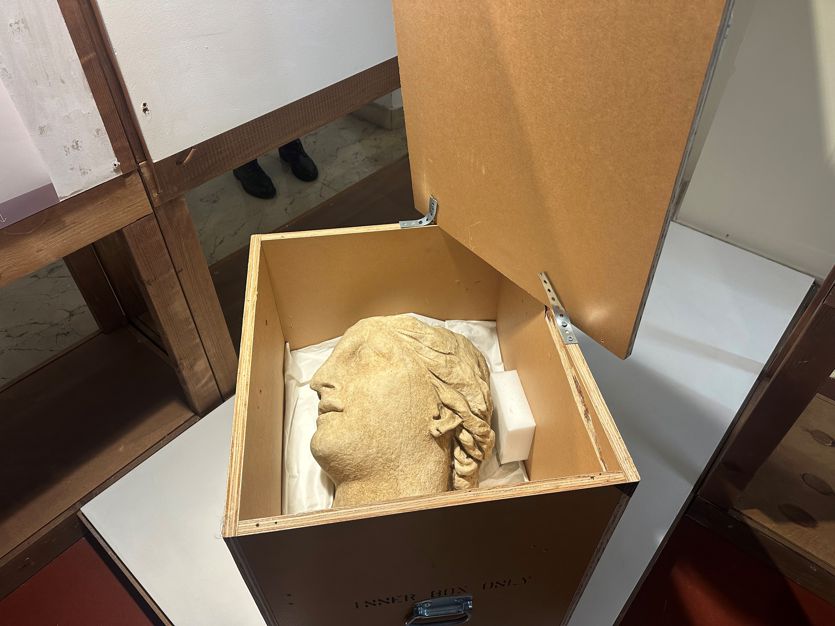
Marble head of the goddess Athena
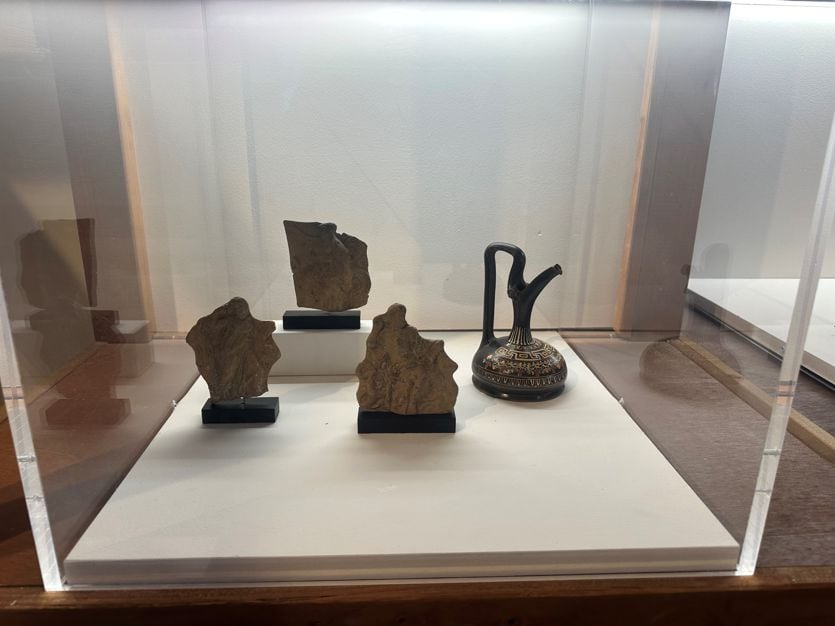
Among the goods on display in Taranto is a marble head of the goddess Athena dating from the end of the third century BC. The head of the goddess is placed in the case used for transport and may have originally been placed in the cella of an open-air temple as a votive image. Athena is a warrior goddess. Other objects are a wall painting with battle scenes, fibulae from 325-300 BC and the 2nd century BC, a ring from the 6th century BC, terracotta and soft stone reliefs, bronze ornaments with gold grafts. The artefacts lack documentation on the context of their provenance and often show tampering or improper restoration, elements that do not allow for an immediate reconstruction of their path, nor to attribute them with certainty to a specific territory, which is not necessarily ascribable to the Taranto area. Only some artefacts show clear and consistent affinities with materials held in the collections of the Taranto Museum, while for others any hypothesis remains premature.
Falzone: reconnected what had been dismembered
Stella Falzone, director of the Taranto Museum, speaks of 'an important day. Our valorisation,' she explains, 'aims at building paths of knowledge and awareness. The artefacts returned to Italy thanks to the action of the Carabinieri assigned to the Protection of Cultural Heritage, an Italian excellence that demonstrates that our historical-artistic heritage is protected by skilful hands and vigilant skills'.
For Falzone, 'the illicit trafficking of artefacts and criminal action have detached the object, the good, from its connection with the context of history and territory. The relationship between objects and context is very important. We have reconnected and given meaning to something that someone had dismembered for the sake of commodification and financial gain. Until recently, important museum institutions had no great scruples about taking art and archaeological objects of unknown provenance, but now the course has been reversed. Major museums like Boston, the Metropolitan, the Getty, I am talking about the most important American museums, are favouring restitutions thanks to the cultural diplomacy of Italy and our Ministry of Culture'.
Marinucci: complex investigations and infinite paths
"One often wonders why these artefacts return to Italy after twenty years and sometimes even more,' says Colonel Antonio Marinucci, commander of the Carabinieri in Taranto, who also represented the Carabinieri's TPC unit in the illustration. 'The reason is that so many checks are carried out first with complex, lengthy, international investigations. The Carabinieri for the Protection of Cultural Heritage start by monitoring auction houses and brokers of art objects and follow their activity. Works exported without certification and authorisation often follow endless paths. Even the documents relating to the object are subjected to washing and reworking so that the reconstruction of the route becomes difficult. It is only after this work has been done that one can go to a museum and present findings and objective data proving that that archaeological good has been stolen'. "It is very important," Marinucci concludes, "to photograph art objects. The Carabinieri of Artistic Heritage have a constantly fed database of stolen works of art and this facilitates the tracing and recovery of the works themselves'.

