
Jenny Saville's tortured nudes on show at the National Portrait Gallery
The retrospective exhibition dedicated to the artist entitled 'The Anatomy of Painting' can be visited until 7 September

2' min read
2' min read
Jenny Saville is one of the world's best known and most highly regarded artists and has had exhibitions dedicated to her in Italy as well, at the Museum of Contemporary Art in Rome and more recently at the Museo Novecento in Florence. Yet the major retrospective now being dedicated to her by the National Portrait Gallery is the first solo exhibition in a British museum. The artist has chosen the fifty paintings and their placement, in chronological order, in the gallery's large rooms that can do justice to her monumental canvases.
The female body
.As can be seen in the first room, already at the beginning of her career in the early 1990s, the 20-year-old Saville had started her personal research centred on the female body and carnality and had created a unique and personal figurative language, rethinking and relaunching figurative painting.

As soon as she had finished her studies at the Glasgow School of Art, she was noticed by collector Charles Saatchi, who bought Propped, from 1992, a portrait of a naked woman precariously seated on a stool, digging her nails into her flesh, a painting that still has the power to shock and which showed the extent to which the young artist wanted to challenge conventional standards of beauty.
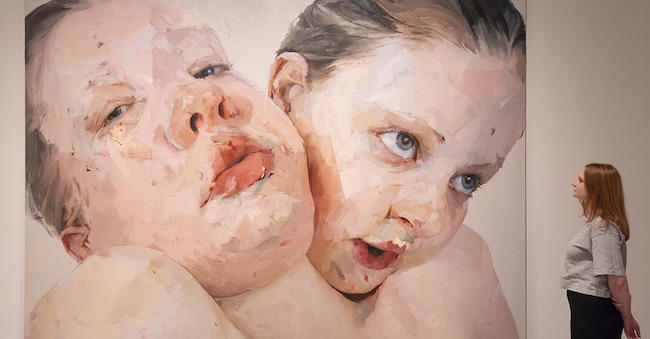
The artist's favourite subject is the carnality of the human figure, the expressiveness of the body emphasised by the powerful and visible brushstrokes. Painting is an absorbing physical activity that Saville declares she loves beyond all else, the act of using brush and palette knife and putting layer upon layer of colour on canvas to render flesh, abundant yet fragile and tender, in an almost 'sculptural' way. Saville cites de Kooning's statement that "flesh is the reason oil painting was invented" as inspiration.
The Naked
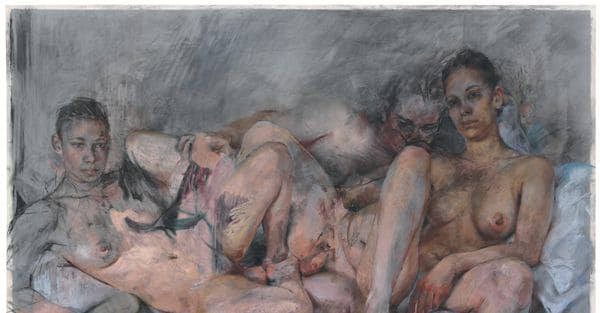
In addition to the often distorted monumental nudes, the faces in the foreground - often self-portraits - are also disturbing: battered flesh, swollen lips, eyes lost in emptiness or filled with terror, a physical torment and psychological discomfort accentuated by the strong, stark colours and strong brushstrokes. In order to observe at first hand how skin and flesh can be crushed, stretched, modified and reshaped, Saville observed live plastic surgery operations.

