
Mascognaz, the mountain dream of the king of luxury yachts
Paolo Vitelli (Azimut Benetti) refurbished 11 chalets in a Walser village and turned them into exclusive suites. And his daughter got five stars

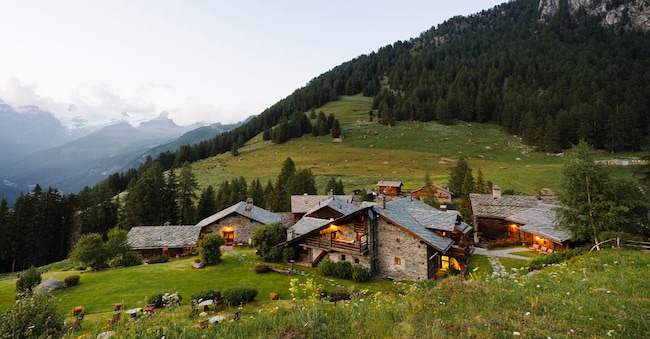
Un sogno che va dal mare alle montagne: da altitudine zero, con gli yacht, a 1.800 metri in quota, con un affaccio sul Monte Rosa. Il sogno è quello realizzato da Paolo Vitelli, grande imprenditore del mondo della nautica, recentemente scomparso, che ha portato la sua azienda, Azimut Benetti, a diventare, dal 1969 a oggi, la numero uno al mondo nella produzione di yacht dai 24 metri in su. Ma non si è fermato lì; perché, da perfetto subalpino (era nato a Torino e ha fondato la sua azienda ad Avigliana), quando il mare gli aveva dato già quasi tutto, ha rivolto lo sguardo ai monti, quelli sopra la casa di famiglia a Champoluc, in Val d’Ayas. E anche lì ha ha fatto impresa, più per passione che per profitto, trasformando, dal 1998 in poi, un antico villaggio Walser, probabilmente risalente al 1300, in un albergo diffuso: l’Hotellerie de Mascognaz; che quest’estate, sotto la guida, ormai, della figlia Giovanna, ha conquistato le cinque stelle.
Vitelli, accustomed to walking the paths around Champoluc, fell in love with this semi-abandoned village in the shadow of Monte Rosa. He discovered that some of the houses dated from the 17th and 18th centuries, but he also found some that dated from the 15th century. At first, he thought of creating a traditional hotel structure, but with respect for Walser architecture. He bought the first rascard, the name of the houses of a population originally from Canton Valais (hence the name), but of Alemannic stock, who settled (in addition to Lichtenstein, Austria and France), in Piedmont (in Valsesia and Ossola) and in Val d'Aosta (in Ayas and the Lys valley).
With a conservative renovation, it transforms the building into a cosy hotel with only six rooms. The idea is to create an elite ambience but for people who love the mountains. The analogy with the world of big yachting is obvious, made up of customers with a passion for the sea, who also seek, however, in the yacht, an exclusive place with which to (momentarily) free themselves from the daily battle for business.
It is easy to see how Vitelli could not resist the charm of the place and decided not to stop at a single building but to gradually broaden his vision. In fact, he began to entertain the idea of an Albergo Diffuso and worked to acquire other rascards in a state of semi-neglect. An undertaking easier said than done, given that, since the 15th century, the ownership of those houses has stratified, accumulated and overlapped: each rascard belongs to brothers, cousins, nephews and nieces, who compete for the thousandths. A puzzle to find them and convince them to sell their shares. But Vitelli does not lose heart and with biblical-like patience, he slowly persuades many of them.
His daughter Giovanna recalls: 'You have no idea how many grappini and salami were consumed in the face-to-face meetings that my father had with the owners of the rascard, to convince them'. As he purchased, Vitelli restored the buildings, always using indigenous materials and local furniture, found with passion among the Valdostan antique dealers, and transformed them into luxury chalets. But a luxury that is only perceived when you enter, or when you enter the alpine spa, with panoramic windows overlooking Rosa, because the exterior has remained that of an ancient Walser village.


