
Maserati GranTurismo and GranCabrio return to production in Modena
Production of the two models was inaugurated at the historic Emilian plant, after being moved from Mirafiori. CEO Jean-Philippe Imparato denies rumours of sale of the brand in crisis

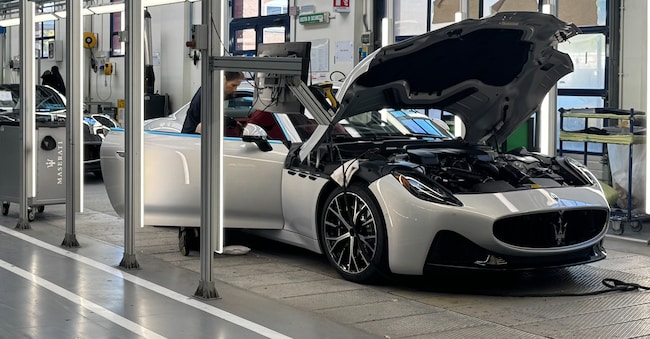
Maserati GranTurismo and GranCabrio return to production at the historic Viale Ciro Menotti plant in Modena. After the halt in production at Mirafiori, where the Fiat 500 hybrid (12 volt mild hybrid) was launched, the two sports cars are returning to the Trident marque's homeland. Because, as reiterated by CEO Jean-Philippe Imparato, with this operation of symbolic value, Maserati reaffirms both the company's commitment to the Italian Motor Valley and its desire to put Modena at the centre. The inauguration of the production line was also an opportunity to underline how the brand is within the Stellantis programmes, not only for production in Modena but also for the Emilian city that will once again become a central player in engineering development. A sort of 'Innovation lab 2.0' ready to work for all the group's brands. A series of prospective actions and visions necessary to restore momentum to a brand in great pain, with significant value on the brand and product front but with market numbers below expectations. On the sales front, Imparato stressed the importance of focusing almost obsessively on product quality, the importance of residual value, a drastic reduction in the stock of unsold cars and an overall production of 15/20,000 cars per year to make the brand profitable. Numbers achievable between the Modena plant and the Cassino plant, where Grecale is produced. The number one also denied the rumours about the sale of the brand in crisis that had multiplied in recent months
From Mirafiori to Modena
The move of the cars translates into a series of numbers that underline the desire to give new emphasis to the Emilian plant, with the two models placed on the same production line as McPura and GT2 Stradale.
A reallocation project completed in 45 days, between the last car to leave the Mirafiori plant in Turin and the first one made entirely in the Modena plant, without any impact on production capacity (from the current 4 to 7 cars per day) or quality levels. The result is the fruit of work that has involved more than 200 people, including technicians, workers and Maserati engineers, and has recorded more than 300 operational activities and 3,500 hours of training to transfer skills, update processes and ensure production continuity.
The production line is divided into six macro-areas: body line with metrology area, painting line, engine assembly line, vehicle assembly line flanked by mechanical preparation areas, testing line and finishing line. The plant, in all its phases, consists of more than 70 stations. In addition, there is the new painting area that meets all production requirements, including customisation for the Officine Fuoriserie Maserati. The assembly line uses the Agv (Automated Guided Vehicle) system to transport the bodies and the Tts (Team Trolley System) swivelling hooks to adapt in real time to the different car configurations. This modular approach makes it possible to go from McPura to GranTurismo with the same line-up team. "The return home of the GranTurismo and GranCabrio", declared Jean-Philippe Imparato, "is not just a tribute to our legendary history, but a strategic and identity choice that looks to the future with pride and determination, confirming the central role of Modena and Maserati's desire to continue to invest in Italy, enhancing excellence, skills and vision. It is also a concrete sign of cohesion and belonging, renewing the firmest intention to invest in this brand".

