
Collective catering: halved margins and the Cam knot
Scarsciotti: 'We are inclusive but companies cannot risk bankruptcy. Cost adjustment is needed'

3' min read
Key points
3' min read
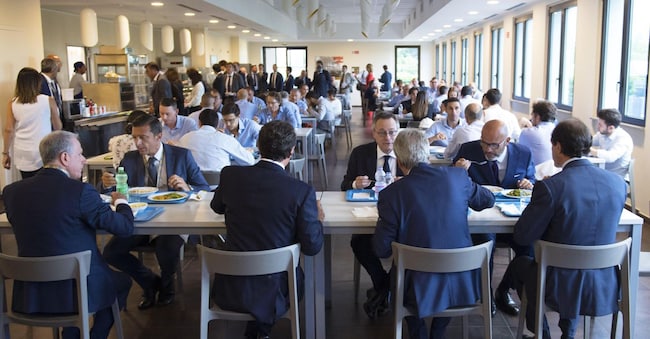
In 2024, margins will be halved for the thousand or so companies in the catering industry, those that prepare and serve meals in schools, company canteens, hospitals, nursing homes and hospices. The sector's turnover is around 4.5 billion, the workforce numbers 100,000 employees, 80% of whom are women, and in one year they serve more than 780 million meals. As a counterbalance here is the erosion of business margins, with an operating result of -69% compared to 2018 and a reduction of the Ebitda margin from 6% in 2018 to 3% in 2023. These are the key figures emerging from the research 'Challenges and opportunities for collective catering in Italy' commissioned by Oricon, carried out by Nomisma, and presented during a meeting held on Wednesday to highlight the sector's evolution and criticalities. A sector that has recovered in absolute terms the pre-pandemic turnover values, keeping the employment level unchanged, but with its business margins drastically reduced under the pressure of the growing costs of food raw materials (+19% from 2018) as well as energy (+37% coal, +36% natural gas, +28% oil) and the rigidity of the regulatory framework. The sector is overseen by five different ministries: Infrastructure and Transport for the Procurement Code, Environment and Energy Safety for Minimum Environmental Criteria (MC), Education and Merit for food guidelines in schools, Agriculture for the Control of Raw Materials and Health for nutritional guidelines for each user, to which are added all the local regulations issued by the regions.
Ours is a public service with a high social and collective value for which we need rules and a logical and coherent regulatory framework that fully interprets the demands of customers," Carlo Scarsciotti, president of Oricon, told the Sole-24 Ore newspaper. "If they ask us to be environmentally sustainable with organic or zero kilometre products, then we must be economically sustainable, otherwise our companies will sink, according to Nomisma data, into economic unsustainability. Clear reference to the Cam Decree of August 2020, at the height of the health emergency triggered by covid. 'No one checked whether it could be applied and whether there was and is sufficient organic raw material,' Scarsciotti emphasises. The work of the companies is made even more complex and costly by the demographic change and the advent of special diets that 'have to be prepared in separate areas and at an increased cost,' recalls the Oricon president, who adds. 'We are inclusive but the companies cannot risk going out of business so we need to adjust costs. Meals have an average price of EUR 5.7, which becomes EUR 5.3 in school catering. "The prices are absolutely incongruous and unreal, far from market values,' Scarsciotti adds. 'Collective catering should find a leading institution that considers it in its entirety, at 360 degrees, and a single text for collective catering that considers the social role of the service but also the difficulties and costs of the companies would be needed'.
The policy responses
.Present at the conference were, among others, Andrea Rossi, Secretary of the Agriculture Commission of the Chamber of Deputies, and Alberto Mattesco, Chief Secretary of the Deputy Minister for the Environment and Energy Security. On the subject of CAMs, Mantesco called for a rethink of their role. "The Minimum Environmental Criteria should be a tool with which to give value, to give competitiveness to our industry and to all the industries that participate in these 'controlled' public tenders, but they cannot be a constraint,' Mattesco said. 'Today I realised that in themselves CAMs in collective catering are not a problem. They are when a whole series of other factors come into play. They are a unitary document that takes all the different aspects into account'. After his speech, the head secretary made it known that he could take charge 'of an evaluation of all the issues that have emerged in order to assess and then suggest a modification of these CAMs that date back to 2020'.
"Collective catering makes public policy for two main reasons - is the premise of Andrea Rossi Secretary of the Agriculture Commission of the Chamber of Deputies -. The first is that at this time
is more or less entering the homes of more citizens. Because where there is a child at school, where there is a worker

