The instant book

Postgraduate master’s degrees: how to choose the right one – a guide from *Il Sole 24 Ore*

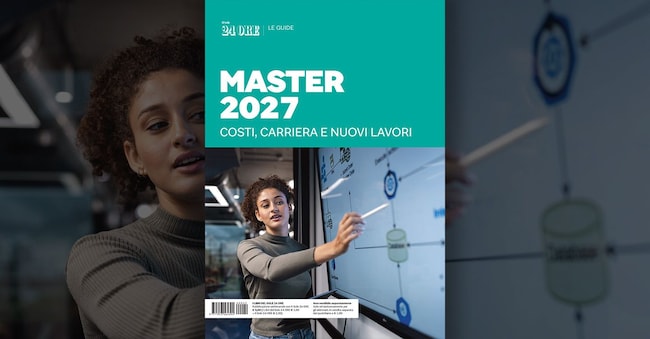
How do you choose a postgraduate master’s degree? The guide produced by *Il Sole 24 Ore* analyses 2,568 master’s programmes across 73 institutions, including universities and leading private colleges

4' min read

Translated by AI
Versione italiana

4' min read

Translated by AI
Versione italiana

Choosing a master’s degree is no longer simply a matter of picking a specialisation to add to your CV. In a labour market shaped by artificial intelligence, business transformation and the constant redefinition of skills, the first question becomes a different one: ‘Why go back to study right now, and what career move are you looking to make?’

This question forms the starting point for *Il Sole 24 Ore*’s new Guide to Master’s Degrees, available at newsagents on Wednesday 16 September alongside the newspaper. This special issue is designed to help readers navigate the postgraduate programmes on offer for the 2026/27 academic year, whilst also assessing their quality, costs and return on investment.

Loading...

The map compiled by *Il Sole 24 Ore* covers 2,568 master’s programmes across 73 centres, including universities and leading private institutions. The largest field is social sciences, economics and law, with 895 courses, followed by medicine with 842, science and technology with 487, and the humanities with 344.

The right master’s degree changes as your career progresses

The main new feature of this year’s Guide, however, is its approach. The starting point is not just the subjects, but the stage in their career at which those making the choice find themselves.

A master’s degree can help a recent graduate to turn theoretical knowledge into practical skills that can be put to use in their first job. It can help those already in work to change sector or role without having to start from scratch. It can support career progression towards roles of greater responsibility, provide new skills to those who need to update their knowledge because technology and regulations are changing their profession, or facilitate a return to work after a break.

Five career milestones – starting out, changing direction, developing, updating your skills and making a fresh start – each of which requires a different approach and strategy. Because there is no single ‘best’ master’s degree: the right one is the one that best aligns with your starting point, your career goals and the stage of your career.

How to tell if a master’s degree is really worth it

However, even before choosing a subject, it is important to check the quality of the course. The Guide sets out the factors to consider before enrolment: recognition of the qualification, course content, faculty, teaching methods, genuine links with businesses, work placements, networking, career services and graduate employment outcomes.

One article is devoted to the eight indicators to look out for to determine whether a master’s degree is worth the investment. Another outlines the questions to ask the career service before enrolling: when does the career support begin? How personalised is it? Does the service merely publish job vacancies, or does it actually put students in touch with companies? And does it continue after graduation?

Data on placement should also be read carefully. Very high percentages are only meaningful if it is clear how they have been calculated, based on how many graduates, how long after the end of the course, and what type of employment is being considered.

The cost isn’t just the tuition fees

The decision is inevitably influenced by the budget as well. The enrolment fee is, in fact, only part of the cost.

Loading...

For those who have to move to another city, rent, food, transport and study materials must be added to the costs. For those undertaking a full-time course, the opportunity cost must also be taken into account – that is, the income foregone by delaying entry into the workforce or temporarily suspending work.

In some cases, when you add up tuition fees, accommodation, living costs and loss of earnings, the total investment can reach or exceed 40,000 euros. That is why the Guide also includes scholarships, grants, loans, financial assistance and tax relief.

From AI to life sciences: the skills that are changing

Once the objectives, quality and investment have been verified, it remains to be seen where the programme is heading. And this is where another feature of the 2026/27 programme emerges: master’s programmes are becoming less and less confined to a single discipline and increasingly serving as forums for the exchange of expertise across disciplines.

The first area covers artificial intelligence, data and cybersecurity, which have now become integral to the work of managers, compliance professionals, marketing specialists and human resources staff.

Industrial transformation brings together advanced manufacturing, energy, supply chains, mobility and urban regeneration, driving up demand for professionals capable of combining technical skills, data, sustainability and organisational expertise.

In the life sciences, biotechnology, pharmaceuticals, digital health, research, regulation and the market all intersect. In the realm of geopolitics, finance and compliance, risk assessment, supply chains, financial planning and new regulations are becoming central. And in the sectors of media, culture, design, fashion, marketing and HR, generative artificial intelligence is already transforming content, creativity, user experience and relationships with audiences.

The common thread is hybridisation: specialist skills remain fundamental, but they gain value when they can interact with other areas of knowledge.

Copyright reserved ©
Loading...

Brand connect

Loading...

Newsletter

Notizie e approfondimenti sugli avvenimenti politici, economici e finanziari.

Iscriviti