
Matera, the Sassi and those two mouths of fire
The bread kneaded by the women of Matera was baked in public ovens and stamped so that it could be identified: it was kept for many days and other dishes were made from it

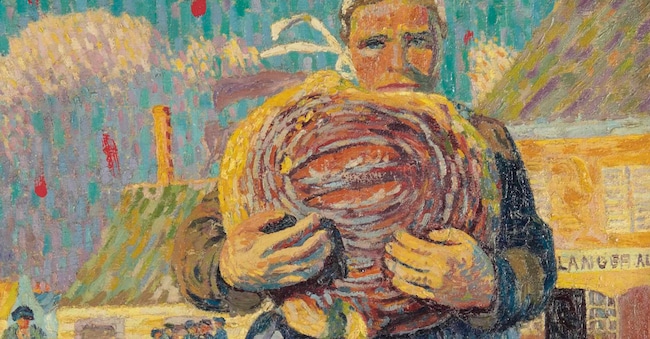
I have the good fortune to know a gentleman of almost one hundred years of age who was born in the Sassi in 1930, who lived there before the emptying out ordered by the special law of 1952 (ordered by Alcide De Gasperi's government) and tells me, every time we meet, about the traditions, habits, and characters that characterised life in the ancient districts of Matera.
Naturally, in its evocations, bread has a central place. Because it was their daily food, along with pasta, pulses and vegetables ('meat was eaten three times a year: Christmas, Easter and 2 July', the day on which the town's beloved patron saint, the Madonna della Bruna, is celebrated).
And so I discovered where the typical taste and texture of the loaf of bread comes from, which many tourists now buy before they leave, which university students do not give up (there is always a place in their rucksack) and which is now widespread throughout Italy.In the Sassi bread, kneaded by the women, was a precious resource: in times of difficulty - especially during the years of war - bread was always a means of survival. In every cave of the Sassi there was a large wooden box that contained the durum wheat grown by the farmers (the majority of the Sassi inhabitants). The others - merchants, workers, artisans - bought it from the farmers themselves. That wheat was taken to the city's mills ('each family had its own of trust') and from the milling process various products were obtained: bran for home-bred farmyard animals ('like the hens that lived under the cot'), semolina used for dark pasta, semolina for light pasta ('sometimes, during festivals, even for some sweets') and flour for bread. The latter, after being sifted and purified of lumps and waste, was poured into the 'tavoliere', another element present in every cave-dwelling and hung on a wall: a table with a wooden frame on which the Matera women worked the flour mixed with water and yeast for a long time, methodically, before wrapping the mixture, divided into parts, in a white sheet and storing it in a woollen blanket. This special bundle was then 'put to bed' and covered, and left to rest and grow.
But the best is yet to come. The elderly gentleman, in fact, tells me with gusto and abundance of detail how the bread went on its journey. At home, in fact, there were obviously no ovens (nor was there, in those days, running water, sewage, electricity, let alone heating). So people took the dough to be baked in public ovens, following a well-established ritual. In Via Fiorentini, the main street of Sasso Barisano, there was a large one with two mouths side by side. That is why that area was called u'mbirn, hell! At four o'clock in the morning, two trumpet blasts resounded in the alleys (the Sassi quarters): it was a kind of 'bread auctioneer' to whom the women had to communicate, looking out of a small window, that they had prepared their loaves of bread that day. The 'auctioneer', an employee of the bakery, made the rounds of the collection house by house (cave by cave) starting at nine o'clock in the morning: he arranged the loaves on a table, neatly arranged in rows, and carried them on his shoulders into the cave lit by a powerful fire. It was no small effort, among the lanes, stairs and steps of the Sassi. A first round was followed by others, until the moulds of those who had booked to be cooked were in place. Yes, but how did they, the women, recognise their 'creature' in that jumble of dough? There was no danger: the baker would give the compounds their precise shape, under the watchful eyes of each of them ('there were those who wanted u pizz, the piece, with a circular base and a sort of dome in the middle; and those u' squanét, the flat, flattened and with less crumb'). At this point, the baker would stamp the bread with the initials of the name of each family: when the baking was finished, these marks were clearly visible and there was no possibility of confusion. So the 'auctioneer', in the early afternoon, would do the operation in reverse: he would carry all the fragrant loaves, lined up on the table, to each house-castle. It was a bread that kept for a long time and satisfied the needs of the large families of the time for days on end. Until the next kneading and trumpet blasts. When it became hard, recalls the almost centenarian, it was transformed into something else: slices were roasted on the brazier, they became crispy and covered with tomatoes. Irresistible. They were the fedde ross, the red slices, forerunners of bruschetta.
When it became so hard that it could no longer be cut, it was chopped up and kept in a bowl full of water. Once it had softened, the water was removed and it was enriched with tomatoes, sliced onion, and/or pieces of pickled peppers, all sprinkled with oil: the so-called cialledda. Two more delicacies were born from the hands of the women of the Sassi: u pizzaridd, a focaccia seasoned with oil, tomato and oregano, made from the leftovers of bread dough; and u ricc d'uggh, the rich in oil: spread on a copper cake tin, with more oil than normal and sugar. The dessert you don't expect, original and tasty.


