He was 99 years old

Mathematics: Peter Lax died, revolutionised science and technology with calculators

Among his most significant discoveries are Lax's equivalence theorem and Lax's entropy condition, which have had enormous repercussions both in pure mathematics and in its practical applications

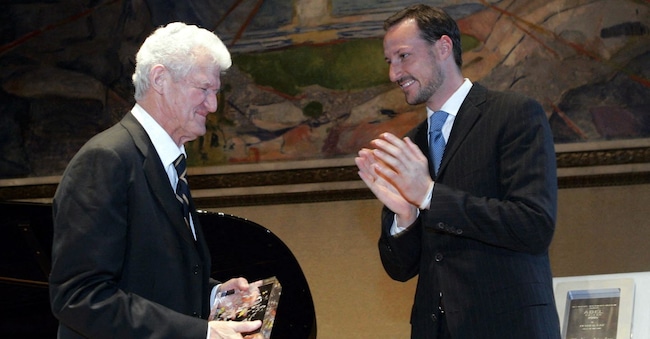
Peter Lax (a sinistra) riceve le congratulazioni del principe ereditario norvegese Haakon dopo aver ricevuto il Premio Abel per la matematica durante una cerimonia a Oslo, il 24 maggio 2005, per il suo contributo alla teoria e all’utilizzo delle equazioni differenziali parziali. Le teorie del professore ungherese della New York University su queste equazioni non lineari si sono dimostrate utili nel prevedere comportamenti complessi in aerodinamica e meteorologia. (AFP PHOTO/Knut Falch/Scanpix)

2' min read

2' min read

US naturalised Hungarian mathematician Peter Lax, who revolutionised science and technology with calculators, pioneering the adoption of supercomputers in the applied sciences, died on Friday 16 May at his Manhattan home at the age of 99.

The news of the death was confirmed by his son James D. Lax to the 'New York Times', who explained that the cause was amyloid cardiomyopathy.

Loading...

He was professor emeritus at New York University, where he was also director of the Atomic Energy Commission's Centre for Computation and Applied Mathematics (1964-72) and director of the Courant institute of mathematical sciences (1972-80).

Born in Budapest on 1 May 1926, Lax was placed in the care of Hungarian mathematicians Rósza Péter and Dénes Kőnig at an early age. When his family, of Jewish origin, emigrated to the United States (1941) to escape anti-Semitic persecution by the Nazis, Kőnig pointed him out to John von Neumann, who became his mentor.

Lax was one of the most influential figures in 20th century applied mathematics. His career had a lasting impact not only in the field of mathematical theory, but also in practical applications in science and technology, making a decisive contribution to solving Cold War technical problems, from aircraft and weapons design to weather forecasting.

Lax was a visionary in applying mathematics to the new computational technologies that were emerging in the 1940s and 1950s. His work focused on the development of numerical methods for solving partial derivative equations describing a wide range of natural phenomena, from the propagation of shock waves to the analysis of weather forecasts.

His approach helped define how computers could be used to tackle complex phenomena, from meteorology to aerodynamics and even stock price forecasting. In particular, his innovations in numerical methods for non-linear hyperbolic equations have had an enormous impact on various fields, including materials science, aerospace design and electronic communication.

Among his most significant discoveries are Lax's equivalence theorem and Lax's entropy condition, which have had enormous repercussions both in pure mathematics and in its practical applications.

Copyright reserved ©
Loading...

Brand connect

Loading...

Newsletter

Notizie e approfondimenti sugli avvenimenti politici, economici e finanziari.

Iscriviti