
Matières Fécales kicks off the fashion weeks by dramatising social tensions
Steven Raj Bhaskaran and Hannah Rose’s brand-project takes to the catwalk at Place de la République, featuring the oppressed transformed into deities and semi-divine figures of colour who carry – quite literally – white billionaires on their shoulders

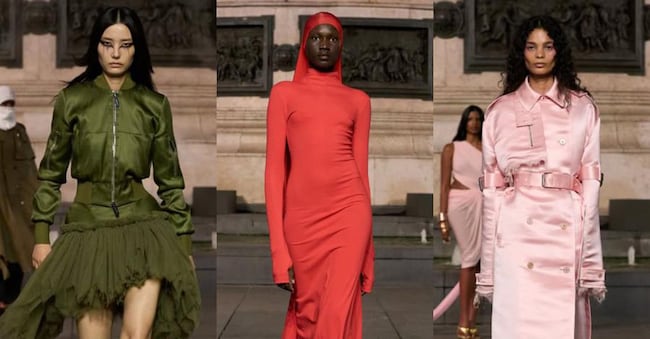
In Paris, they don’t beat about the bush. They don’t do business in a run-of-the-mill way, nor do they water down their vision, because there is such a high concentration of designers – though many are merely aspiring designers. Two relatively new names, who already have a sizeable following, are kicking off Fashion Week.
Steven Raj Bhaskaran and Hannah Rose bring Matières Fécales to none other than the Place de la République, with hordes of fans jostling at the entrance and the ultimate seal of pop fame: Rihanna amongst the audience. A place of camaraderie and protest, for a collection that celebrates marginality with a pharaonic mega-production and a theatricality as muscular and brazen as it is aimless.
The show’s narrative framework is autobiographical, drawing on Steven Raj Bhaskaran’s own experiences and the difficulties he has faced due to the colour of his skin – which is dark. A burning, urgent and unresolved issue which, when translated into a theatrical metaphor – and, moreover, within the context of a fashion show – risks being trivialised in a blatant manner. Between the oppressed who become deities and people of colour who are semi-divine figures carrying – quite literally – white billionaires on their shoulders, we find ourselves in the realm of populism. But fashion has long accustomed us to the dramatisation of social and political issues, which it always manages to defuse. The real problem with Matières Fécales is that, show-making blunders aside, the brand’s aesthetic is highly derivative: from the great Lee McQueen to Miguel Adrover, via Raf Simons’ urban guerrilla phase, it’s all been done before, just with a slightly gothic twist. It might be better to focus on that. When this project was in its infancy, it was far more authentic and interesting.
Hellen Hodakova Larsson’s language – known simply as Hodakova – is harsh, jagged, self-indulgently rough, yet intimately feminine, albeit in a raw and childlike way. The way she plays with forms, with the body, and with the narrative has a prepubescent quality to it, as if captured at that moment when the first stirrings of adolescence are still but flashes on a distant horizon.
This season, the show – hosted in the garden of the Swedish Cultural Institute – has the derailing incoherence of a dream: absurd associations of objects, from the plaster on the floor to a delirious text handed out to guests, folded into the shape of a paper boat; from miraculous fishing nets draped like dresses to stiff, oiled fabrics used everywhere. Wearable sculptures, on the other hand, have been kept to a minimum, and they are not missed. Is Hodakova moving towards maturity? It’s about time.

