
Matilde, adapts processes to the context thanks to accumulated knowledge
The company operates in the food, rubber and cosmetics industries and thanks to its newly developed model manages regulatory changes and what impacts supply chains

3' min read
3' min read
Tradition is not doing things the way they have always been done. It is knowing how to do things well. And, often, doing things well requires changing the way of doing them. In a traditional food business, flavour, organoleptic quality and nutritional value are values to be safeguarded, but the components of the recipe that produces them must sometimes change. And if this happens, the production system, the speed of reaction to the market, the profit and loss account can go into crisis. That is when Matilde, an artificial intelligence, can come into action.
There can be several reasons for a change in the recipe. First, regulation is an important factor, especially in Europe, where certain components are discouraged or banned over time. Secondly, supply chain stability is another key reason: wars, climate change, geopolitics, cause great tensions in the supply chains of components essential for certain productions. Finally, it is possible that recipes may have to change to achieve economic benefits: ingredient prices are certainly not fixed over time and all the variables of business costs may influence decisions on the need to save on certain components. These are critical changes that can jeopardise company stability, market position and profitability.
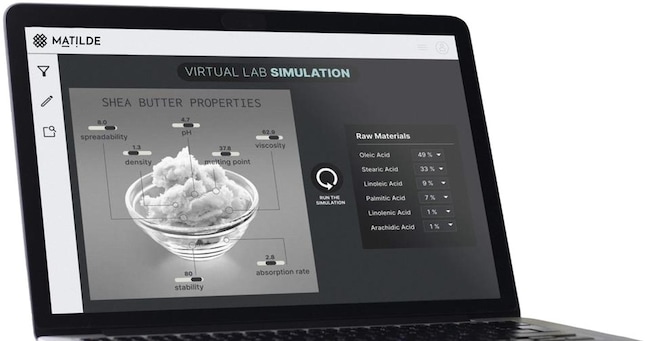
Well, Matilde is an artificial intelligence designed to manage these transformations. "If the experimentation to optimise these changes takes place materially in the laboratory, it can take a very long time," explains Francesca Saraceni, CEO of Intellico, the company that grew out of the innovative world of the Milan Polytechnic and designed Matilde. "But if one can rely on prior knowledge of similar transformations or experiments on similar changes, an artificial intelligence-based model can speed up the process, simulating laboratory experiments and helping to define which innovations are most likely to generate a valuable result.
In effect, Matilde exploits the knowledge accumulated over the company's history and simulates changes in product components, enabling a rapid and reasoned evaluation. "Also because," Saraceni recalls, "Matilde is an 'explainable' artificial intelligence. That is, it is a model that shows how it arrives at its conclusions and can therefore also be used to assess which are the essential variables or interactions between components to keep under control'. In complex systems, such as food products, but also cosmetics and chemicals, the results of changes are not only defined by the components that change but also by their relationships. The taste of a food product depends not only on the ingredients but also on how they influence each other and how they are prepared. The laboratory time for experiencing these changes is very long. Matilde, once she has learned about the company, all the experiments that have already been tried and documented, all the changes that have already been introduced and evaluated, takes a few days or a few hours.
Intellico was established in 2022. It currently operates with companies in the food, rubber and cosmetics industries. It has a turnover of one and a half million. And it has adopted the Euronext elite programme of Borsa Italiana to follow a discipline of quality management and communication with the market. The skills derived from the engineering and management school of the Milan Polytechnic are at the helm of a company that can currently count on a team of twenty people. And it is experiencing significant growth. The group also includes doDigital, the first company to which Francesca Saraceni dedicated herself, and which is dedicated to preparing the company database so that it can best serve the process of adopting artificial intelligence models. So that tradition and innovation proceed in parallel.


