
Mattarella turns 85: the challenges facing the Quirinale, from elections to the Constitution

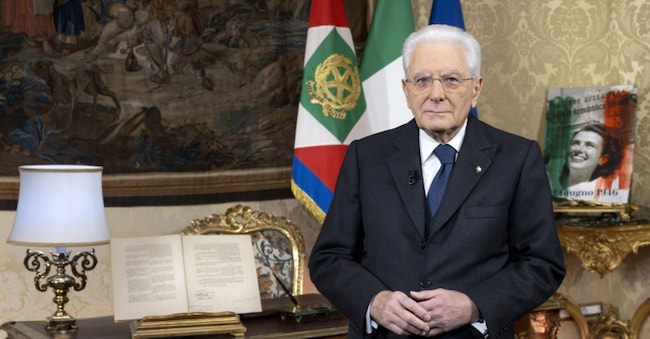
He will spend his birthday at Castelporziano, having lunch with his children and grandchildren, before returning to the Quirinale. Mattarella is celebrating his 85th birthday; the last 11 years as Head of State have been far from straightforward, given the various political crises and the succession of governments he has sworn in, not to mention the Covid pandemic and the wars. But even this 85th birthday of his comes at a time marked by some difficulties. There are already fixed dates on the agenda, but one event remains a question mark: the forthcoming general election. Will he have to dissolve Parliament early? Or will the parliamentary term run its natural course until September? Be that as it may, Mattarella knows that, in any case, he will have to face months of election campaigning, with its trials and tribulations that often involve the Quirinale as well. One need only look at the events of recent days.
A look ahead to a challenging season
Let’s start with the electoral law: it is unclear what the final version will be – with or without preferential votes, with or without a run-off. But, above all, if the current version remains in place – with all the doubts regarding its constitutionality that it has already raised – the first to be held accountable will be the Head of State at the moment of signing. And that’s not all. During the election campaign, clashes and confrontations flare up to fuel propaganda, but they often concern issues relating to the Constitution and the rule of law. We are talking about security, which seems to have become the main battleground between the two sides, with the added issue of revising the law on self-defence and the associated compensation for offenders. It is precisely on this front that Mattarella is already exercising his role of constitutional oversight, a role he has no intention of relinquishing.
No to the political role of ‘anti-Meloni’
As we have seen over the years, his approach to the presidency has been quite clear: he has no intention of playing a political role, let alone that of an ‘anti-Meloni’. However, with the same resolve, he intends to preserve the integrity of the office of President of the Republic and uphold the limits and guidelines laid down by the Constitution. We can therefore expect that, on the issues listed above – and there are quite a few of them – he will not fail to exercise his role as guarantor in complete autonomy. Certainly, the exercise of this role bears the hallmark of his style. This does not involve immediately seeking a platform for visibility. Rather, Mattarella always chooses to act, first and foremost, through moral suasion. That is to say, that form of institutional diplomacy which is based on collaboration between the various organs of the State and which makes itself felt through his offices, with suggestions and recommendations to bring texts and regulations back within the proper constitutional bounds without the need to resort to public reprimands.
Moral suasion and public appeals
Of course, that happens too, as we saw a few days ago in the case of Minister Nordio’s inappropriate move to launch a pardon inquiry into the jeweller Roggero, who had been convicted of the murder of two thieves. A move that placed the Minister for Justice outside the bounds of the Constitution, as Mattarella – publicly – sought to remind him by summoning him to the Quirinale and pointing out that the Constitution entrusts only the President with the independent power to grant pardons (as also established by a ruling of the Constitutional Court). He also reiterated what Einaudi used to say, namely that a Head of State must leave the presidential prerogatives intact for his successor.
The international front
His 85th year is already shaping up to be a complex one on the international front as well. There are not only the war zones – starting with the Russia-Ukraine conflict, on which he has repeatedly spoken out in support of Kyiv, provoking attacks from Russian government officials – but also the situation in the Middle East. Here too, he has not hesitated to condemn the carnage in Gaza at the hands of Netanyahu, or the attacks in Lebanon, which have even targeted our UNIFIL mission. The final front, then, is the one ignited by Trump and Israel’s war against Iran, further destabilising a world that has abandoned multilateralism. This is an approach which, according to Mattarella, must be restored so that we do not resign ourselves to a geopolitical order dominated by the arrogance of a few. Among them is Trump, who turned 80 in June and is set to face the mid-term elections this autumn – an event that will be followed with particular attention by Mattarella, a staunch supporter of Atlanticism but one whose values are clearly at odds with those of the American tycoon.


