
Mattarella in Seveso: no to trade-offs between human and economic costs
It was one of the “most dramatic” events in Italian history and “on a global scale”, says the Head of State, recalling “the trauma, the suffering, the anguish caused by the toxic cloud and then the exodus that was necessary”

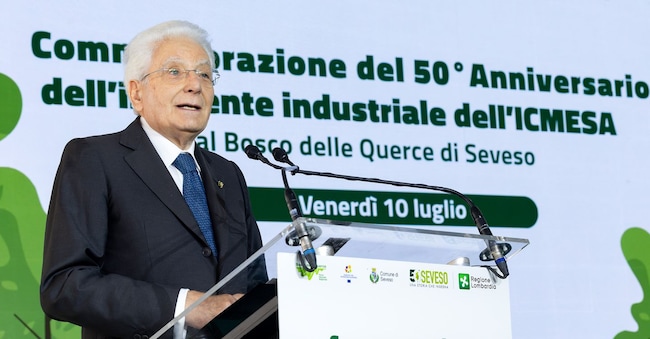
Mattarella was greeted with applause and a standing ovation as he entered the marquee erected in the Bosco delle Querce for the ceremony at 50th anniversary of the Icmesa dioxin disaster. Shortly before, the Head of State had made a point of meeting the young people from Seveso’s sports clubs. “You are the future of this park; I entrust you with the responsibility of managing it in the best possible way.” Fifty years have passed since that tragedy, but, as the mayor of Seveso, Alessia Borrioni, said, “Today is the day of our redemption”, and she thanked “the President for his presence, which is a recognition of the pain and dignity of a town that has never stopped believing in the future”. In her speech, she recalled that moment – the destruction, the abandoned homes, the isolation – but also the hope of those who remained and were able to get back on their feet. This redemption, indeed, is symbolised by the restoration of the oak forest, which is “the soul of Seveso: we,” said the mayor, “are now brimming with life,” she concluded.
The drama and the turning point
As Mattarella recalls in his speech, that was one of the “most dramatic” events in Italian history and “on a global scale”, he says, recalling “the trauma, the suffering, the anguish caused by the toxic cloud and then the exodus that became necessary”. But the Head of State is keen to emphasise that this was, above all, “a turning point” in Italian and European consciousness regarding “the culture of safety and prevention”. Indeed, that emergency spurred the rapid development of regulations “which were of historic significance because they were based on the protection of human life and the environment as a fundamental human right”. However, that turning point arose from a human tragedy, with many victims due to dioxin exposure – from the 200 children affected by skin diseases to pregnant women. “Personal and community tragedies” but supported by the solidarity and assistance of the fire brigade and doctors; Mattarella also recalls the figure of Carlo Galante, the Icmesa worker who entered the unit where the reactor had caused the disaster and, wearing nothing but a simple mask, operated the valve to limit the damage. “It was an act of true heroism,” insists the Head of State, who shows no leniency towards those responsible.
Unacceptable irresponsibility
“Even today, 50 years on, the intolerable irresponsibility of the company’s top management is still evident in the culpable delay with which they provided information on the gravity of what was happening.” An unambiguous judgement which emphasises that “the presence of dioxin was first concealed and then downplayed”, but that it was “equally shocking that it was only the disaster which revealed that trichlorophenol – a highly dangerous substance – was being produced at the plant. This constituted extremely serious reticence and cover-ups”. In short, beyond the tragedy itself, there was “the unforgivable delay in providing information”.
The Civil Uprising
Mattarella, however, wishes to celebrate what he calls a “civil revival” amongst the population, citing the Bosco delle Querce as an example of “evidence of the ecosystem’s recovery”. He adds, “the future has been reclaimed”. This is also thanks to the fact that, following the disaster, “stringent regulations such as environmental impact assessments and environmental authorisations to protect citizens” were introduced. He refers to the three Seveso Directives, which have become European laws.
No to trade-offs between economic and human costs: the EU must strike a balance
But what lesson does Seveso leave us with today? “Technological progress must serve people and communities.” And he is even more emphatic when he says that “any view that cynically posits a trade-off between human costs and economic benefits must be firmly rejected”. That is why he calls on Europe to “offer a balanced response” to these choices.


