
Mattarella: 'Sometimes I enacted laws I did not agree with'
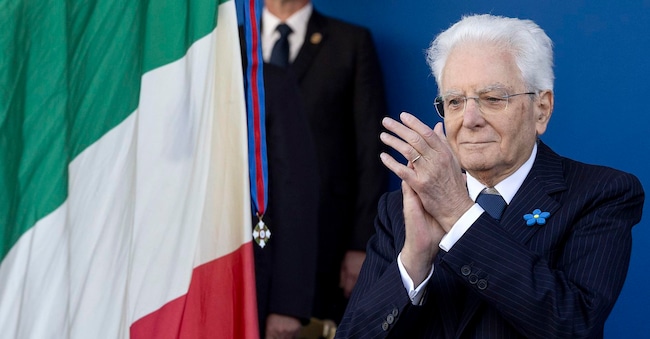
The President of the Republic spoke at the event "25 years of the Permanent Young Publishers Observatory".
3' min read
Key points
3' min read
"Sometimes you hear that there has been an appeal to the head of state not to sign a law because it is wrong, or if he signs it he is told that he agrees with it. Both statements are wrong'. This was how the President of the Republic, Sergio Mattarella, addressed the students attending the Salone delle Fontane in Rome, at EUR, to celebrate the 25th anniversary of the Permanent Observatory for Young Publishers. He did so in response to a precise question from a student. He went straight to the point: 'I am a referee, outside the political dispute. But the task of the Head of State is to remind everyone of the limits within which they operate'.
The 'super partes' role of the Colle
.A reminder, in short, of the super partes role of the head of state who 'intervenes when the mechanism jams. And it can happen'. In all this, the question from Tommaso, a student from Padua, is how does a man who has been through so many years of Italian politics keep his convictions, his ideas, outside the door. 'Yes I have taken decisions that I do not agree with, it has happened several times; the president promulgates laws and issues decrees, but he has rules that he must respect. Several times I have promulgated laws that I do not agree with, that I thought were wrong and inappropriate, but they were voted by Parliament and I have a duty to promulgate unless they are clearly unconstitutional. In that case I have a duty not to promulgate, but they must be evident, a single doubt does not authorise me not to promulgate'.
In front of a thousand or so students, the Head of State arrived without a prepared speech, but responded for some fifty minutes - to a room of young people attentive to his words, as could be understood from the silence surrounding Mattarella's words - on topics such as the importance of media literacy, the development of critical thinking, risks and opportunities linked to the growing use of artificial intelligence in our society, the super partes role of the President of the Republic in our democracy, young Italians and their future in the country, young people and politics.
The Head of State as "impartial arbiter"
."The Albertine Statute provided that the legislative power was entrusted to the two Chambers and to the king, who also had the power of sanction to say 'I do not agree with this law'," Mattarella added, inviting people to think of the president of the Republic as a referee: "I have also used the image, and I have said that the players must also help him in the application of the rules, plurality in the appearance of rules is fundamental. All this 'applies to the executive, legislative and judicial powers' because 'each power and organ of the State must know that it has limits that it must respect because the functions of each are not opposing forts to wrest power from one another, but elements of the Constitution called to collaborate, each with its own task and respecting that of the others. It is the principle of check and balance'.
Technology and information
The theme of technology and its intertwining with information was in any case central to the thought that the Head of State wanted to convey to the young people who had arrived from all over Italy to take part in the celebrations of the Observatory's activities chaired by Andrea Ceccherini. And relying on the web as 'the trusted doctor' is the great danger to be discarded, says Mattarella, referring in his reasoning, evidently though without ever mentioning it, to the tragic death of Margaret Spada: the 22-year-old girl who died in Rome following a rhinoplasty operation: 'We must avoid the risk of relying on the web as if it were the trusted doctor. We are seeing this also in these days with dramatic consequences. There are dangerous circuits that capture the user'.


