Politics and territories

Mayors: hard to govern without resources

Housing and services the priorities. Sala (Milan): funds for citizens to buy houses. Gualtieri: the government's plan lacks resources

by Lello Naso
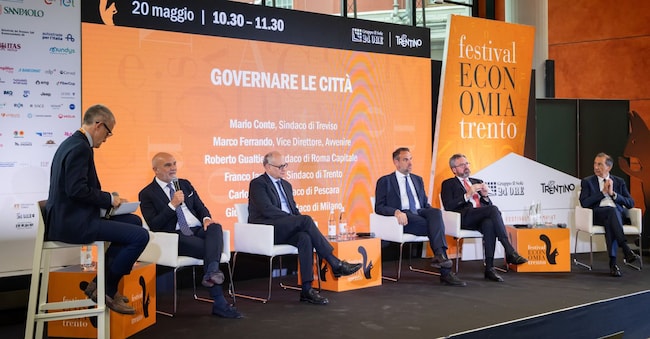
Governare le città

Nella foto: Marco Ferrando; Carlo Masci; Roberto Gualtieri; Mario Conte; Franco Ianeselli; Giuseppe Sala

4' min read

Translated by AI
Versione italiana

4' min read

Translated by AI
Versione italiana

They feel like an active reserve of the Republic. The outpost that, having administered and done politics in the field, makes its experience available to the community for the future, even at higher levels of government. Mario Conte, mayor of Treviso; Roberto Gualtieri, mayor of Rome; Franco Ianeselli, mayor of Trento; Carlo Masci, mayor of Pescara and Beppe Sala, mayor of Milan, stimulated by the deputy editor of Avvenire, Marco Ferrando, claim the work done at the helm of their respective communities. Starting with the mother of all questions for a mayor: can cities be administered?

"One must," Sala replies, "be aware of the enormous difficulties of the present, starting with the lack of resources. Only by believing in growth can funds be found to guarantee services to citizens. From public transport, which costs Milan 150 million deficit every year, to welfare, 400 million deficit. We must grow by drawing resources from the most well-off, those who pay rents in the Galleria, which under my management have risen from 35 to 85 million, to give to those most in need. Growth plus solidarity is the recipe'.

Loading...

Ianeselli believes that good governance of a city passes through necessary respect for its vocations: 'Trento,' he explains, 'is the last stronghold in Italia before the German world. It must choose between bulwark and contamination. It is a city that must guarantee quality to students and be attractive so that they can stay as graduates. It has a social soul: it must be governed with the associations, in the territory'.

'Treviso,' says Conte, 'is a small reality, with few resources where problems are amplified. We have a deficit of bureaucratic competences, we would love to have the autonomy of Trento. We often come up against bureaucracy and a higher level that prevents us from doing everything we would like'.

Gualtieri debunks the cliché of ungovernable Rome. "If it were, I wouldn't have run," he jokes, but not too much. "The city was in a bad state, but I can say that we governed well." Starting with everyday life 'On the ground,' he says, 'we see phenomena first and deal with them concretely. We are laboratory and outpost. For the climate, transport, fragility, the digital city. Even if our weapons are blunt. We cannot raise the tourist tax to ten euro for people who pay 30 thousand euro for a room. We cannot raise the occupancy tax for tables in the Spanish Steps. Citizens are asking for more services, but the resources are fewer and fewer'.

From the metropolis to the province. "We are the front office of the population," explains Masci. "Never before have we had to deal with social emergencies as in this period. In Pescara, there were 8,000 service interventions in 2019, there were 20,000 in 2025. The NRP confronts us with the challenge of managing the works carried out. We have made five new kindergartens, but we will have to manage them'. Without funds, is the implied refrain.

On priorities, besides resources, the mayors agree on the housing emergency, which has been forgotten for too long. Gualtieri emphasises how, in a housing market that is not working, targeted investment in housing is needed. "In the housing plan there are no additional resources for Erp, the houses with minimum rents for citizens with very low incomes. We are buying houses on the market to rent them out at low rents. We are paying for the wicked property disposal policies of the second republic'.

"The government's housing plan," says Sala, "is a start. But we have to realise that while there are 40 million homes in Italia, there is a shortage in the cities. We should start by directly financing citizens to buy the houses of the institutions, banks and insurance companies that want to get rid of them'.

Conte tells about the delivery of 60 cohousing flats in Treviso. He points out the risk that the EU funds for housing, transferred to the municipalities through the state, are in danger of not arriving and launches a very concrete proposal, as mayor. "Disused barracks and schools, many of them," he says, "should be immediately transferred to the municipalities that can regenerate them in a very short time and hand them over to the population". Mascia emphasises the construction of four new student halls of residence in Pescara and the need to renovate the existing 'dilapidated' public building stock. Ianeselli invokes an old, simple social-democratic plan: 'Make public housing and deliver it to those who need it. Having the courage to go high so as not to consume land, even in small cities'.

Concrete solutions, as mayors. All, except Gualtieri, at the end of their second term and all available, but only if called, for new political posts. Only Gualtieri renounces Satan and all temptations. "I will be mayor for eight years, I don't see anything else. The most complicated, but perhaps most beautiful job in politics. As Masci says, 'the one where you take off your party's shirt and put on the city's. All of us today, across the political spectrum, have talked about the same problems and suggested similar solutions, those of common sense and good governance'. After all, that would be politics.

Copyright reserved ©
Loading...

Brand connect

Loading...

Newsletter

Notizie e approfondimenti sugli avvenimenti politici, economici e finanziari.

Iscriviti