Test drive

Mazda CX-6e, the road test: how does this XL-sized electric SUV perform?

The Mazda CX-6e focuses on style, space and comfort. Technology takes centre stage, but the large touchscreen won’t win everyone over.

4' min read

Translated by AI
Versione italiana

4' min read

Translated by AI
Versione italiana

Mazda is changing, and the new CX-6e is proof of that. As well as the new ‘6e’ saloon, the Japanese manufacturer has also launched a large electric SUV that sets aside the driving dynamics that have always made Mazda famous. Instead, for this model, the Hiroshima-based manufacturer has focused on technology, space and comfort. The result is a completely different kind of vehicle.

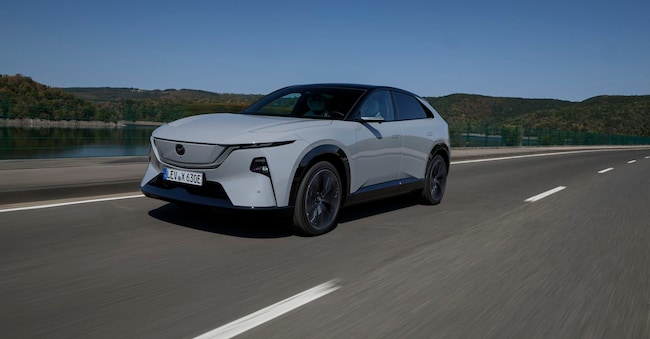
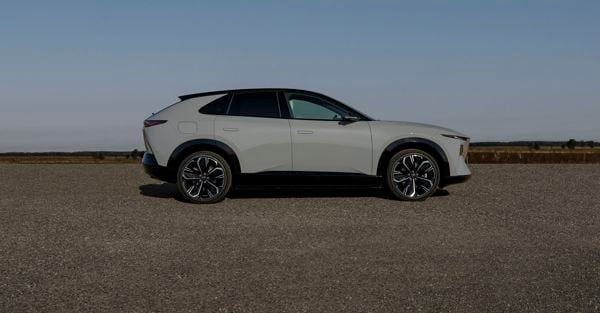
Measuring 4.8 metres in length and 1.9 metres in width, the Mazda CX-6e belongs to the large SUV family. However, its styling is designed to tone down its imposing presence and avoid flashy lines. This is achieved thanks to its proportions, the sleek roofline and numerous aerodynamic details that give the CX-6e a more dynamic appearance.

Loading...

The surfaces are clean but not bland. The front end is very attractive and the rear is also well designed, particularly the area around the pillars. In this way, the CX-6e manages to stand out without resorting to overly flashy design features.

Mazda has taken a bold step when it comes to colours, offering not only its famous ‘Soul Red’ but also more unusual shades, including a deep purple that makes the CX-6e even more distinctive.
Everything changes on the inside

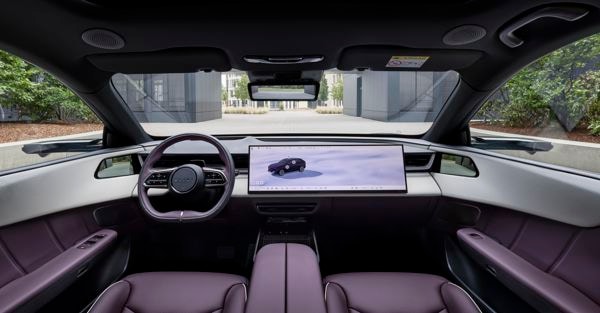
Once on board, the first thing you notice upon entering the cabin is a huge 26.5-inch horizontal display and, above all, the absence of a dashboard in front of the driver. This display is the car’s true control centre. From here, you can control the climate control, driving modes, regeneration levels and many other functions. The graphics are modern and the system responds well, but the decision to concentrate almost everything on the screen didn’t strike us as the most practical.
For some operations, you have to navigate through several menus, and when using the device on a day-to-day basis, a few more physical controls certainly wouldn’t have gone amiss.

As mentioned earlier, there isn’t even a traditional instrument cluster in front of the driver – a choice already made (and much debated) by Tesla for its Model Y. Mazda, too, therefore relies on a head-up display that projects key information onto the windscreen. It is crisp and easy to read, albeit rather basic. Furthermore, if you use Google Maps – and therefore Android Auto – as your sat-nav, directions are not projected, as the system is not native to Android. The result is that, to follow a route, you often find yourself shifting your gaze from the road to the large display, which is positioned slightly below the driver’s optimal line of sight. Of course, voice guidance comes to the rescue; in this specific case, we might say it is essential for avoiding distractions whilst driving.

255 CV and a range of up to 480 km

The CX-6e shares its technical platform with the Mazda 6e and is manufactured in China through a partnership with Changan. Under the bonnet is a 255 CV electric motor mounted on the rear axle, powered by a 78 kWh battery. The CX-6e accelerates from 0 to 100 km/h in around 7.9 seconds, and Mazda claims a WLTP range of up to 484 km for the Takumi model with 19-inch wheels.

Good figures, though not record-breaking. But it is the efficiency, above all, that makes a good impression. During the test, energy consumption stood at around 7.4 km/kWh, an impressive result for an SUV of this size.

DC fast charging reaches up to 200 kW and, under ideal conditions, allows the vehicle to be recharged in a relatively short time.

Loading...

It’s a pleasure to drive on the road, but don’t expect a sports car

Anyone looking for a Mazda to drive with a knife between their teeth is likely to be a little disappointed. The CX-6e has a much more laid-back character. It’s designed for travelling, for navigating traffic stress-free and for clocking up the kilometres in the most relaxed way possible.

The rear-wheel drive and the claimed weight distribution of 47:53 nevertheless give it good balance. The steering is precise and the car is easy to drive, even on the most winding roads.

It probably performs at its best on the motorway. The cabin is well insulated, and tyre noise and wind noise are kept to a minimum.

Plenty of space, average boot capacity

The interior space is one of the CX-6e’s strong points. Passengers in the front travel in comfort, and even those taller than average can sit comfortably in the second row. The 2.9-metre wheelbase helps, and the flat floor makes even the middle seat more comfortable.

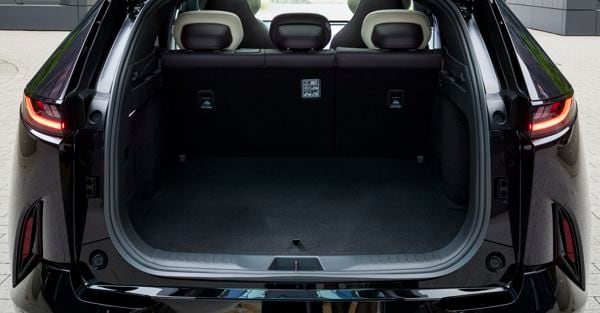
The 468-litre boot isn’t one of the largest in its class, but there’s also a small 80-litre front compartment, which is handy for storing charging cables and other items.

The CX-6e comes with a comprehensive range of features even in the Takumi trim level, which includes, amongst other things, a panoramic roof, 19-inch alloy wheels, a head-up display, a 360-degree camera and various comfort features.

The Takumi Plus adds 21-inch wheels, heated and ventilated seats for both front and rear passengers, and a decidedly more unusual feature: cameras in place of traditional wing mirrors. It’s a technology that continues to divide opinion. On paper it’s interesting, but in everyday use it takes a bit of getting used to and judging distances isn’t always straightforward. Personally, I still find traditional wing mirrors a simpler and more natural solution.

A different sort of Mazda, but one with plenty going for it

The CX-6e isn’t the most fun Mazda to drive, nor does it set out to be. Its true strength lies elsewhere: travelling in comfort, in silence and with plenty of space.

It boasts a stylish design, a cosy interior, good fuel efficiency and a comprehensive range of features. The large touchscreen may be to some people’s taste or seem excessive, whilst certain technological features, such as cameras in place of wing mirrors, seem more like a stylistic choice than a genuine necessity.

It’s a different kind of Mazda from the ones we’re used to – less sporty and more digital, but by no means lacking in character. To get your hands on one, you’ll need to budget 46,750 euros for the ‘standard’ Takumi version. That’s a few thousand euros less than the various Tesla Model Y Premium or BYD Sealion 7 Comfort models with which it will compete in the market.

Copyright reserved ©

Brand connect

Loading...

Newsletter

Notizie e approfondimenti sugli avvenimenti politici, economici e finanziari.

Iscriviti