
Mazda prepares e-car but continues on the path of alternative solutions
Made in Hiroshima: the strategies of the Japanese manufacturer

2' min read
2' min read
Mazda will present its second 100% electric model by the end of the year. The Japanese manufacturer is ready to face the important regulatory challenges of 2025 with a new battery-powered model. As a matter of fact, the European regulations, which will come into force on 1 January 2025, foresee a 15% reduction in CO2 compared to now, bringing the limit to just under 94 g/km, precisely 93.6 g/km of CO2.
This is why Mazda is continuing its multi-solution strategy to reduce CO2 emissions and to take into account the current economic environment.
The aim with the introduction of the new Bev model will be to increase the number of sales of zero-emission models.
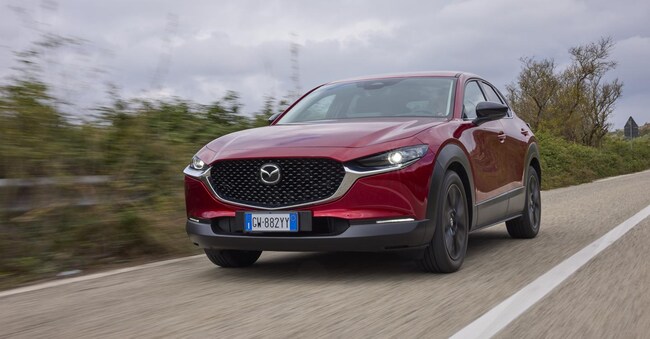
Meanwhile, the Hiroshima-based manufacturer has already unveiled the 2025 model years of two models at the heart of the range: the MX-30 and Marza3. Both are now equipped with a new engine from the e-Skyactiv G family: the 2.5-litre 140 hp Euro6E engine (140 hp and 238 Nm of torque) that joins the already known e-Skyactiv X 2.0-litre 186 hp engine. A significant jump in displacement and against the industry standard but in line with the brand's 'right-sizing' approach.
The engine is equipped with Mazda's M-Hybrid cylinder deactivation system and electrification system, which contribute to improved driving comfort and real-world performance thanks to 16 per cent higher torque, and improved fuel efficiency with a minus 1.65 per cent average fuel consumption that peaks at minus 7.1 per cent on the highway compared to the previous 122 hp e-Skyactiv-G engine.

