
Mazzucchi at the helm of Federico II: ‘AI should be geared towards the common good’
The philologist, the new vice-chancellor, takes up his post on 1 September: the central theme of his programme is how to manage the changes currently taking place

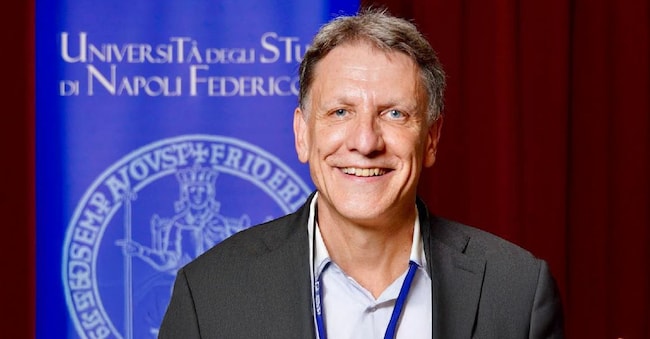
‘It is my firm belief that Federico II must fully embrace its role as a leading European public university: a bastion of democracy, inclusion and social mobility; a driving force for economic, social and cultural development in Naples and Southern Italy; a scientific community capable of conducting research at the highest international standards, delivering a radically renewed approach to teaching and attracting talent from all over the world. A university that continues to regard knowledge as a common good’. These are some of the objectives set out by the new vice-chancellor of the University of Naples, Andrea Mazzucchi, who will take up his post on Tuesday 1 September. After 25 years, a humanist returns to lead Italia’s oldest university.
Andrea Mazzucchi was elected on 3 July in the first round by a large majority. Born in 1966, a native of Puglia but a Neapolitan by choice, he is a full professor of Italian Literary Philology, currently serving his second term as head of the Department of Humanities at Federico II University, and a former president of the University’s School of Humanities and Social Sciences. Regarded as one of the most authoritative scholars of Dante and the medieval Italian literary tradition, he was educated in Naples and Florence and is the author of over 300 publications. He is a full member of the Accademia Pontaniana and the National Society of Sciences, Letters and Arts, president of the Society of Italian Literary Philologists, and a member of the Accademia della Crusca. Since 2017, he has directed, at the Biblioteca dei Girolamini in Naples, the School of Advanced Studies in the History and Philology of Manuscripts and Ancient Books, established in partnership between the University of Naples Federico II and the Ministry of Culture in response to the serious book theft that had struck the historic library in 2012.

A humanist and philologist has taken the helm of the university, at a time when the use of artificial intelligence is becoming widespread. ‘Of all the transformations currently underway, none appears set to have an impact comparable to that of artificial intelligence: not merely a new technology, but a new cognitive infrastructure destined to alter the relationship between human beings, knowledge and social organisation,’ says Mazzucchi. Its applications now extend to every area of university life: research, teaching, services, administration and technology transfer. The fundamental question is not whether artificial intelligence will enter the university – it has already done so – but how to govern its use. The university has a dual responsibility here: to contribute to the scientific and technological development of artificial intelligence and, at the same time, to critically analyse its ethical, legal, social and economic implications. Federico II possesses all the expertise required to tackle this challenge in an interdisciplinary manner, positioning itself to become a national centre for responsible innovation, where artificial intelligence is directed towards the common good, personal growth and the democratic development of society.”
Furthermore, according to Mazzucchi, ‘Federico II must continue to be a place of freedom: freedom of research and teaching, freedom to exchange different ideas and to express dissent – which should be recognised not as an obstacle to government action but as a valuable resource for more informed decision-making. At a time marked by the polarisation of public debate and the shrinking of the space for reflection, the university must remain one of the places where one of the main instruments of individual and collective emancipation is found. I would like to help build a Federico II that is even stronger in research, more innovative in teaching, more efficient in its organisation, more international in its relations, more inclusive within its community and more authoritative in its public role. A Federico II capable of leading change without losing its identity. A Federico II that continues to be, for Naples, for Southern Italy and for the country as a whole, one of the main pillars of knowledge and democracy.’
Mazzucchi succeeds Professor Matteo Lorito and will lead the University for the six-year term from 2026 to 2032. The new rector of the University of Federico II takes office two months ahead of the natural expiry of his predecessor’s term. Lorito had, in fact, brought forward the end of his term – which was due to expire on 31 October 2026 – to 9 July, in order to take up the post of member of the Executive Board of the National Agency for the Evaluation of the University and Research System (ANVUR).


