
McLaren increasingly at the heart of global motorsport
In Singapore, McLaren officially won the constructors' championship, which it has largely dominated this year. With its second consecutive victory, its tenth in total, the British team has established itself as a benchmark in motorsport and, indirectly, also in the luxury sports segment

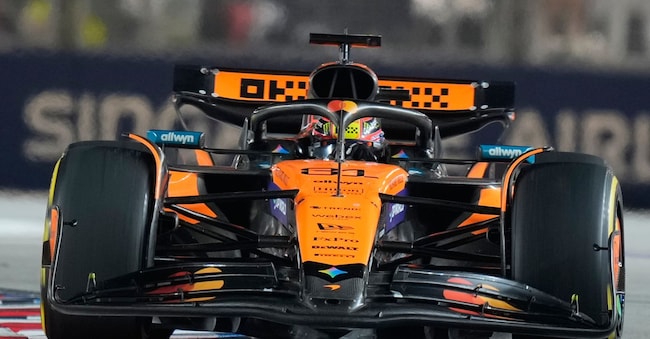
The Austin Grand Prix opens the last quarter of the 2025 F1 season. The last six races will be particularly intense, as they are structured on two triplets and include three sprint races, the first of which takes place in Texas. If the constructors' championship is officially closed, with McLaren's tenth win, for the drivers' championship the games are increasingly open.
The failure of Norris's engine at Zandvoort seemed like a sign of destiny, launching Piastri to +34 on his rival and over +100 compared to a constantly beaten Verstappen. And yet, right from Holland, where McLaren was about to join Ferrari and Mercedes for the record of consecutive double wins, something happened. The GPs of Monza, Baku and Singapore (three very special circuits) did not see the Woking team win, but they did highlight a rise in performance by Red Bull and Mercedes. So, for Piastri, the points lead over Verstappen remains 63, but those of Norris are only 41: does it make sense for McLaren to bet on just one driver? It's unlikely to happen, considering the balance in the papaya house and the direction of Andrea Stella: "We will not change our management of drivers after the constructors' title.
Motorsport at the heart of McLaren reality
Just like Ferrari, McLaren, before being a luxury car manufacturer, is a racing stable. The Woking racing stable is in fact the brainchild of a successful young driver, New Zealander Bruce McLaren, who at only 26 years of age lays the foundations for his own racing stable that will see its debut in Formula 1 in 1966.
But from 1974 onwards, the team made its mark on Formula 1 history: since then, the team has won ten constructors' titles and twelve drivers' titles, the latter of which have been won by some of the great names in Formula 1 history: Emerson Fittipaldi (1974), James Hunt (1976), Niki Lauda (1984), Alain Prost (1985, 1986, 1989) and Ayrton Senna (1988, 1990, 1991). In the late 1990s, Mika Häkkinen took McLaren back to the top step in 1998-1999, while in 2008 Lewis Hamilton won his first title at the wheel of McLaren.
McLaren in Formula 1: financial results
In the graph shown, it is possible to observe how the economic trend of the papaya racing team between 2015 and 2024 has strongly followed the sporting results. In the period under consideration, McLaren experienced complex years, accumulating £169 million of losses between 2015 and 2019. Leaving behind the disastrous Honda and Renault engine manufacturers, McLaren became competitive again in 2020 with its Mercedes partner: unforgettable was the one-two at Monza 2021 with which Ricciardo ended a period of more than eight years without victories for the British team. Since then, the team led by Andrea Stella (racing director from 2020 and team principal from 2022) has achieved a crescendo of sporting results, but also economic ones, with a second positive five-year period (35 million of accumulated profits).


