
Bespoke technologies are driving water savings
Among the solutions adopted in agriculture, tourism and industry, digital twins of networks, sensors, microfiltration, desalination and heat recovery stand out as key ways of turning water into a strategic asset

Key points
The food industry, hospitality and manufacturing: different sectors, the same sense of urgency. Water is essential for growing crops, processing food, washing, cooling and welcoming guests. Where it is most precious, it becomes essential to reduce waste and water consumption. Today, the frontier of water conservation no longer lies solely in consuming less, but in using water more effectively, repeatedly and with less energy. There is no single silver-bullet technology, but rather a combination of solutions: sensors, artificial intelligence, reuse, microfiltration, desalination, heat recovery and digital network modelling. ‘The countless uses of water mean that there are no single winning technologies, but rather different technologies to be developed and integrated into a complex system,’ explains Stefano Malavasi, Professor of Hydraulics at the Politecnico di Milano. This shift in approach is crucial: we must move away from managing water based on average values – standard consumption, constant pressures, fixed irrigation schedules – and instead adapt decisions to what is actually happening.
Politecnico di Milano at the forefront
Among the most promising technologies, explains Malavasi, is the digital twin: a digital replica of a water network, an irrigation system or an industrial plant. A virtual model that interacts with sensors and real-world data to identify where water is being lost, when pressure is too high, where consumption is abnormal and where action is needed. Whilst difficult to apply everywhere, it points the way forward: moving from ‘scheduled’ management to data-driven management. Technology alone, however, is not enough unless its impact is measured. “The main difficulty in optimising water resources is defining the objective function,” observes Malavasi. In other words: we need to decide what we want to improve. Simply saving cubic metres is not enough: what matters is energy, the quality of the recovered water, public health, service continuity, leaks and the equitable distribution of benefits. At the Politecnico’s FluidLab, Malavasi is working on the integration of water, energy and control. “For years, we have been patenting and developing technologies for recovering energy from hydraulic processes, with a view to optimising them for civil and industrial applications.” One example is Oas, “a special hydraulic valve for irrigation which, whilst regulating the flow of water, recovers some of the energy that would normally be wasted”. That energy is used to operate the valve remotely and to control the irrigation network, without adding any external power.
The Mutti sensor
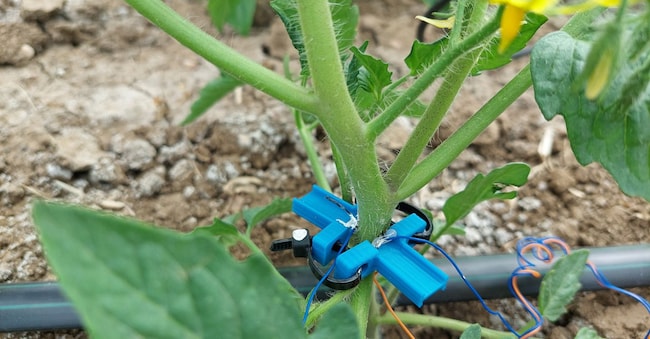
It is this approach – measuring, reducing waste and reusing where possible – that is reflected in the three sectors where water consumption is highest: agriculture, tourism and industry. In precision agriculture, the aim is not simply to irrigate less indiscriminately, but to irrigate more effectively. Mutti, in collaboration with the Institute of Materials for Electronics and Magnetism of the National Research Council (CNR), has trialled Bioristor, a sensor attached to the stem of tomato plants. The device detects the plant’s physiological state and helps to determine when it needs water. In tests, the system – combined with AI – enabled a 45 per cent saving in water compared with conventional practices and improved quality indicators such as the soluble solids content of the tomato.
Delphina’s case
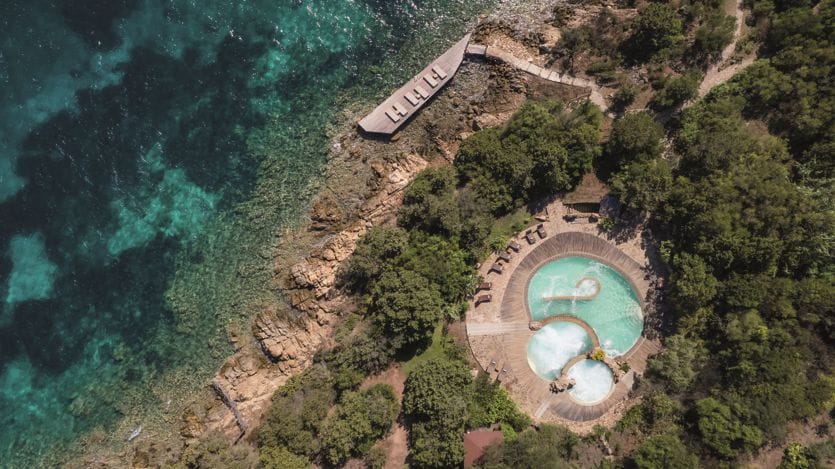
In tourism, the focus is on reducing pressure on local resources. In Sardinia, Delphina Hotels & Resorts combines consumption management, reuse and care for the landscape. In its thalassotherapy centres, seawater is drawn from offshore, microfiltered, used in swimming pools and wellness treatments, and then returned to the sea with the same parameters as when it was drawn. In this way, the resort’s operations do not place a burden on local water networks. Water savings are also achieved through the gardens: 112 hectares of Mediterranean parks, featuring native species that require less water.
Calvisius caviar
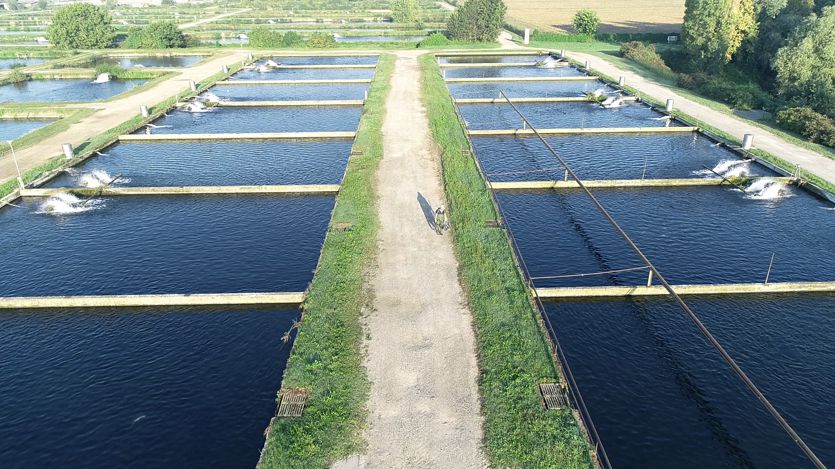
The industrial approach is different, where savings stem from the integration of production processes. In Calvisano, Agroittica Lombarda produces Calvisius caviar using a model developed in the 1970s through the integration of steelmaking, aquaculture and agriculture. The water for the tanks comes from the estate’s own aquifer. Heat is recovered from the adjacent steelworks of the Feralpi Group and transferred via a heat exchanger to the groundwater, bringing it to the ideal temperature for sturgeon farming. After use, the water is returned to the irrigation network via three outlets: it thus reaches the fields having already been used in aquaculture and enriched with microalgae beneficial to the soil, saving energy for farmers. It is a cascade system: an industrial process produces heat, aquaculture utilises it, and agriculture receives reclaimed water.

