The cycle traveller

Medieval villages, half-timbered houses, storks and castles: cycling through Bavaria

From thermal baths to Ludwig’s castles, with all their mysteries, the Romanische Strasse offers a journey through Bavaria and German history, which can also be explored by bike: 460 kilometres suitable for everyone, passing through medieval villages and 19th-century castles, amidst myths and legends

6' min read

Translated by AI
Versione italiana

6' min read

Translated by AI
Versione italiana

In the beginning there was ‘Deutschlands Reiseweg Nummer 1’, Germany’s number one travel route. The year was 1900. In the heart of Europe, the Second Reich had recently come into being – a new, formidable geopolitical entity that would go on to upset the precarious balance of power on the Old Continent. Place and date of birth: 18 January 1871, the Hall of Mirrors, Palace of Versailles. A symbol of France’s humiliation following the disgrace of Napoleon III’s military defeat at Sedan at the hands of William I’s Prussia.

In Berlin, the new state was keen to align itself with the best practices of its neighbouring and rival countries. This was a colossal undertaking, which, starting with the industrial and military sectors, extended to other areas as well, including tourism promotion. Thus, various German travel routes were established. The first of these was the route from Würzburg to Füssen, travelling through Bavaria from north to south.

Loading...

There, one could admire the charms of old Germany, an idyllic country, idealised for tourism, characterised by villages protected by walls, medieval half-timbered houses with sloping roofs, timber-framed structures with the gaps filled with mortar and straw; storks; vineyards dating back to Roman times; old churches; medieval castles and more recent ones built in the nineteenth century; right up to the dreamlike buildings of Ludwig II, King of Bavaria.

A Take on Romanticism

Fifty years later, in 1950, Germany was trying to get back on its feet following the devastation of the Second World War. In that half-century, all sorts of things had happened. The Second Reich was no more. Following the Weimar Republic and Hitler’s Third Reich, the Federal Republic of Germany was founded in 1949. The capital was no longer Berlin, but Bonn.

The country was brought to its knees. At the same time, there was also a strong drive to turn the page and start afresh after the horrors of Nazism.

Against this backdrop of post-war revival, efforts to promote tourism also resumed. The name ‘Deutschlands Reiseweg Nummer 1’ seemed too bureaucratic and cold. To make the product more appealing, a rebranding exercise was needed, not least to offer the world a narrative different from that of the Holocaust and the extermination camps. Thus the Romantische Strasse, or Romantic Road, was born: a marketing ploy that immediately proved successful.

Originally conceived as a route to be travelled by car in the 1980s – partly as a result of the environmental movement – the route has been revitalised as a cycle tourism route. Today, it is one of the most popular destinations for German cycle tourists and one of the most sought-after routes in European cycle tourism.

Sulla Romantiche Strasse a due ruote

Photogallery26 foto

Information at your fingertips

The website romantischestrasse.de provides (also in Italian) useful information, including GPX tracks that can be downloaded onto a bike sat-nav or smartphone. Komoot, a platform for cycle tourism, offers free route tracks divided into ten stages.

Anyone wishing to shorten the route can make use of the bike-friendly train, which covers much of the route (though not all of it). Those who prefer not to organise things themselves can find local tour operators online who will arrange the trip and luggage transport.

The route from Würzburg to Füssen covers 460 kilometres and 3,550 metres of climbing, which, when broken down into stages, becomes a relatively easy challenge; on an e-bike, it is within the reach of (almost) everyone. Those coming from Italia may wish to consider the south-to-north route, Füssen to Würzburg, with 2,920 metres of elevation gain – 600 metres less than the north-to-south option.

Loading...

However, the website and the information centre (tel. 0049 9851 551387) recommend the north-to-south route, which often offers a tailwind and culminates in a spectacular approach to the Pre-Alps. Those arriving by car from the south and choosing to start from Würzburg can take the train (around five hours) from Füssen to Würzburg.

Thermal baths after a cycle ride

To be on the safe side, it’s always best to bring good-quality rainwear, although with climate change you might well find yourself experiencing a whole week of sweltering summer heat. Do bring a swimming costume as well. Along the route you’ll find two first-class thermal spas: the Solymar Therme in Bad Mergentheim and the Kristall-Therme in Schwangau. After a bike ride, a soak in the thermal waters is always a most welcome treat.

Taking Würzburg as your starting point, a must-see attraction is the Residenz, a UNESCO World Heritage Site. With its opulence, it looks like an 18th-century palace, inspired by Versailles. In reality, it is a bishop’s residence.

The finest artists of the time worked there, including our own Giambattista Tiepolo, who in 1750 adorned the palace with magnificent frescoes celebrating his patron, Prince-Bishop Karl Philipp von Greiffenclau.

Severely damaged by Allied bombing in 1945, the building has miraculously survived to this day thanks to the efforts of a US Army officer, John Skilton, an art historian by profession, who, despite the smouldering rubble, managed to find the necessary materials using whatever was to hand to prevent the building from collapsing, thus saving it for subsequent restoration.

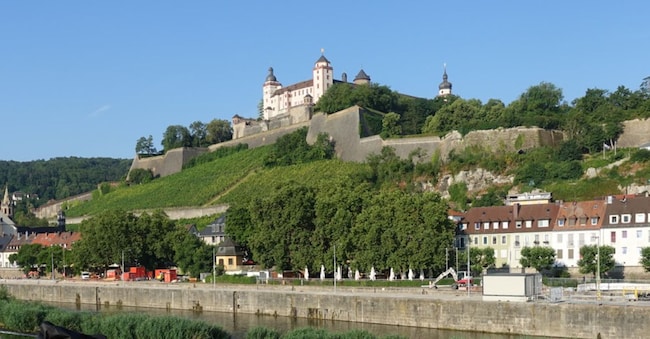
Also not to be missed is the fortress of Würzburg, Marienburg, which stands overlooking the River Main and the town’s old bridge.

Half-timbered houses, castles and storks

From Würzburg, the route – which is well signposted – leads south. It passes through ‘Romanised’ Germany, where even today the landscape is dominated by vine-growing, a tradition introduced by the empire’s legionaries as far back as the time of Tacitus. There are many enchanting medieval villages not to be missed: Tauberbischofsheim, Rothenburg ob der Tauber, Dinkelsbühl and Nördlingen, a small village situated within a vast crater formed 15 million years ago by a meteorite impact on the Earth’s crust.

Well-preserved hamlets within the city walls, with narrow streets and alleyways lined with half-timbered houses. On the rooftops, amongst the chimney stacks, storks build their nests; they are a constant presence in these parts.

For a short stretch, the Romantic Road leaves Bavaria and crosses into the neighbouring state of Baden-Württemberg. The beautiful Renaissance castle at Weikersheim is well worth a visit here.

Social housing in the 16th century

Another notable stop is Augsburg. Not so much for the city itself – which was heavily damaged during the war – but for the Fuggerei, the first example of social housing for the poor, commissioned in 1521 by Jakob Fugger, a German Catholic banker. It is an entire neighbourhood, a quadrilateral enclosed within walls, with gates that open at night only on request.

It houses dozens of small, perfectly decent flats, let for the very modest sum of 88 euro cents a year. Even today, the allocation criteria are those laid down by Fugger: applicants must have been born in Augsburg, be Catholic and be of limited means. A visit to the Fuggerei is highly informative, including the small museum in the air-raid shelter.

After Augsburg, the route takes you to Donauwörth, where the Romantic Road crosses the Danube Cycle Path. Once you’ve passed Landsberg on the River Lech, the final stretch, from Schongau to Schwangau, is perhaps the most scenic.

On the horizon, you can begin to make out the outline of the Bavarian Pre-Alps. As you get closer, the mountains take on increasingly distinct contours. Stop off at Schwangau. Treat yourself to a spa bath and devote the following day to Ludwig II of Bavaria.

Ludwig’s World

He ascended the throne at the age of just 18: an eccentric, an intellectual, a lover of art, openly unfit – by his own admission – for the duties of government, a friend of Richard Wagner, and perhaps homosexual (according to rumours of the time), Ludwig II was the bane of the court of Munich. A man of striking good looks, coveted as a husband by princesses across half of Europe, the king – much loved by the people – shunned marriage and institutional responsibilities.

He preferred to take refuge in his mountains, where he would retreat to the family castles and those he had built with his subjects’ money. In some of these, he stayed for only a few weeks or a few days, such as Herrenchiemsee and Neuschwanstein, the fairytale castle that inspired Walt Disney and which, through animated films, has left its mark on the collective imagination of several generations.

In 1886, a medical-psychiatric commission, set up by the Court of Munich, declared the king “unfit to rule”. A few days later, Ludwig, aged forty, died in circumstances that were never fully clarified. His body was found in a small lake in the area; it was said that he had drowned. In 1973, Luchino Visconti made a film about him, *Ludwig*, starring Helmut Berger and Romy Schneider. Today, Neuschwanstein is a destination plagued by overtourism. It is advisable to book your visit well in advance.

From Schwangau, the destination, Füssen, is just a stone’s throw away. Füssen is also well worth a visit, particularly the castle with its trompe-l’oeil effects. By the end of the tour, you’ll have had your fill of history, scenery and beauty – and perhaps a bit of a workout too. But it will all have been worth it.

And, inevitably, the question will arise: where shall we go on our next cycling trip?

Copyright reserved ©
Loading...

Brand connect

Loading...

Newsletter

Notizie e approfondimenti sugli avvenimenti politici, economici e finanziari.

Iscriviti

Tutto mercato WEB