Asia and Oceania

Pakistan sends troops to Saudi Arabia to defend Riyadh from Houthi attacks

According to Islamabad, ‘the deployment will help strengthen the Kingdom’s defence capabilities against a backdrop of new security concerns’

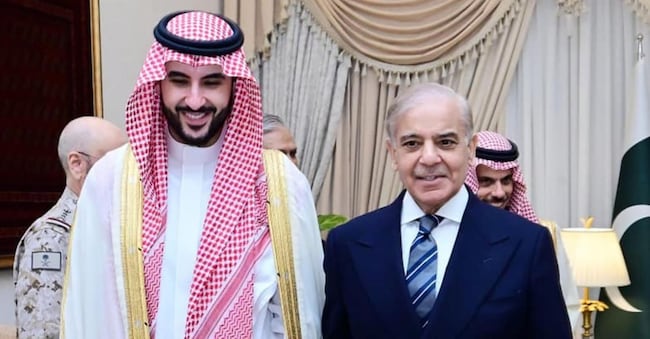
Il primo ministro pakistano Shehbaz Sharif, a destra, con il ministro della Difesa saudita Khalid bin Salman bin Abdulaziz Al Saud  EPA

3' min read

Translated by AI
Versione italiana

3' min read

Translated by AI
Versione italiana

NEW DELHI – Just over fourteen months after the signing of the Strategic Mutual Defence Agreement between Pakistan and Saudi Arabia, and less than four months after the Mecca Pact – to which Turkey has also acceded – Islamabad’s armed forces have announced that they will send troops to Saudi Arabia to help bolster its defences against attacks by the pro-Iranian Yemeni Houthi militias.

The announcement came two days after a meeting in Islamabad between defence officials and military representatives from the three countries, who reaffirmed their support for Riyadh under a trilateral agreement stipulating that an attack against one of the members is to be regarded as an attack against all. At the conclusion of the summit, the participants condemned the Houthis’ ‘atrocious and ongoing’ attacks on civilians and civilian infrastructure in Saudi Arabia.

Loading...

What we know about the deployment

In a statement issued on Sunday, the Pakistani Armed Forces clarified that, in line with the defensive nature of the pact, the military will carry out its duties within the allied country, but did not disclose the size of the contingent, its specific tasks, or the timing and duration of the deployment.

Although Riyadh has been hosting Pakistani military personnel since 1982, it is undeniable that Sunday’s decision marks a significant step forward in the alliance between the two countries. The Strategic Mutual Defence Agreement was signed several months before the Israeli-American attack on Iran, but despite the increasingly frequent attacks on Saudi Arabia, the mutual defence clause has never been triggered.

Sunday’s statement reaffirmed Pakistan’s commitment to protecting Islam’s two holiest mosques, located in the Saudi cities of Mecca and Medina, and added that ‘the troops will carry out their assigned tasks within Saudi territory, in accordance with the agreed commitments and the established framework for defence cooperation’.

‘New safety concerns’

In a clear reference to the recent attacks, the statement also states that ‘this deployment will help to further strengthen the Kingdom’s defensive capabilities against the backdrop of new security concerns’. In recent months, Saudi Arabia has been repeatedly targeted, and on 10 October, a Houthi attack on King Khalid International Airport in Riyadh, 700 kilometres from the border with Yemen, left 14 people dead and over 300 injured.

Islamabad has always preferred to regard the attacks by the Houthis against Riyadh as a response to Saudi incursions into Yemen rather than outright aggression, so as to avoid the risk of being drawn into a regional conflict on the opposite side to that of a neighbouring country, Iran. A civil war has been raging in Yemen for 12 years, pitting the Tehran-backed Houthi militias against a government supported by Riyadh and the international community, which, however, does not control the capital, Sana’a.

Another factor that may have influenced Islamabad’s decision not to intervene in recent months is the fact that Pakistan is already embroiled in an intermittent conflict with neighbouring Afghanistan, as well as having to contend with attacks launched by various militant groups in the provinces of Khyber Pakhtunkhwa and Balochistan.

The financial and geopolitical issues behind the agreement

Speaking on Sunday in Islamabad at a workshop on national security, Pakistani Prime Minister Shehbaz Sharif spoke of the “long-standing relations based on mutual trust and respect” with Riyadh, emphasising that the Mecca Pact “is not directed against any country and has absolutely no aggressive intent”.

The agreement signed last August by Turkey, Pakistan and Saudi Arabia has reshaped the strategic balance of power in the Middle East, bringing together Ankara’s formidable defence industry, Islamabad’s nuclear deterrent and Riyadh’s financial clout. But that is not all. In an era characterised by the overwhelming political, economic and military power of the American and Chinese superpowers, the Mecca Pact has brought together three middle powers united by the Islamic faith.

Loading...

“This partnership,” said Sharif, “will now safeguard not only our security interests in the region, but also our progress and prosperity.” In recent months, Pakistan and Saudi Arabia have extended the maturity of loans totalling 8 billion dollars, thereby enabling Islamabad to avert a balance of payments crisis, bolster its foreign exchange reserves and meet the financing guarantees required by the International Monetary Fund’s programmes.

Copyright reserved ©
Loading...

Brand connect

Loading...

Newsletter

Notizie e approfondimenti sugli avvenimenti politici, economici e finanziari.

Iscriviti