Sport and development

Mediterranean Games: 400 million invested in the revitalisation of Taranto

Over the course of two years, 45 projects were completed, including stadiums, sports halls, swimming pools and sports centres

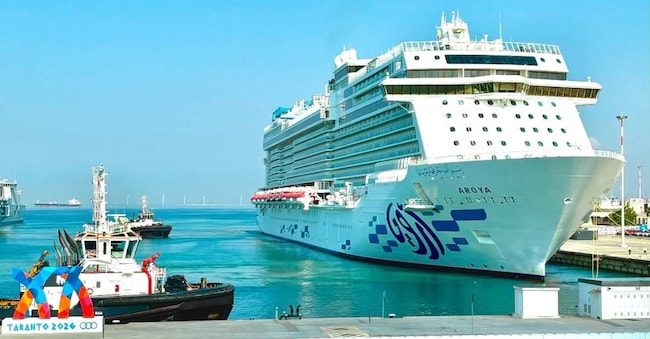
La nave Aroya che ospiterà una parte di atleti dei Giochi del Mediterraneo

5' min read

Translated by AI
Versione italiana

5' min read

Translated by AI
Versione italiana

Four thousand athletes, including 500 from Italia – the largest delegation; 33 sports; 26 participating countries from three continents; 275 million invested by the Government, through Commissioner Massimo Ferrarese, to build or refurbish sports facilities, a further 100 million – also from public funds – for the organisation, and an additional 6 million from the Government for regeneration projects in Taranto; 3,000 volunteers involved in various services; 2 ships (the Aroya and the Romantika) chartered to accommodate the athletes. These are the key figures for the 20th edition of the Mediterranean Games, which will be inaugurated on the evening of Friday 21st at the stadium in Taranto, where the closing ceremony will also take place on 3 September.

And the opening ceremony will be attended by a distinguished institutional delegation, with Italia represented by the President of the Republic, Sergio Mattarella; the Presidents of the Senate and the Chamber of Deputies, Ignazio La Russa and Lorenzo Fontana; Prime Minister Giorgia Meloni; and several ministers. The Executive Vice-President of the European Commission, Raffaele Fitto, will also be present, alongside other heads of state and government.

Loading...

This is the second time that the Games, which have been running for 75 years, have returned to Puglia since the June 1997 edition in Bari. The Games are a celebration of sport, an opportunity to highlight the centrality of the Mediterranean and Italia’s role at a complex geopolitical juncture, and – as Pope Leo put it – a chance to affirm ‘a prophecy of peace and brotherhood amongst peoples’. But Taranto is also banking on the Games to present a different image of itself and a new narrative: that of a city which, despite being hit by the ‘ex-Ilva’ storm – where the hot area will be shut down at the end of October by order of the judiciary – is striving to envisage a different future, combining the sea, the local area and its ancient history with a significant heritage of sports facilities.

Bringing this edition of the Games to a successful conclusion has been a marathon. Yes, because although the Games were awarded to Taranto in August 2019, the organisation only really got underway at the start of 2024, following Commissioner Ferrarese’s appointment in mid-2023. At that stage, there were only 150 million allocated by the previous government, a few renderings and just one project – that of the nautical centre – which would later prove to be incomplete and therefore had to be redone.

The work, therefore, effectively started from scratch. Added to this is the fact that several months between 2023 and 2024 were marked by controversy and conflict between the Government, the Puglia Regional Authority and Taranto City Council, with the then regional governor, Michele Emiliano, accusing the Government of having snatched the Games away from Puglia by appointing a commissioner. Reflecting on those events, the Minister for Sport, Andrea Abodi, remarked: ‘We have made significant changes to the organisational structure and infrastructure. The spirit of these past few years began three and a half years ago with the formation of the Government and the realisation that something needed to change.’ Meanwhile, the Vice-President of the European Commission, Raffaele Fitto, recalling his time as Minister for Cohesion, added: “The appointment of the commissioner, which was not an easy decision at the time, was key to resolving the problem.”

In fact, it was also during that period that a new local organising committee was set up, with the Government and CONI taking a majority stake in place of the local authorities, whilst a further 125 million was allocated under the 2024 Budget Act. “Between regeneration, refurbishment and new construction projects,” comments Commissioner Ferrarese, who is also chair of the local organising committee, “we have built 9 stadiums, 20 sports halls, 2 Olympic-sized swimming pools, 4 athletics tracks, a water sports centre, a tennis centre, an archery centre, 2 urban parks and 6 school sports halls for young people. A total of 45 projects. All this in just under two years, bearing in mind that the latest decree on funding, signed by the then Minister Fitto, dates back to 30 August 2024. Over these two years, we have drawn up the detailed designs, launched the tendering processes, awarded the contracts, carried out the works and halted the decision – already taken in December 2024 by the international committee – to strip Taranto of the Games because everything had come to a standstill. In Taranto, investment totalled 170 million; in the province of Taranto, a further 47; in the province of Lecce, 39; and in the province of Brindisi, around 20.”

The most important facilities are in Taranto (the Iacovone Stadium, the swimming stadium, the PalaRicciardi, the sailing centre and the tennis centre) and in Lecce (the stadium on Via Del Mare). The two football stadiums have been refurbished, whilst the Olympic swimming pools (two 50-metre pools, one indoor and one outdoor), the PalaRicciardi (with both outdoor and indoor facilities) and the sailing centre are new developments.

In the current assessment of the Games (whose sponsors include Snam, Nike, Leonardo, Stellantis, Rds and Itabus), two factors stand out: having met the deadlines – despite a very rainy winter and the scorching heat of recent weeks – and having stayed within the budget for the construction works. Tommaso Foti, Minister for European Affairs, Cohesion and the National Recovery and Resilience Plan (PNRR), who now oversees the Games portfolio alongside his colleague Abodi, stated: ‘The budget has been met perfectly. When we talk about projects, we must always relate them to the resources available and the way in which they have been spent.’ And to stay within budget, Ferrarese – an entrepreneur who has also served as president of Confindustria Brindisi and on the national executive committee under the chairmanship of Luca Cordero di Montezemolo – also resorted to ad hoc solutions. This was the case when rising material costs threw the financial projections for several projects off course. So, in order to stay within the budget without scaling back the projects, funding for part of those works was temporarily withdrawn, with the resources subsequently recouped from auction discounts. Through Sport e Salute, the commissioner launched all the major tenders. Smaller and medium-sized projects, on the other hand, were entrusted to the local councils.

Taranto is looking forward with interest to the event that is about to begin, but a major challenge lies ahead: managing the facilities after the Games. The council has issued two calls for tenders covering seven facilities, and nine proposals have been received and are now under review. Mayor Piero Bitetti notes: “We are about to experience two very special weeks, but we also have a duty to consider how to capitalise on the investments made and how to invest in other sectors of the economy.”

Copyright reserved ©
Loading...

Brand connect

Loading...

Newsletter

Notizie e approfondimenti sugli avvenimenti politici, economici e finanziari.

Iscriviti