Behind the lens

Meeting Nick Knight, the genius who revolutionised the language of fashion

As a boy, he dreamed of becoming a doctor to explore the human being. He became a photographer and an artist who uses images to understand the world, spanning painting, sculpture, artificial intelligence, film and augmented reality.

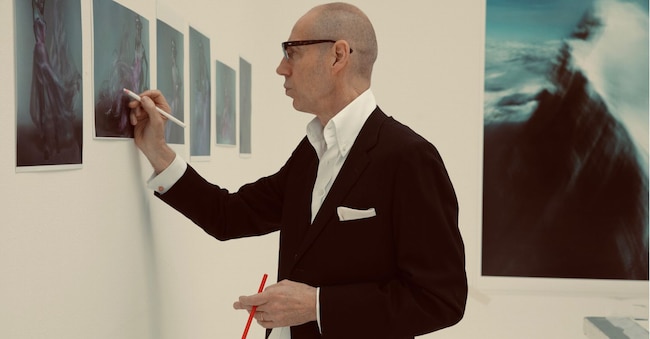
by Angelica Moschin

Nick Knight al lavoro nel suo studio. (ph Lara Hughes)

4' min read

Translated by AI
Versione italiana

4' min read

Translated by AI
Versione italiana

His voice is clear, inquisitive, marked by that aplomb that is both measure and irony typically British. He is walking among the trees, returning from his morning Pilates class, when he begins to speak. For over forty years, Nick Knight, born in 1958, has been redefining the language of fashion with images that seem to come from the future, crossing painting, sculpture, artificial intelligence, cinema and augmented reality. His photographs neither seek truth nor take refuge in fiction. They are born from a crack in the world and reach out to you without filters, reminding you that beauty cannot be looked at, but felt, as if the world itself were taking you in its hands.
Lara McGrath alias @thegoatdancer esplora le potenzialità del second-hand, con capi acquistati sue Bay nel fashion film “The Goat Dancer” (2025), di Nick Knight.

"As a boy I dreamed of becoming a doctor. I wanted to explore the human being, but I did not like being in a hospital. With photography, however, I found another way to do it. I would borrow my father's camera, take pictures in markets, at bus stops: it was a reason to talk to anyone. All I had to do was ask: "Can I take your picture?" And nine out of ten would say yes'.

Loading...

That tension towards encounter has remained over the years. "I photograph to understand, not to document. I have always tried to create what I have never seen". This gave rise to a vision that was ahead of its time, a language capable of moving between fashion, music and cinema, radically redefining aesthetics and its ethical implication, a subject very dear to him.
Colin Jonescon abiti Matières Fécales, 2025.

The first projects, such as Skinheads (1982), arose from the observation of subcultures. In the 1980s, his meeting with Marc Ascoli and Yohji Yamamoto marked the first turning point: with Peter Saville, photography became a conceptual construction and an autonomous visual language. In the 1990s, alongside Alexander McQueen and John Galliano, he took fashion into a quiet and electric baroque dimension.

With SHOWstudio, founded in 2000, 'I dreamed of bringing shows online,' he says. "With the first ones we could only reach a few hundred people, then with Alexander McQueen's, Plato's Atlantis, we reached millions of users. I wanted fashion to stop being an exclusive club by invitation only and for everyone to be able to enter". SHOWstudio thus became a laboratory for the democratisation of fashion, a bridge between creativity and a global audience.

Il fotografo Nick Knight davanti alla porta del suo studio a Belgravia, Londra. (ph Lara Hughes)

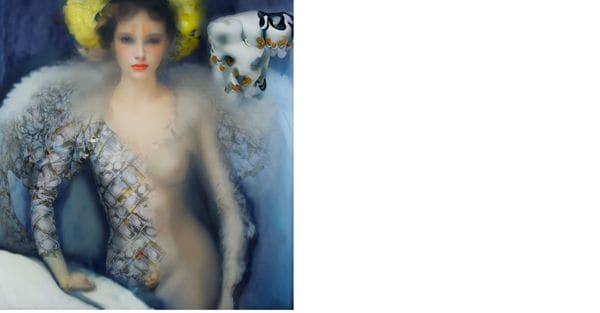
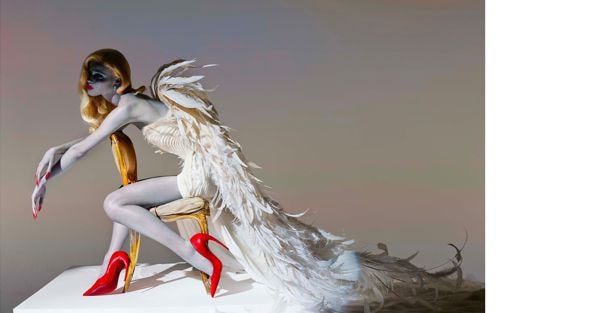
In his London studio, images arise from a process that is both analytical and intuitive. "Photography starts from a whole and then begins to subtract. It is like science: you try to understand by eliminating what is superfluous". Many compositions are developed on immaculate backgrounds, where every detail becomes light; yet Knight has never locked himself in minimalism. In fact, he also constructs complex and theatrical environments, designed to reflect the psychology of the subject, as in the shoot with Miley Cyrus, recently portrayed in a cabaret outfit that evokes 1930s German cinema. "Each person is a universe in itself. Miley is not a model, she is a performer and should be photographed as such. I wanted to capture that mix of boyish grace and wild energy that distinguishes her". Sometimes the image becomes painting, the chromatic tension of a Vermeer or the diaphanous materiality of a Morandi resurface, in other cases it dissolves into digital three-dimensionality. Alex Consani's shot in a Chanel dress is exemplary: the model emerges as an angelic vision, suspended between corporeity and light.

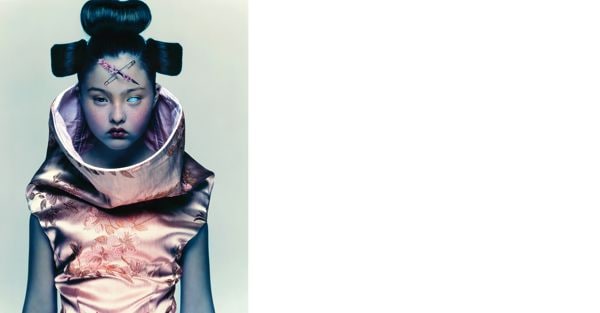
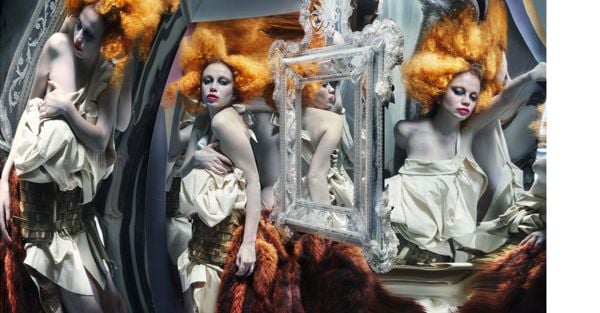
Devon Aoki per Alexander McQueen, 1997.

Knight has made diversity an aesthetic and political principle: people with disabilities, rare genetic diseases, mature bodies, fluid identities find a human and powerful presence in his portraits. "Beauty must be human, not regulated by standards. Fashion as an art form tends to include; as an industry, it tends to exclude so we have to figure out which side we want to be on". In many portraits the woman appears hieratic, almost sculptural, warrior and muse at the same time: Devon Aoki remains one of the best known examples of this tension.

Alex Consani in Chanel, 2007.

Parallel to fashion, Knight cultivates an ongoing dialogue with nature. He photographed roses for ten years, studying them as living organisms and not as decorative objects. The book Flora (2004) collects plants and flowers from the Natural History Museum in London, studied with the precision of an anatomist; the roses in the volume Dior in Bloom are exercises in concentration and memory. 'Nature is precious today because we are losing it,' he explains. Spirituality also occupies a place in his research: 'I am an atheist, but attracted to what I do not understand. During the lockdown I read the entire Bible from beginning to end; it reminded me that every story is an attempt to give form to the unknown'. It is this balance between knowledge and mystery that gives his work that unclassifiable and at times timeless aura: suspended between the present and that which escapes the measure of time.

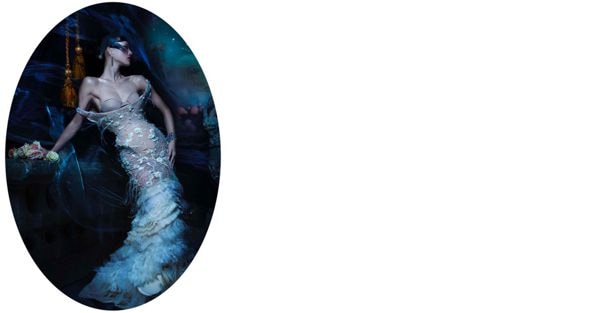
Sora Choi in Schiaparelli, 2025.

"Every day there is something I don't know, and that is a privilege. If you already know everything, you can't create anything. It is this curiosity that keeps us active: technology has expanded the possibilities and responsibility of artists. SHOWstudio is a practical example of this: the net has opened up fashion to the public, shifting the balance of power.

"Artificial intelligence, in this sense, is a new school of art. We must enter it now, before it is colonised. If artists stay out of it, the future will only speak the language of dominant thought, not the language of imagination. It has to be said bluntly: the stigma, prejudice and mistrust that still surround this tool must be overcome. AI is here to stay, so let's use it, and use it well'.

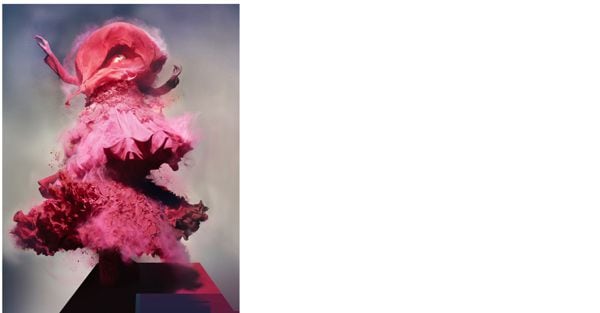
“Pink Powder”, Lily Donaldson in John Galliano, 2008.

Today, as then, Knight pushes the boundaries of traditional photography. While the medium has changed, the desire to see with the same awe that the French photographer Nadar felt in the 19th century when he lifted his camera above Paris remains intact.

"Of all my passions, the greatest remains my family. My wife, my children. They are my top priority. In a virtual world, they are my reality'. Perhaps that is Nick Knight's secret: knowing how to combine avant-garde and tenderness, experimentation and heart. In every shot, the essential remains, and in that essential there is everything.

Copyright reserved ©
Loading...
Loading...

Newsletter

Notizie e approfondimenti sugli avvenimenti politici, economici e finanziari.

Iscriviti