
Melonellum takes to the Chamber amid uncertainty over two secret ballots, but the leaders are already devising their strategies
Meloni is banking everything on tactical voting against Vannacci and on divisions amongst her opponents, whilst Schlein is preparing to fend off Conte’s takeover bid for the PD

Key points
- The protection of the vote of confidence and the threat of early elections
- Meloni is banking everything on tactical voting: the aim is to curb Vannacci and exceed 42 per cent
- The broad coalition takes the lead, but arithmetic does not equal politics
- By naming her candidate for Prime Minister, Meloni forces Schlein and Conte into a primary battle
- Conte’s takeover bid for the PD to win the polling station challenge
- Calenda, Lupi, Renzi and the others: the variable thresholds for small parties
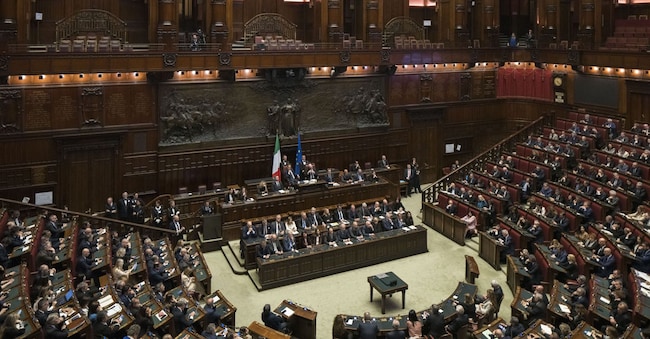
In the Chamber of Deputies, there is more than a little concern amongst the majority over the secret ballot, given the precedent set in July, when – in the secrecy of the ballot box – mavericks from the centre-right and the League had scuppered the system of fixed-list candidates, which was subsequently reintroduced in the Senate. But the electoral reform drawn up by the centre-right – and opposed by the entire broad coalition, whether you call it ‘Stabilicum’ or ‘Melonellum’ – is arriving in the Chamber of Deputies under heavy security. Indeed, under very heavy security.
The protection of the vote of confidence and the threat of an early general election
The government has already called a vote of confidence on the two articles of the bill, and Prime Minister Giorgia Meloni has made it clear: if, during the two secret ballots – the first on the preliminary constitutionality rulings and the final one on the text itself – anyone were to try to pull any ‘stunts’, the country would head straight to the polls. And the election would be held under the current voting system, the Rosatellum, which for the centre-right would mean certain defeat or, at best, a draw – and thus a ‘stalemate’: the presence of Roberto Vannacci’s Futuro Nazionale could in fact ‘hand’ even the single-member constituencies considered safe to the now-united opposition, overturning the 2022 result. And, above all, there would be another election before first-term MPs become eligible for a pension (the deadline is between late March and early April 2027).
Meloni is banking everything on tactical voting: the aim is to stem Vannacci’s rise and exceed 42 per cent
Full steam ahead, then, with the ‘tactical voting’ strategy to try to stem the rise of Roberto Vannacci’s party (‘if you vote for him, the left will win’) in the hope of exceeding the 42 per cent threshold that triggers the majority bonus. This bonus – at the behest of the Lega, which hopes in this way to compensate for the loss of single-member constituencies in the North under the Rosatellum – is allocated not as a percentage but via fixed coalition lists of 70 deputies and 35 senators, up to a ceiling of 220 deputies and 113 senators (between 55 and 57 per cent of the seats). But for Meloni, this is a gamble that is far from won. Because the truth is that the reform was conceived before the Vannacci phenomenon took off, with his ‘Futuro Nazionale’ party reaching over 8 per cent in the polls, mainly at the expense of the League. As a result, the centre-right is currently below the critical threshold. The latest Ipsos poll by Nando Pagnoncelli speaks for itself: Vannacci’s party stands at 8.8 per cent nationally, the Lega has fallen below 5 per cent (4.7 per cent) and, as a result, the centre-right without Vannacci stands at 39.4 per cent.
The broad coalition takes the lead, but an arithmetic sum is not the same as a political one
But even the leaders of the broad coalition – polling at 44.5 per cent according to Pagnoncelli – cannot rest easy: the combined support for the PD, M5S, AVS and Italia Viva is merely an arithmetic total, not a political one. It is reasonable to imagine that, come the time of the vote, a section of M5S voters would not vote for a coalition led by Schlein, opting instead to abstain or cast a protest vote; conversely, a section of PD voters would shift towards the centre-left under Calenda if Conte were to win the primaries. This creates the paradox of a law that the majority chose to call the ‘Stabilicum’ in the name of a certain outcome – and thus of governability – but which could instead lead to a ‘political quagmire’ if both blocs were to remain below 42 per cent. But Meloni is placing great faith in tactical voting, in her ability to communicate effectively during the election campaign and, above all, in her opponents’ divisions: in short, with the ‘Stabilicum’ she can play a game that, under the ‘Rosatellum’, would be lost from the outset.
By naming her candidate for Prime Minister, Meloni forces Schlein and Conte into a primary battle
The most significant change, after the majority bonus, is – not surprisingly – the introduction of the requirement to name the candidate for Prime Minister at the time of submitting the party symbols and manifesto, failing which the lists will be deemed inadmissible. This provision was strongly championed by Meloni to introduce a sort of ‘mini-prime ministerial system’ after the ‘mother of all reforms’ – the Casellati Bill on the direct election of the Prime Minister – was shelved following the ‘No’ victory in the confirmatory referendum on the justice reforms. The requirement to name the coalition leader already existed in the old ‘Porcellum’ law under which elections were held in 2006, in 2008 and in 2013, but there is no doubt that this time it is causing turmoil within the broad coalition and forcing the leaders of the PD and M5S, Elly Schlein and Giuseppe Conte, into potentially divisive and riven primaries for the premiership. Which is precisely Meloni’s objective.


