
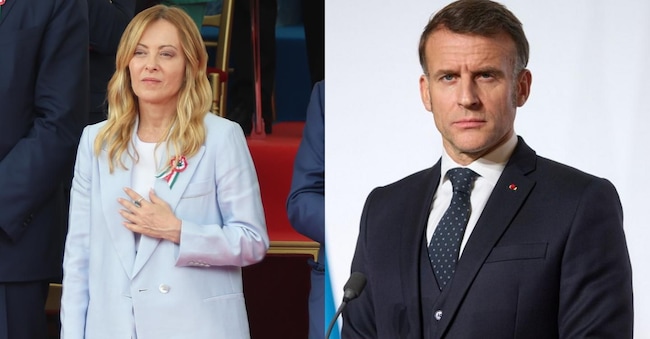
Meloni and Macron: their first bilateral meeting will take place in Antibes – signs of a thaw between the two sides
Following the G7 summit in Evian and the European Council, and ahead of the NATO summit in Ankara, the Italian Prime Minister and the French President are set to meet. From Ukraine to defence, all issues are on the table. Only on Lebanon is there complete agreement

Key points
- From defence to energy: testing the alliance
- The crux of the international dossiers: full agreement only on Lebanon
One thaw leads to another. Or at least that is the hope. On the eve of the G7 summit, which opens on Monday in Evian, the Élysée Palace today confirmed the date of the ‘first Italy-France bilateral summit’: postponed several times in recent months, and certainly not helped by the wall that has frequently risen between Giorgia Meloni and Emmanuel Macron, it will finally take place in Antibes on the French Riviera on 25 June.
Four years of friction and truces
This is certainly not the first meeting between the Prime Minister and the French President: shortly after the Meloni government took office, the two leaders met informally at a hotel in central Rome; then, in June 2025, Macron was received at Palazzo Chigi. In the meantime, there has been no shortage of ‘incidents’ and mutual accusations: on rights, on the management of immigration, on abortion (never mentioned in the Italian G7 declaration of 2024). But it was Macron’s hyper-activism on Ukraine and the frequent exclusion of Italy from various initiatives – most recently, the E3 format of France, Germany and Britain, which attempted in vain to open a window in negotiations with Moscow – that caused the greatest rift. A ‘great chill’ certainly fuelled in part by the role Meloni had sought to carve out for herself in Europe, now significantly scaled back: that of a bridge-builder with Donald Trump.
From defence to energy: testing the alliance
Now Meloni and Macron will attempt to put their differences behind them and turn the page, accompanied by their respective ministerial delegations. The Treaty of the Quirinale, signed by Mario Draghi in 2021 after a long gestation period, formalises the strengthened relationship between the two countries. And ‘the relationship has always remained very solid’, Italian government sources insist. On the agenda on the French Riviera, which will also host a Franco-Italian economic forum in Le Cannet, are the strategic sectors on which to strengthen the partnership (defence, space, energy and infrastructure) and there is – to quote the Élysée Palace statement – an exchange of ‘views on key European and international issues’.
The sticking point over international issues: full agreement only on Lebanon
It is precisely these international crises that present the most intractable challenges. At present, full agreement exists only on Lebanon, where Italia and France intend to advocate for an international mission to succeed UNIFIL, the Italian-led UN mission due to expire at the end of the year. Here, there is complete harmony: the government wishes to play an active role ‘shared with the French’.
The longest distances to Kyiv
Where Macron and Meloni are furthest apart is, once again, Kyiv. The French president supports Friedrich Merz’s German proposal for a fast-track EU accession process for Ukraine; the Italian Prime Minister continues to reject the idea of fast-track procedures that would bypass the processes already underway for the Western Balkans, primarily Montenegro and Albania. Macron does not rule out the idea of sending troops to the front once the ceasefire has been signed; Meloni has made it clear on several occasions that she will not even send mine clearance teams to the field. And that she will only participate in the mission to Hormuz promised by the Volenterosi once the conflict has effectively ended, with two minesweepers – which have already docked in Djibouti – and only after Parliament has given the go-ahead.


