
Meloni defends cohesion and agricultural policy funds
The Prime Minister brings together the 17 ‘Friends of Cohesion’ and defends funding for agriculture. The situation in Libya prompts caution regarding the new loan to Ukraine. The Ukrainian government: we do not intend to escalate the conflict
from our correspondent Manuela Perrone
 Aggiungi Il Sole 24 Ore
ai preferiti su Google
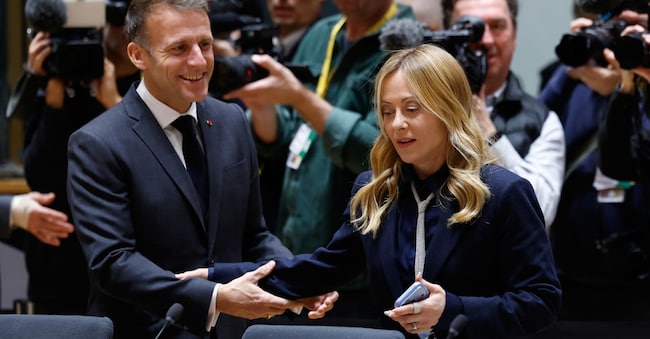
Brussels – It is a summit characterised by ‘light-years’ of distance, tactical manoeuvring and warnings: this applies both to the Union’s future budget and to the new 45-billion loan to Ukraine. Giorgia Meloni arrives at the extraordinary European Council meeting in Brussels with an air of pessimism: ‘We are not prepared to sign off on a budget under which we would have to give more to receive less. We are light years away from a solution.’
The Prime Minister, alongside Romanian President Nicușor Dan, is leading the anti-austerity front gathered within the ‘Friends of Cohesion’, the informal group of 17 countries that meets in the morning before proceedings begin. With regard to the heated debate on the new Multiannual Financial Framework for 2028–2034, their demands can be summarised in two ‘no’s’: to the ‘gradual reduction in resources in the next budget’ and to the erosion of funding allocated to the Common Agricultural Policy and Cohesion Policy, which are deemed ‘essential for the Union’s growth, competitiveness and economic and social convergence’. ‘They cannot be sacrificed to fund new priorities,’ says Meloni.
This stance contrasts with that of German Chancellor Friedrich Merz, a champion of Nordic austerity, who still considers the budget of 1,582 billion (10 per cent less than the Commission’s proposal) in the new ‘negobox’ prepared by the President of the European Council, António Costa, to be too high. But Meloni knows that harping on about the CAP, with farmers once again marching in Brussels, does not leave Germany indifferent: the emphasis on the importance of food sovereignty, in a Europe exposed to growing threats, resonates more strongly than the defence of cohesion, which has suffered too many setbacks.
This is why the Prime Minister is focusing her argument on the Common Agricultural Policy. She will do so again on Monday at the bilateral meeting with Merz in Rome, and she is also doing so during the consultations with Costa’s groups, which are continuing until this evening: Italia first meets with the ‘Friends of Cohesion’ – from Bulgaria to Spain, via the Baltic states – and then with the major players: Germany, France, the Netherlands, Poland and, once again, Spain. Due to the inflexibility of the Germans and the Dutch, the second round is the most complicated, but also the one with the greatest potential for progress, thanks to French support, with a view to moving beyond the phase of confrontation and smoothing out the rough edges of the negotiations. As for the hope of reaching an agreement at the December European Council – as Macron, in particular, would like to see in order to wrap things up before the spring presidential elections – Meloni is playing it safe: “Only if the terms are decent and fully in line with national interests.” The Prime Minister is in no such hurry: she is waiting to see whether a right-wing wind will truly blow across Europe, starting with Spain. And she hopes that, following her endorsement of the Spaniard Pablo Hernández de Cos at the helm of the ECB, the EU will unite in support of Maurizio Martina at the FAO.
Complicating matters is the Ukraine issue, which Merz has linked to the budget negotiations. Just four days after the proposal for a new 45-billion loan for 2027, Kyiv launched an attack on the two Russian ships in Libya. Meloni confirmed the irritation that had immediately been leaked by the government via the Foreign Minister, Antonio Tajani. “I believe that the war must not and cannot spread to the Mediterranean,” the Prime Minister stated emphatically from Brussels. “We must be very clear on this with our Ukrainian friends and also with our partners.” Palazzo Chigi denies any contact between the Prime Minister and the Ukrainian President following the ‘Volenterosi’ meeting in Berlin, but the message has been delivered loud and clear to Volodymyr Zelensky. Later that evening, the Ukrainian Foreign Minister reported that he had contacted his Libyan counterpart to clarify: “We have no intention whatsoever of extending the war to Libya or any other country.”


