Europe

Meloni: at the EU Council to seek solutions on energy, Ukraine and immigration

The Prime Minister’s address to the Senate: the priorities are to protect businesses and citizens from rising energy costs, to support Ukraine and to tackle illegal immigration

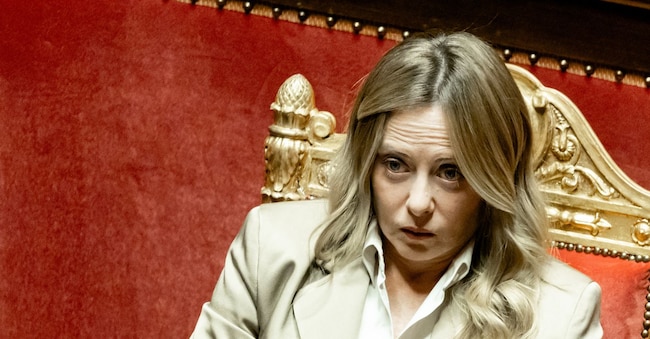
Il Presidente Giorgia Meloni in occasione delle comunicazioni del Presidente del Consiglio in vista della riunione del Consiglio europeo del 15 e 16 ottobre. Senato  Roma, Mercoledì 14 Ottobre 2026 (Foto Mauro Scrobogna / LaPresse)

PM Giorgia Meloni on the occasion of the statements by the President of the Council of Ministers ahead of the European Council meeting of 15 and 16 October. Senate, Rome, Wednesday, 14 October 2026.(Photo by Mauro Scrobogna / LaPresse) LAPRESSE

6' min read

Translated by AI
Versione italiana

6' min read

Translated by AI
Versione italiana

Solutions to tackle rising energy costs, staunch defence of Ukraine (because ‘it is tantamount to defending our own freedom’), negotiations on the new EU budget, a more gradual approach to Next Generation EU reimbursements, and a firm ‘no’ to illegal immigration that leads to legalised status.

Prime Minister Giorgia Meloni outlined a wide-ranging plan this morning in the Senate ahead of the European Council meeting on 15 and 16 October.

Loading...

‘President Trump’s risky decision on diesel’

The starting point can only be the current situation, with rising energy prices putting Italian businesses and households under strain. A key point in the Prime Minister’s speech came when she described the diesel agreement announced by US President Trump with Putin’s Russia to cap diesel prices as a ‘very risky move’ ‘We all understand, and agree,’ explained the Prime Minister, ‘with the need to keep energy prices in check, as they are a burden on households and businesses, including in Italia. But we must be aware that the surge in fuel prices is primarily due to the war in Iran, not the conflict in Ukraine. Therefore, the outcome of this decision is uncertain, whilst the risks are clear’. Such a decision would amount to ‘a legitimisation of Moscow’, she continued, ‘whilst its bombs continue to fall on Ukrainian cities, providing new revenue to fund the war, and an implicit weakening of the leverage provided by sanctions: these are factors we cannot ignore, and which contradict what Western states, including the United States, have done so far to push Putin to the negotiating table’.

Energy: Europe must avoid imposing further burdens on businesses and citizens

On the issue of high energy prices, according to the Prime Minister, Europe must first and foremost focus on what lies within its own power, starting with avoiding the imposition of new obligations and taxes – such as the ETS – on businesses and households already struggling with high energy costs. ‘Alongside the international response,’ he explained, ‘we also need the courage to look at what we can do here in Europe. Starting with the most obvious thing: ensuring that rules devised in a context completely different from the one we are currently experiencing do not end up exacerbating the effects of the crises we are facing today. Because our businesses are now facing increasingly aggressive global competition, and every additional cost that Europe imposes on itself is an advantage it hands to its competitors. And the time we have to correct our course is not infinite. This is what Italia has focused its efforts on.”

Scope for manoeuvre under the safeguard clause

In the meantime, however, some progress has been made, such as the new room for manoeuvre authorised by Brussels under the safeguard clause. “Security and energy are two sides of the same coin,” added Meloni. “Without security, energy costs more. And without energy, there might be nothing left to defend. That is why we requested – and secured – that the national safeguard clause could be used not only for defence spending, but also for the measures needed to tackle the energy crisis. The result is that, out of the maximum margin of 1.5 per cent of GDP provided for by the clause, Italia has decided to use 1.2 per cent, divided equally: 0.6 per cent for measures to tackle high energy prices – around 14 billion euros for vulnerable households and energy-intensive businesses – and a further 0.6 per cent for defence and security. In other words, given the circumstances, we have chosen not to use the entire margin set aside for defence.”

‘It is misleading to claim that these are resources taken away from healthcare and education’

On the subject of the safeguard clause, the Prime Minister also emphasised that ‘the opposition’s claim that defence spending takes resources away from healthcare and education is untrue. It is false. Those resources are earmarked and cannot be diverted to other areas of expenditure’.

Negotiations on the next European budget

A key item on the agenda of the EU Council meeting on the 15th and 16th will also be the discussion on the next EU financial framework, regarding which the Council President has argued that ‘the starting point should not be how large the budget should be, but what Europe considers essential in the coming years. First we define the objectives, then we find a way to fund them. Not the other way round. That said, we have a number of reservations regarding the new own resources proposed by the Commission, but we are prepared to work on the basis of a clear principle: to ease the burden on national budgets as much as possible, without imposing new taxes on European citizens and businesses. We believe that we can and must also consider a more gradual repayment of the debt incurred for Next Generation EU, so that these repayments do not constrain other European policies precisely in the years when we need to invest the most.”

‘In Europe, government decisions cannot be overruled by the bureaucracy’

Still on the subject of the relationship between Member States and the European Union, another important point in the Prime Minister’s speech to the Senate concerned ‘Government decisions, which are not drafts that the bureaucracy can amend at will,’ she explained. ‘This trend whereby Heads of State and Government make decisions that are then systematically undermined by bureaucratic rules is unacceptable and must be rectified.’

Support for Ukraine: the only path to peace

A key part of the speech was then devoted to Ukraine and Italia’s firm support for Ukraine’s defence against Russian attacks. ‘Let’s make one thing clear,’ Meloni emphasised, ‘nobody wants war and we all want peace. The difference lies in how we think peace can be achieved. We are convinced that support for Ukraine is not an alternative to peace but is what makes peace possible. If Ukraine were to stop defending itself, we would not have peace; instead, we would be discussing Russia’s occupation of a European nation and a return to Soviet imperialism. Defending Ukraine is the only way to bring Putin to the negotiating table.”

Combating illegal immigration

Finally, a substantial section of Prime Minister Meloni’s address to the Senate was devoted to the issue of immigration. ‘If the message gets across that irregular entry can subsequently lead to legal residence,’ explained the Prime Minister, ‘there is a risk of encouraging further departures, bolstering the traffickers’ business model and undermining some of the efforts we are making to reduce irregular arrivals. And we cannot allow that to happen.’ In this regard, “Ceuta,” she continued, “has also taught us that a border crisis does not always arise on its own. And those who use desperate people as a means of exerting pressure on our borders are not merely forcing their way across a border. They are attacking Europe. And Europe must equip itself with the tools to respond.”

Loading...

“For years in Europe,” continued the Prime Minister, “a deportation order has very often remained nothing more than a piece of paper. Today we have more effective tools, thanks in part to the new European rules, and the results are clear: this year, repatriations have reached their highest level ever recorded for the same period, and they continue to rise. I would like to thank Minister Piantedosi and all those who work every day to achieve this result. The message must be clear: anyone who enters Italia illegally cannot expect to stay here. And then there is the work being done along the entire route. Thanks to our collaboration with the International Organisation for Migration and with Algeria, Libya and Tunisia, over the last two years some 65,000 migrants have voluntarily returned to their countries of origin, even before attempting to cross the Mediterranean. That is 65,000 people who have not entrusted their lives to people smugglers.”

The Ceuta crisis and the suspension of the Schengen Agreement

The Prime Minister’s speech also touched upon Italia’s suspension of the Schengen Agreement and the situation regarding Spain in the wake of the Ceuta crisis.

“It is difficult to argue,” concluded Meloni, “that Italia does not have the right to use a measure that has been used against it dozens of times. I would remind my colleagues that Italia has the same obligations as the other Member States, but it also has the same rights. We do not accept that defending borders is a right for others but a fault when it comes to Italia. The Schengen Code expressly provides for the possibility of temporarily reintroducing internal border controls for reasons of public order or security’, and that Member States have ‘from 2006 to the present day, Member States have resorted to this measure almost 500 times, and in over 30 cases the controls directly concerned Italia. France, for example, has maintained border controls with us for over ten years’.

Copyright reserved ©
Loading...

Brand connect

Loading...

Newsletter

Notizie e approfondimenti sugli avvenimenti politici, economici e finanziari.

Iscriviti