
Meloni: “I will not sign a decree to give one billion euros to magistrates at this time; my priority is the most vulnerable groups”
Magistrates are classified as ‘staff employed under public law’, and their salaries are reviewed every three years in line with the average pay rises received in the meantime by those public-sector employees covered by collective agreements, that is to say, the vast majority of civil servants

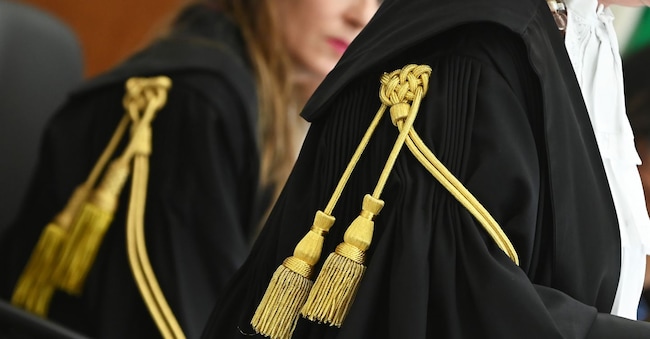
“If the Council of State deems it appropriate, let it appoint the commissioner. Everyone will bear their own responsibilities. But in all conscience, I cannot put my signature to a Prime Ministerial Decree under which I would have to allocate nearly one billion euros to pay rises for magistrates. That is ten times as much as what I am seeking just to tackle the issue of road haulage and prevent the delivery of goods from coming to a standstill across Italia.” These were the words of Prime Minister Giorgia Meloni, speaking to Adnkronos over the telephone.
“After that,” the Prime Minister continued, “if the representative organisations wish to work together to find a solution, I am, as always, ready to listen to them, not least because I am convinced that the vast majority of magistrates understand the situation and the priorities at this time”.
Government seeks funds to tackle the economic crisis
Giorgia Meloni has just returned from a lengthy European Council meeting in Brussels, which was largely devoted to high fuel prices and inflation, which are putting a strain on households and businesses. It is said that, at the moment, she is constantly attending meetings and summits in an effort to secure the resources needed to support those hardest hit by the global economic crisis: the road haulage sector, farmers, fishermen and households. According to estimates, the road haulage sector alone needs at least 100 million. The government is seeking these funds item by item, because every euro counts. And at precisely the same time, as reported by *Il Sole 24 Ore*, the Prime Minister is expected to sign the Prime Ministerial Decree (Dpcm) to comply with the court rulings establishing a new method for calculating adjustments to magistrates’ salaries and ordering the Government to pay arrears as well: in practical terms, this is estimated at up to around 100,000 euros, including arrears, for each magistrate, plus an increase of around 20,000 euros a year for subsequent years.
But how did we end up with this astronomical figure? Unlike for other groups, pay rises for magistrates are not decided through collective bargaining. Every three years, they are adjusted by law, using the pay rises for other civil servants as a benchmark. The Government calculates the figure based on ISTAT parameters and sets it by decree. Using the method employed to date by previous governments, according to figures published in the last few hours, the increases were 4.85 per cent for 2018–2020 and 6.69 per cent for 2021–2023. However, the National Magistrates’ Association and other magistrates’ associations lodged an appeal, arguing that the calculation system needed to be reviewed, and the magistrates of the Regional Administrative Court (TAR) and the Council of State ruled in their favour.
New calculation method and doubling of pay rises
So now, under the new method, the increases rise to 6.22 per cent and 12.32 per cent – almost double for the last three-year period. The cost of this recalculation to the Italian State would be 979 million euros. In short, one billion euros. The Government, through the State Legal Service, lodged an appeal. However, the Regional Administrative Court and the Council of State ruled against the Government and in favour of the appellants. “The actual amounts are far lower than those reported in the newspapers,” the ANM explained in recent days. “Moreover, these are salary components due by law, which the administration has failed to pay for years,” the ANM added. “Their total is the direct consequence of the accumulated delays in payment.” Now, if the Prime Minister does not sign the decree, the Council of State is set to appoint an ad acta commissioner. “I do not wish to stir up controversy,” said Meloni, “but in all conscience, I do not feel able to put my signature to this measure.”

