
Meloni presses Europe and proposes 'common yard for radical reform of bureaucracy in Italia'
The Prime Minister chooses the confindustrial audience to thunder against the slowness of EU decisions and the ties to competitiveness. Ets 'paradoxical system'
Key points
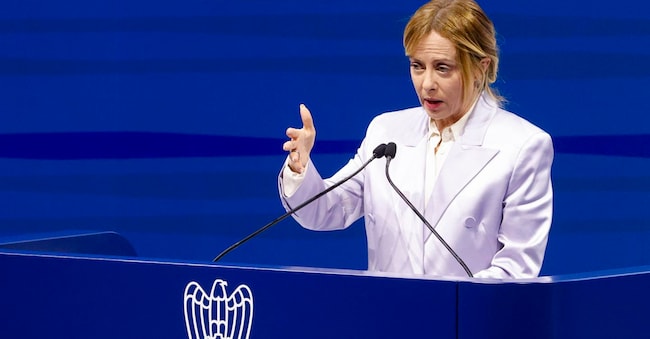
"Thank you for your work: if Italia is recognised as the home of the beautiful, the good and the well-made, it is thanks to you". Giorgia Meloni speaks at the annual assembly of Confindustria in the aftermath of the "revenge" at the administrative elections, the post-referendum breath of fresh air that the government and majority did not expect. To the industrialists led by Emanuele Orsini - who stresses, applauded, how "collectively we have not done enough" for growth and recommends activating "five levers" with courage, starting with energy and Ets suspension, to support the Italian production system - the premier delivers a clear proposal: "Let us open a common yard for a radical reform of bureaucracy in Italia".
Commitment without fans is possible
Meloni, who was taking notes in her notebook, did not miss Orsini's longest-applauded passage: 'Italian citizens understand difficult decisions when they are made with clarity and shared responsibility. What they do not understand and do not deserve is to see every necessary decision turned into an electoral battlefield'. The debate - agrees the President of the Council - often ends up in 'supporters', 'yet in recent years we have shown that another path is possible: the method we have adopted represents a small, great revolution. Even when you start from different positions you can discover yourself as a team if you share the same goal'. And 'trust, courage and responsibility', the values recalled by Orsini, have also inspired the government's efforts.
The challenges of polycrisis
Without renouncing special thanks to the President of the Republic, Sergio Mattarella, 'because his presence reminds the entire nation how important the role of industry is on the historical, identity, economic and also reputational front', Meloni emphasised how instability and uncertainty are becoming the rule in the age of polycrisis and end up laying bare the fragilities of the global order.
Europe 'do less and do it better'
In this context, according to Meloni, 'the idea of a Europe that thought it could limit its role to that of a trading platform by leaving control over the hubs of value chains to others appeared short-sighted. We discovered how suicidal it was to let our fate depend on the choices of others'. Hence the pleas: 'We ask Europe to do less and better. We demand the application of the principle of subsidiarity. We demand sensible priorities and speed of decisions. We need a change of pace on competitiveness: simplification and bureaucratisation must be our mantra'.
Energy measures
But the lunge against the European Union leaves the field to a concrete proposal: the opening of a common yard for a 'radical reform of bureaucracy in Italia'. The premier stretches out her hands on the inclusion of the cloud among subsidised investments and then moves on to the hot topic of energy. She vindicates the measures already launched by the government, the bill decree, the commitment to make Italia a 'European energy hub', the mechanism that introduces the decoupling of electricity and gas prices. He reiterated that the proxy law for the resumption of nuclear power would be approved by the summer.


