
Meloni in Berlin, support for Ukraine is 'multidimensional' in draft resolution
No reference to weapons or military aid in the text that the majority will present to the House on Wednesday. Implicit reference to Russian frozen assets: 'solid legal and financial bases' required
Key points
It is a test of balancing between the different souls of the centre-right the draft resolution that will be presented Wednesday in the Chamber of Deputies, on the occasion of Giorgia Meloni's communications on the eve of the European Council of 18-19 December. The document, forwarded by the government to the majority group leaders on Monday 15 December as the premier was preparing to leave for the Summit of the Willing in Berlin, carefully avoids the words 'weapons' and 'military'. For Ukraine, the support pledged in the introduction is "multidimensional".
Monday evening summit
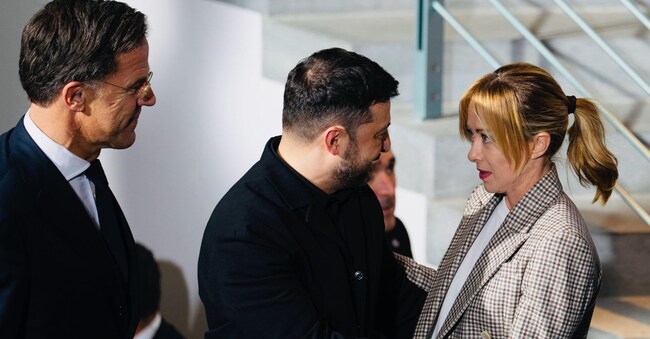
The Prime Minister's brief mission to Berlin for the summit on Ukraine lasted just over five hours. The Prime Minister left for Rome at the end of the summit, which took place in the evening in the offices of the German Federal Chancellery. Meloni saw European leaders, Ukrainian President Volodymyr Zelensky, US representatives and EU and NATO leaders, starting with Ursula von der Leyen and Mark Rutte, to discuss the peace process for Kiev. Since last Sunday, the PM's diplomatic advisor, Fabrizio Saggio, has taken part in preparatory meetings in Berlin at the NSA level that have included both coordination between European states and a meeting with the Ukrainian negotiating team and the American negotiators Witkoff and Kushner. The objective, as filtered by Palazzo Chigi, was 'to confirm the cohesion between Europeans, Ukrainians and Americans in order to consolidate the negotiation process initiated with American mediation'.
The message to European partners: work with the US
Weighing heavily the "no" of Matteo Salvini's League are both the Arms decree with only the dry and automatic extension of military aid to Kiev in 2026 and the EU's use of frozen Russian assets to finance support for Ukraine. This is why the resolution sounds like a brake pulled on all points. But also as a renewal of the message to Europe to support every effort for a ceasefire, "continuing to work with the United States and keeping the European front cohesive so that a just and lasting peace based on international law and the United Nations Charter is achieved", and to "ensure that this path includes solid security guarantees for Ukraine, with the participation of both sides of the Atlantic".
Russian assets, need 'solid legal and financial foundations'
The frozen assets are never named. However, the government's position as recorded in the draft resolution reiterates all the reservations always expressed by Rome, ever since the informal European Council in Copenhagen. The resolution commits the Executive - we read - to "continue to act against the Russian Federation by resorting to all the instruments of diplomacy, including sanctions, without disregarding coordination with the other G7 member states" and on condition that "solid legal and financial bases" are ensured. Our country fears more than others the impact on the path of fiscal consolidation. For this reason, 'Italy, which with considerable effort has earned the prospect of an exit from the excessive deficit procedure, will pay particular attention to the issue of the current and future impact on public finance balances'.
EU Enlargement "on an equal footing between candidates"
Even on Ukraine's entry into the EU, which Putin's Russia dislikes, Italy is very cautious. Enlargement must be pursued "downstream of a gradual process based on merit and on the implementation of functional reforms to ensure the proper financing of the Union, to be carried out on an equal footing among the candidates". No sprint, in short: Kiev must not be given preferential lanes with respect to, for example, the Western Balkans.


