
Meloni has dinner with Trump and Erdogan; the issue of expenses is on the agenda
The tycoon: I like the Italian Prime Minister, but she hasn’t helped us. She: ‘Cordial relations’

Key points
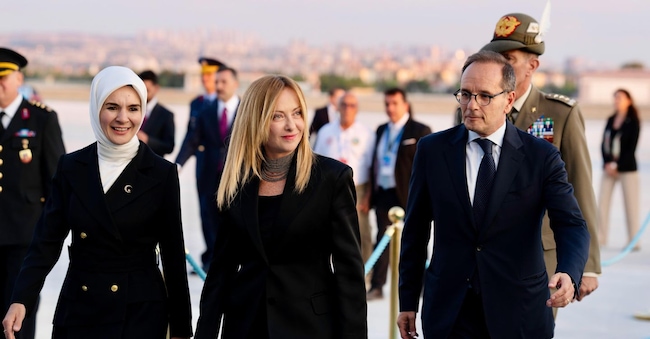
“Cordial relations.” This was how Giorgia Meloni, returning to her hotel in Ankara after the dinner for the heads of state and government of NATO countries, responded to journalists who asked her about Donald Trump. Wearing a black suit, the Prime Minister arrived late, as the last to do so. She walked through the main entrance a few minutes after the host, Turkish President Recep Tayyip Erdoğan, and the US President had entered the presidential palace in the central district of Beştepe. Meloni sat at the same table as Trump, alongside Erdoğan, the Secretary General of the Alliance, Mark Rutte, the German Chancellor Friedrich Merz and his wife Charlotte, the French President Emmanuel Macron with his wife Brigitte, and the (outgoing) British Prime Minister Keir Starmer. These are the very same leaders of European governments whom the US President claims to be disappointed with. Yet the dinner – featuring traditional Turkish cuisine, from ravioli to baklava – takes place in a cordial atmosphere. And between courses, issues relating to NATO’s military expenditure and commitments are discussed.
Trump: I like Meloni, but she hasn’t helped us
The start had not been encouraging. Trump arrived in Ankara in the afternoon. And, during his bilateral meeting with Erdoğan, he did not hold back on recriminations and barbs directed at allies, even raising the issue of the withdrawal of US troops from Europe and the need to “control” Greenland. And he returned to the subject of the Italian Prime Minister. He did so in a less aggressive tone, following the meme about the need for a “restraining order” for Meloni – who was treated as if she were a stalker to be kept at a distance – and following accusations that she had “begged” him for a photo at the G7 summit in Evian. In fact, he describes her as “a good person” whom “I like”. But the accusation remains the same: “She wasn’t there for us on Iran.”
When asked about his latest post on the Italian Prime Minister, Trump replies that ‘our relationship has become a bit strained; she refused to help us. I didn’t put any pressure on her, but she refused to get involved in the Strait of Hormuz; she refused to get involved with Iran’. According to Trump, it was Meloni who ‘spoilt the relationship’, the ‘special relationship’ of yesteryear. And she has “made a mistake” on Iran. Not least because “the United States has plenty of oil, more than anyone else; we don’t need the Strait of Hormuz. We intervened because we thought it was important. She wasn’t there for us, and I wasn’t happy about that.”
The Tajani–Rubio meeting
Behind Trump’s resentment lies not only the refusal to allow the use of NATO bases – in particular the one at Sigonella – for US strikes against Iran. But also the Italian government’s decision not to participate in PURL (Prioritised Ukraine Requirements List), namely the programme for the purchase of US arms to be sent to Kyiv. The fact is that signals from the US State Department and the Pentagon indicate a willingness to continue cooperating on various issues. It is no coincidence that the Deputy Prime Minister and Foreign Minister Antonio Tajani (who was also in Ankara alongside Defence Minister Guido Crosetto) held a brief meeting in the Turkish capital with US Secretary of State Marco Rubio on the sidelines of the NATO summit, prior to the scheduled dinner for the Alliance’s foreign ministers. This dinner coincides with the tightly secured dinner for heads of state and government hosted by Erdoğan.
The morning summit
This morning, following the welcome ceremony for Erdoğan himself and NATO Secretary-General Mark Rutte – which included an official group photo – the actual proceedings are set to begin. It is hard to say how the meeting will go: what is certain is that the 32-way discussion is scheduled to last from 11.15 am to 2 pm. Not very long, then. After all, the shorter the summit, the lower the risk that something might go wrong with Trump.


